
Cardiovasc Diabetol. 2023;22(1):153.
Characteristics predicting the efficacy of SGLT-2 inhibitors versus GLP-1 receptor agonists on major adverse cardiovascular events in type 2 diabetes mellitus: a meta-analysis study.
제1저자 손민지 · 교신저자 임수
소속 (4)
- Department of Internal Medicine, Seoul National University Bundang Hospital, Seoul National University College of Medicine, 82, Gumi-ro 173 Beon-gil, Bundang-gu, Seongnam, 13620, Republic of Korea.
- Diabetes, Endocrinology and Metabolism Section, Department of Medicine I, St. Josef-Hospital (Ruhr-University Bochum), Gudrunstr. 56, D-44791, Bochum, Germany.
- Diabetes, Endocrinology and Metabolism Section, Department of Medicine I, St. Josef-Hospital (Ruhr-University Bochum), Gudrunstr. 56, D-44791, Bochum, Germany. michael.nauck@rub.de.
- Department of Internal Medicine, Seoul National University Bundang Hospital, Seoul National University College of Medicine, 82, Gumi-ro 173 Beon-gil, Bundang-gu, Seongnam, 13620, Republic of Korea. limsoo@snu.ac.kr.
Abstract
BACKGROUND Recent large clinical trials have demonstrated cardiovascular benefits of similar overall magnitude for sodium-glucose cotransporter-2 inhibitor (SGLT-2i) and glucagon-like peptide-1 receptor agonist (GLP-1RA) therapy in subjects with type 2 diabetes. We sought to identify subgroups based on baseline characteristics with a differential response to either SGLT-2i or GLP-1RA.
METHODS PubMed, Cochrane CENTRAL, and EMBASE were searched from 2008 to 2022 for SGLT-2i or GLP-1RA randomized trials that reported 3-point major adverse cardiovascular events (3P-MACE). Baseline clinical and biochemical characteristics included age, sex, body mass index (BMI), HbA1c, estimated glomerular filtration rate (eGFR), albuminuria, preexisting cardiovascular disease (CVD), and heart failure (HF). Absolute and relative risk reductions (ARR and RRR) regarding incidence rates for 3P-MACE with a 95% confidence interval were calculated. The association of average baseline characteristics in each study with the ARR and RRR for 3P-MACE was investigated by meta-regression analyses (random-effects model, assuming inter-study heterogeneity). Meta-analysis was also conducted to investigate whether the efficacy of SGLT-2i or GLP-1RA on 3P-MACE reduction could differ according to the patient's characteristics (e.g., HbA1c above/below cutoff).
RESULTS After a critical assessment of 1,172 articles, 13 cardiovascular outcome trials with a total of 111,565 participants were selected. In meta-regression analysis, the more patients with reduced eGFR in the studies, the greater ARR by SGLT-2i or GLP-1RA therapy. Similarly, in the meta-analysis, SGLT-2i therapy tended to be more effective in reducing 3P-MACE in people with eGFR < 60 ml/min/1.73 m2 than in those with normal renal function (ARR - 0.90 [-1.44 to - 0.37] vs. - 0.17 [-0.34 to - 0.01] events/100 person-years). Furthermore, people with albuminuria tended to respond better to SGLT-2i therapy than those with normoalbuminuria. However, this was not the case for the GLP-1RA treatment. Other factors including age, sex, BMI, HbA1c, and preexisting CVD or HF did not affect the efficacy of either SGLT-2i or GLP-1RA treatment on the ARR or RRR of 3P-MACE.
CONCLUSIONS Because decreased eGFR [significant] and albuminuria [trend] were found to predict a better efficacy for SGLT-2i in 3P-MACE reduction, this class of drug should be preferred in such patients. However, GLP-1RA may be considered for patients with normal eGFR because it showed better efficacy than SGLT-2i in this subgroup [trend].
© 2023. The Author(s).
Keywords
Diabetes mellitus, type 2Glucagon-like peptide 1 receptor agonistMajor adverse cardiovascular eventsMeta-analysisMeta-regressionSodium–glucose cotransporter-2 inhibitor
Figures
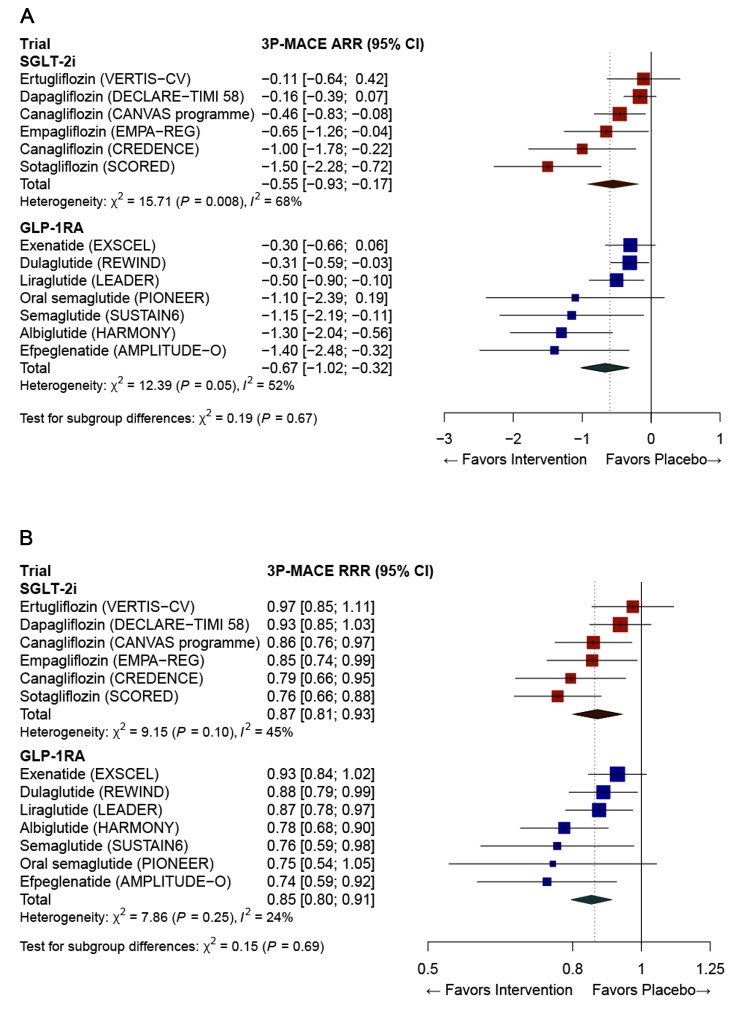
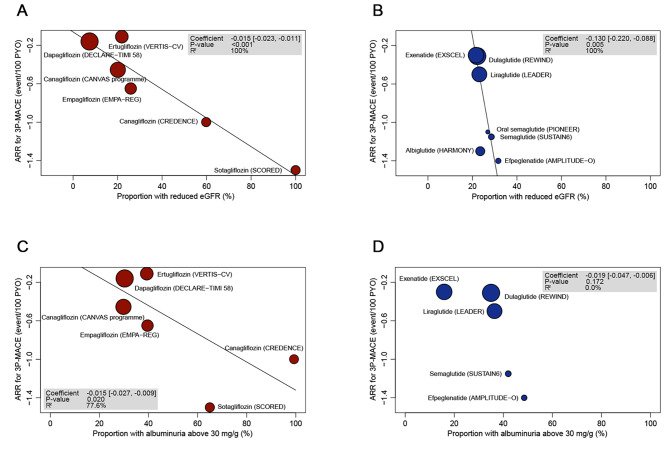
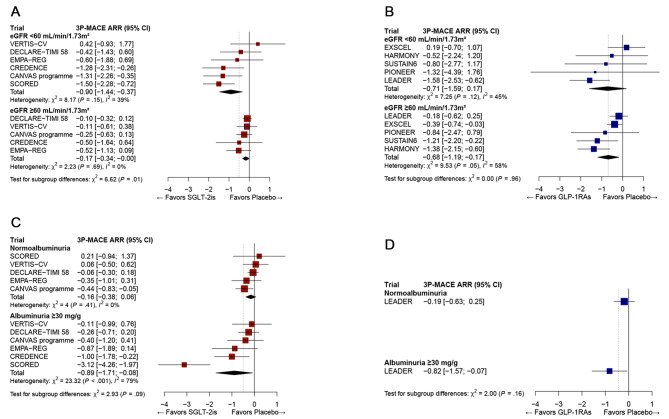
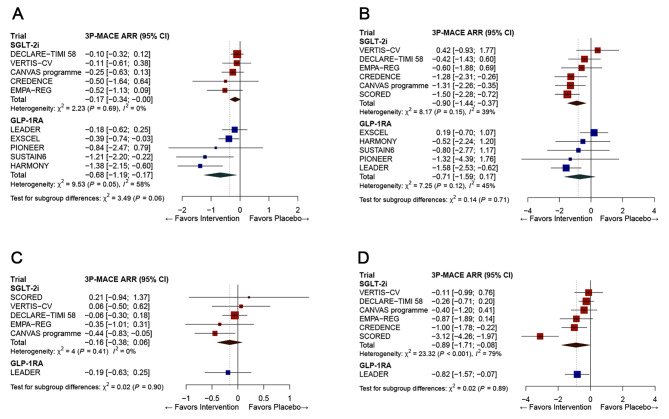
그림 출처: PubMed Central 공개 논문 (PMC10303335)
Conflict of interest statement
M.A.N. has been member on advisory boards or has consulted with Boehringer-Ingelheim, Berlin-Chemie/ Menarini, Eli Lilly & Co., Merck Sharp & Dohme, Novo Nordisk, Shou-Ti/Gasherbrum, Regor Pharmaceuticals, Sun Pharma. He has received grant support from Merck Sharp & Dohme and Novo Nordisk. He has also served on the speakers’ bureau of Berlin-Chemie/ Menarini, Eli Lilly & Co., Medical Learning Institute, Medscape, Merck Sharp & Dohme, Novo Nordisk, Sanofi, and Sun Pharma. S.L. has been a member of advisory boards, or has consulted, for Merck, Sharp & Dohme, and Novo Nordisk. He has received grant support from AstraZeneca, Merck, Sharp & Dohme, and Astellas. He has also served on the speakers’ bureau of AstraZeneca, Boehringer Ingelheim, Eli Lilly & Co., Merck, Sharp & Dohme, and Novo Nordisk.
그 밖의 정보
- 출판 형태
- Meta-Analysis, Journal Article
- 저널
- Cardiovascular diabetology · eISSN 1475-2840
- 전자 출판
- 2023-06-28
- MeSH
- Humans · Albuminuria · Cardiovascular Diseases* / diagnosis / epidemiology / prevention & control · Diabetes Mellitus, Type 2* / diagnosis / drug therapy / epidemiology · Glycated Hemoglobin · Heart Failure* · Sodium-Glucose Transporter 2 Inhibitors* / adverse effects · Glucagon-Like Peptide-1 Receptor Agonists*
- Substances
- Glycated Hemoglobin · Sodium-Glucose Transporter 2 Inhibitors · Glucagon-Like Peptide-1 Receptor Agonists
- 참고문헌
- 37편