
Mol Cancer. 2023;22(1):164.
A circulating cell-free DNA methylation signature for the detection of hepatocellular carcinoma.
제1저자 김시초, 김다원, 조은주 · 교신저자 유수종, 김영준
소속 (12)
- Interdisciplinary Program of Integrated OMICS for Biomedical Science, Yonsei University, Seoul, Republic of Korea.
- R&D center, LepiDyne Inc, Seoul, Republic of Korea.
- Department of Internal Medicine and Liver Research Institute, Seoul National University College of Medicine, Seoul, 03080, Republic of Korea.
- Department of Biochemistry, College of Life Science and Biotechnology, Yonsei University, Seoul, 03722, Republic of Korea.
- Department of Integrative Bioscience & Biotechnology, College of Life Sciences, Sejong University, Seoul, Republic of Korea.
- Department of Surgery, Seoul National University College of Medicine, Seoul, Republic of Korea.
- Department of Internal Medicine, Seoul National University College of Medicine, Seoul Metropolitan Government Boramae Medical Center, Seoul, Republic of Korea.
- Department of Bio-AI convergence, Chungnam National University, Daejeon, Republic of Korea.
- Department of Convergent Bioscience and Informatics, Chungnam National University, Daejeon, Republic of Korea.
- Department of Internal Medicine and Liver Research Institute, Seoul National University College of Medicine, Seoul, 03080, Republic of Korea. ydoctor2@snu.ac.kr.
- Interdisciplinary Program of Integrated OMICS for Biomedical Science, Yonsei University, Seoul, Republic of Korea. yjkim@yonsei.ac.kr.
- Department of Biochemistry, College of Life Science and Biotechnology, Yonsei University, Seoul, 03722, Republic of Korea. yjkim@yonsei.ac.kr.
Abstract
To address the shortcomings of current hepatocellular carcinoma (HCC) surveillance tests, we set out to find HCC-specific methylation markers and develop a highly sensitive polymerase chain reaction (PCR)-based method to detect them in circulating cell-free DNA (cfDNA). The analysis of large methylome data revealed that Ring Finger Protein 135 (RNF135) and Lactate Dehydrogenase B (LDHB) are universally applicable HCC methylation markers with no discernible methylation level detected in any other tissue types. These markers were used to develop Methylation Sensitive High-Resolution Analysis (MS-HRM), and their diagnostic accuracy was tested using cfDNA from healthy, at-risk, and HCC patients. The combined MS-HRM RNF135 and LDHB analysis detected 57% of HCC, outperforming the alpha-fetoprotein (AFP) test's sensitivity of 45% at comparable specificity. Furthermore, when used with the AFP test, the methylation assay can detect 70% of HCC. Our findings suggest that the cfDNA methylation assay could be used for HCC liquid biopsy.
© 2023. BioMed Central Ltd., part of Springer Nature.
Keywords
BiomarkerCancer diagnosisCell-free DNADNA methylation.Hepatocellular carcinomaLiquid biopsyMethylation-sensitive high-resolution melting analysis
Figures
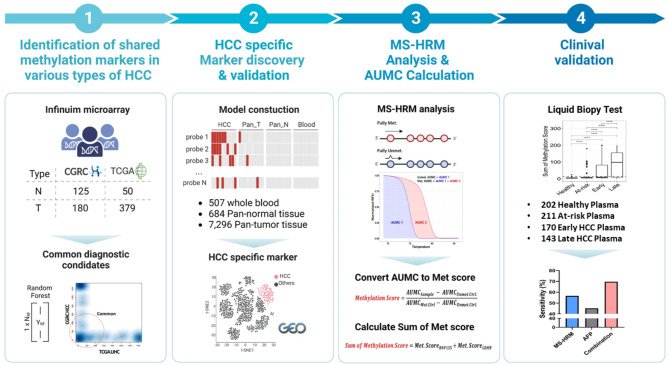
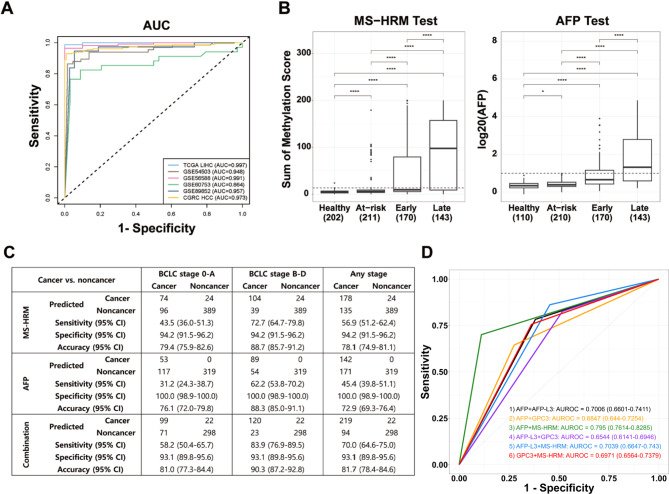
그림 출처: PubMed Central 공개 논문 (PMC10557228)
Conflict of interest statement
The authors declare no conflict of interests.
그 밖의 정보
- 출판 형태
- Letter, Research Support, Non-U.S. Gov't
- 저널
- Molecular cancer · eISSN 1476-4598
- 전자 출판
- 2023-10-06
- MeSH
- Humans · Carcinoma, Hepatocellular* / diagnosis / genetics / pathology · alpha-Fetoproteins / genetics / analysis / metabolism · Liver Neoplasms* / diagnosis / genetics / pathology · DNA Methylation · Biomarkers, Tumor / genetics / metabolism · Cell-Free Nucleic Acids* / genetics · Ubiquitin-Protein Ligases / metabolism
- Substances
- alpha-Fetoproteins · Biomarkers, Tumor · Cell-Free Nucleic Acids · RNF135 protein, human · Ubiquitin-Protein Ligases
- 참고문헌
- 12편