
BMC Med. 2024;22(1):212.
Information technology-supported integrated health service for older adults in long-term care settings.
제1저자 최정연, 김홍수 · 교신저자 김광일
소속 (14)
- Departments of Internal Medicine, Seoul National University Bundang Hospital, Seongnam, Republic of Korea.
- Department of Public Health Sciences, Graduate School of Public Health, Seoul National University, Seoul, Republic of Korea.
- Institute of Health and Environment, Seoul National University, Seoul, Republic of Korea.
- Institute of Aging, Seoul National University, Seoul, Republic of Korea.
- Department of Environmental Health, Korea National Open University, Seoul, Republic of Korea.
- Healthcare ICT Research Center, Seoul National University Bundang Hospital, Seongnam, Republic of Korea.
- Department of Preventive Medicine, Kyung Hee University, Seoul, Republic of Korea.
- Department of Industrial Engineering, Ulsan National Institute of Science and Technology, Ulsan, Republic of Korea.
- Department of Rehabilitation Medicine, Seoul National University Bundang Hospital, Seongnam, Republic of Korea.
- Department of Rehabilitation Medicine, Seoul National University College of Medicine, Seoul, Republic of Korea.
- Healthcare Convergence R&D Center, ezCaretech Co. Ltd, Seoul, Republic of Korea.
- Healthcare Convergence R&D Center, Healthconnect Co. Ltd, Seoul, Republic of Korea.
- Departments of Internal Medicine, Seoul National University Bundang Hospital, Seongnam, Republic of Korea. kikim907@snu.ac.kr.
- Departments of Internal Medicine, Seoul National University College of Medicine, 82 Gumi-ro, 173 Beon-gil, Bundang-gu, Seongnam-si, Kyeongi-do, 13620, Republic of Korea. kikim907@snu.ac.kr.
Abstract
BACKGROUND To examine the effectiveness and safety of a data sharing and comprehensive management platform for institutionalized older patients.
METHODS We applied information technology-supported integrated health service platform to patients who live at long-term care hospitals (LTCHs) and nursing homes (NHs) with cluster randomized controlled study. We enrolled 555 patients aged 65 or older (461 from 7 LTCHs, 94 from 5 NHs). For the intervention group, a tablet-based platform comprising comprehensive geriatric assessment, disease management, potentially inappropriate medication (PIM) management, rehabilitation program, and screening for adverse events and warning alarms were provided for physicians or nurses. The control group was managed with usual care. Co-primary outcomes were (1) control rate of hypertension and diabetes, (2) medication adjustment (PIM prescription rate, proportion of polypharmacy), and (3) combination of potential quality-of-care problems (composite quality indicator) from the interRAI assessment system which assessed after 3-month of intervention.
RESULTS We screened 1119 patients and included 555 patients (control; 289, intervention; 266) for analysis. Patients allocated to the intervention group had better cognitive function and took less medications and PIMs at baseline. The diabetes control rate (OR = 2.61, 95% CI 1.37-4.99, p = 0.0035), discontinuation of PIM (OR = 4.65, 95% CI 2.41-8.97, p < 0.0001), reduction of medication in patients with polypharmacy (OR = 1.98, 95% CI 1.24-3.16, p = 0.0042), and number of PIMs use (ꞵ = - 0.27, p < 0.0001) improved significantly in the intervention group. There was no significant difference in hypertension control rate (OR = 0.54, 95% CI 0.20-1.43, p = 0.2129), proportion of polypharmacy (OR = 1.40, 95% CI 0.75-2.60, p = 0.2863), and improvement of composite quality indicators (ꞵ = 0.03, p = 0.2094). For secondary outcomes, cognitive and motor function, quality of life, and unplanned hospitalization were not different significantly between groups.
CONCLUSIONS The information technology-supported integrated health service effectively reduced PIM use and controlled diabetes among older patients in LTCH or NH without functional decline or increase of healthcare utilization.
TRIAL REGISTRATION Clinical Research Information Service, KCT0004360. Registered on 21 October 2019.
© 2024. The Author(s).
Keywords
Health services for the agedInformation technologyLong-term care
Figures
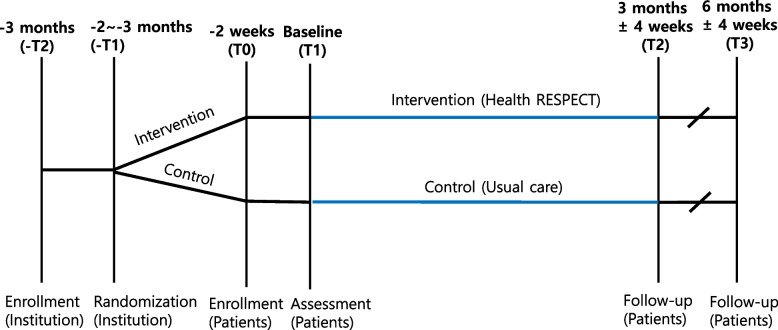
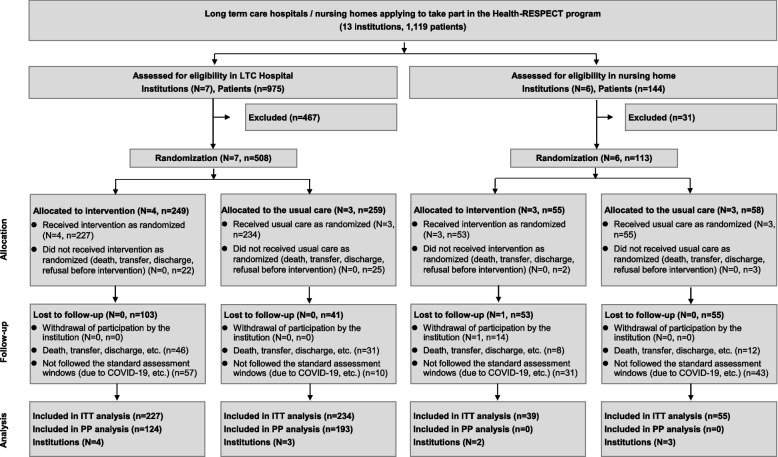
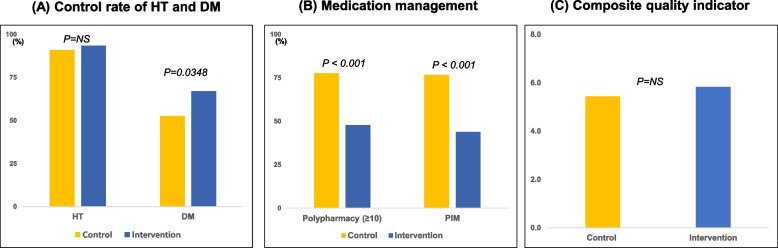
그림 출처: PubMed Central 공개 논문 (PMC11134747)
Conflict of interest statement
The authors declare that they have no competing interests.
그 밖의 정보
- 출판 형태
- Journal Article, Randomized Controlled Trial, Research Support, Non-U.S. Gov't
- 저널
- BMC medicine · eISSN 1741-7015
- 전자 출판
- 2024-05-29
- MeSH
- Humans · Aged · Male · Female · Aged, 80 and over · Long-Term Care* / methods · Delivery of Health Care, Integrated* · Information Technology · Nursing Homes · Polypharmacy
- 참고문헌
- 40편