Department of Internal Medicine, Seoul National University College of Medicine, Seoul, Korea.
Department of Internal Medicine, Seoul National University Bundang Hospital, Seoul National University College of Medicine, Seongnam, Korea.
Abstract
Patients with hyperglycemia are at a high risk of cardio- and cerebrovascular diseases. Diabetes patients also have poor outcomes after cerebrovascular disease development. Several classes of drugs are used for diabetes management in clinical practice. Thiazolidinedione (TZD) was introduced in the late 1990s, and new antidiabetic agents have been introduced since 2000. After issues with rosiglitazone in 2007, the U.S. Food and Drug Administration strongly recommended that trials investigating cardiovascular risk associated with new antidiabetic medications should be conducted before drug approval in the United States, to prove the safety of these new drugs and to determine their superiority to previous medications. Currently, results are available from two studies with TZD focusing on cardiovascular diseases, including stroke, and from 12 cardiovascular outcome trials focusing on major adverse cardiovascular events associated with new antidiabetic agents (four with dipeptidyl peptidase-4 inhibitors, three with sodium-glucose cotransporter-2 inhibitors, and five with glucagon-like peptide-1 analogues). These studies showed different results for primary cardiovascular outcomes and stroke prevention. It is important to determine whether prescription of TZD or new antidiabetic medications compared to conventional treatment, such as sulfonylurea or insulin, is better for stroke management. Furthermore, it is unclear whether drugs in the same class show greater safety and efficacy than other drugs for stroke management.
Keywords
Diabetes mellitusDipeptidyl-peptidase IV inhibitorsGlucagon-like peptide 1Sodiumglucose transporter 2StrokeThiazolidinediones
Figures
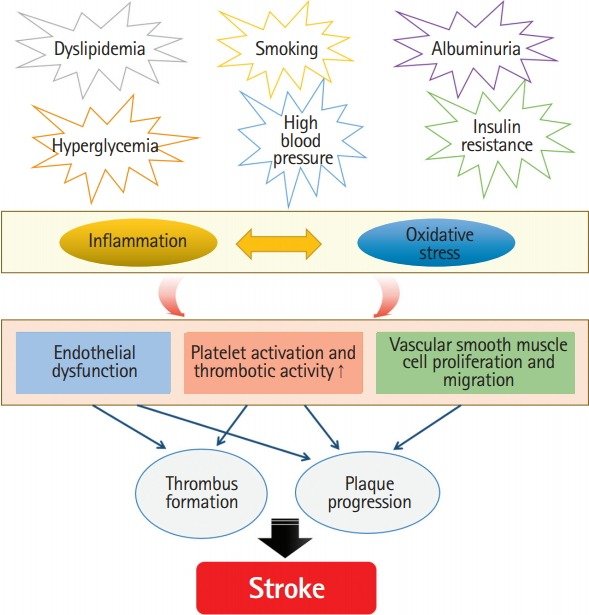
Figure 1.Pathogenic mechanisms for the involvement of hyperglycemia in the development of atherosclerotic cerebrovascular diseases. VSMC, vascular smooth muscle cell; AGE, advanced glycosylation end product; ROS, reactive oxygen species; PKC, protein kinase C; eNOS, endothelial nitric oxide synthase; NO, nitric oxide; TG, triglyceride; HDL, high density lipoprotein; NFκB, nuclear factor κB; MCP-1, monocyte chemoattractant protein-1; PDGF, platelet-derived growth factor; TNF-α, tumor necrosis factor-α; VCAM, vascular cell adhesion molecule.Figure 2.Contributing risk factors and their roles in the development of stroke.Figure 3.Effect of thiazolidinedione and novel antidiabetic agents on primary cardiovascular outcome and stroke. The hazard ratios (HRs) with 95% confidence intervals (CIs) are provided for the active drug compared with the placebo. Primary cardiovascular outcomes are slightly different in each study. The overall effects were calculated using fixed effects models unless there was a significant heterogeneity among trials. Heterogeneity of the clinical trials was assessed using Cochran’s Q test and Higgins and Thompson’s I2 (P<0.05 or I2 >50 were considered as indicative of significant heterogeneity). Analyses were performed using R version 3.5.1 (R Foundation for Statistical Computing). PROactive, PROspective pioglitAzone Clinical Trial In macroVascular Events; IRIS, Insulin Resistance Intervention after Stroke; MI, myocardial infarction; DPP4, dipeptidyl peptidase-4; SAVOR-TIMI, Saxagliptin Assessment of Vascular Outcomes Recorded in Patients with Diabetes Mellitus-Thrombolysis in Myocardial Infarction; MACE, major adverse cardiovascular event; CV, cardiovascular; EXAMINE, Examination of Cardiovascular Outcomes with Alogliptin versus Standard of Care; TECOS, Trial Evaluating Cardiovascular Outcomes with Sitagliptin; CARMELINA, Cardiovascular and Renal Microvascular Outcome Study With Linagliptin in Patients With Type 2 Diabetes Mellitus; SGLT2, sodium-glucose cotransporter-2; EMPA-REG OUTCOME, Empagliflozin, Cardiovascular Outcomes, and Mortality in Type 2 Diabetes; CANVAS, CANagliflozin CardioVascular Assessment Study; DECLARE-TIMI58, Dapagliflozin Effect on CardiovascuLAR Events-Thrombolysis in Myocardial Infarction 58; GLP1, glucagon-like peptide-1; ELIXA, Evaluation of Lixisenatide in Acute Coronary Syndrome; EXSCEL, Exenatide Study of Cardiovascular Event Lowering; LEADER, Liraglutide Effect and Action in Diabetes: Evaluation of Cardiovascular Outcome Results; SUSTAIN-6, Trial to Evaluate Cardiovascular and Other Long-term Outcomes with Semaglutide 6; HARMONY, albiglutide and cardiovascular outcomes in patients with type 2 diabetes and cardiovascular disease. *The parenthetical value is the upper boundary of the one-sided repeated CI, at an a-level of 0.01; † IRIS study recruited participants with insulin resistance, but without type 2 diabetes mellitus.