
Arthritis Res Ther. 2019;21(1):163.
Effects of tapering tumor necrosis factor inhibitor on the achievement of inactive disease in patients with axial spondyloarthritis: a nationwide cohort study.
제1저자 박준원 · 교신저자 이은영
소속 (6)
- Division of Rheumatology, Department of Internal Medicine, Seoul National University College of Medicine, 101 Daehak-ro, Jongno-gu, Seoul, Republic of Korea.
- Department of Rheumatology, Ajou University School of Medicine, Suwon, Republic of Korea.
- Division of Rheumatology, Department of Internal Medicine, SMG-SNU Boramae Medical Center, Seoul, Republic of Korea.
- Division of Rheumatology, Department of Internal Medicine, Yonsei University College of Medicine, Seoul, Republic of Korea.
- Department of Rheumatology, Hanyang University Hospital for Rheumatic Diseases, Seoul, Republic of Korea.
- Division of Rheumatology, Department of Internal Medicine, Seoul National University College of Medicine, 101 Daehak-ro, Jongno-gu, Seoul, Republic of Korea. elee@snu.ac.kr.
Abstract
OBJECTIVES To investigate the association between the extent of tapering tumor necrosis factor inhibitor (TNFi) and the likelihood of achieving inactive disease in patients with axial spondyloarthritis (axSpA) METHODS: We analyzed 1575 1-year follow-up interval data of 776 axSpA patients treated with TNFi for more than 1 year in a nationwide observational cohort. The decision on tapering TNFi was made by patients and their physicians. We quantified TNFi used during interval as a dose quotient (DQ). The intervals were classified into the heavy-tapering (DQ < 50), mild-tapering (DQ 50-99), and control groups (DQ = 100). Outcome variables included achieving Ankylosing Spondylitis Disease Activity Score-inactive disease (ASDAS-ID) and major clinical response of Bath Ankylosing Spondylitis Disease Activity Index (BASDAI50) in the follow-up visit. The effects of TNFi tapering on the outcome were analyzed using the generalized estimating equation.
RESULTS At the baseline visit, 91.1% of the patients showed a high disease activity (ASDAS-CRP ≥ 2.1). DQ of each interval was significantly influenced by the ASDAS-CRP measure in the prior follow-up (P < 0.001). ASDAS-ID was observed in 42.3% of the intervals. A multivariable analysis showed that the likelihood of outcome achievement was comparable between the control and mild-tapering groups, but significantly decreased in the heavy-tapering group (vs. the control group, adjusted OR = 0.28, [95% CI, 0.08-0.94]). In contrast, the likelihood to achieve BASDAI50 response was not different among the groups. In the subgroup of patients who reached ASDAS-ID 1 year after TNFi treatment (n = 327), ASDAS-ID was observed in 66.1% of the subsequent intervals, and only the mild-tapering group showed a likelihood of target maintenance comparable with that of the control group (adjusted OR = 1.25 [0.41-3.80]). This likelihood decreased with an increase in ASDAS-CRP.
CONCLUSION Mild tapering of TNFi has efficacy comparable with that of the standard-dose treatment for ASDAS-ID achievement in patients with axSpA.
Keywords
Dose taperingInactive diseaseSpondyloarthritisTumor necrosis factor
Figures
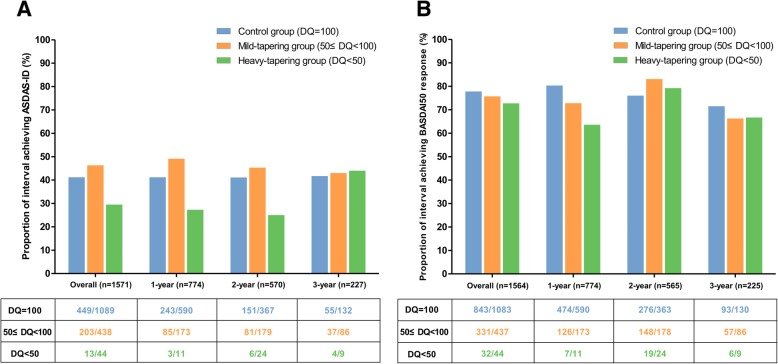
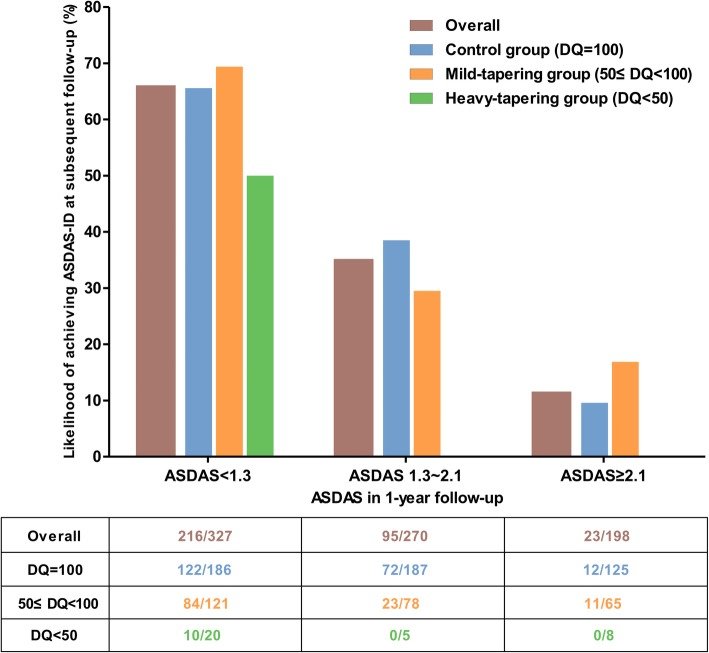
그림 출처: PubMed Central 공개 논문 (PMC6611048)
Conflict of interest statement
The authors declare that they have no competing interests.
그 밖의 정보
- 출판 형태
- Journal Article, Observational Study, Research Support, Non-U.S. Gov't
- 저널
- Arthritis research & therapy · eISSN 1478-6362
- 전자 출판
- 2019-07-04
- MeSH
- Adalimumab / therapeutic use · Adult · Antibodies, Monoclonal / therapeutic use · Antirheumatic Agents / therapeutic use · Cohort Studies · Dose-Response Relationship, Drug · Etanercept / therapeutic use · Female · Humans · Infliximab / therapeutic use · Male · Middle Aged · Republic of Korea · Severity of Illness Index · Spondylitis, Ankylosing / drug therapy / metabolism / parasitology · Treatment Outcome · Tumor Necrosis Factor Inhibitors / therapeutic use · Tumor Necrosis Factor-alpha / antagonists & inhibitors / metabolism
- Substances
- Antibodies, Monoclonal · Antirheumatic Agents · Tumor Necrosis Factor Inhibitors · Tumor Necrosis Factor-alpha · golimumab · Infliximab · Adalimumab · Etanercept
- 연구비
- Korea National Institute of Health HI14C1277
- 참고문헌
- 27편