
BMC Geriatr. 2021;21(1):234.
How does the multidimensional frailty score compare with grip strength for predicting outcomes after hip fracture surgery in older patients? A retrospective cohort study.
제1저자 최정연, 김진각 · 교신저자 김광일
소속 (6)
- Department of Internal Medicine, Seoul National University Bundang Hospital, 82, Gumi-ro 173beon-gil, Bundang-gu, Seongnam-si, Gyeonggi-do, Republic of Korea.
- Department of Orthopedic Surgery, Seoul National University Bundang Hospital, 82, Gumi-ro 173beon-gil, Bundang-gu, Seongnam-si, Gyeonggi-do, Republic of Korea.
- Department of Internal Medicine, Seoul National University Bundang Hospital, 82, Gumi-ro 173beon-gil, Bundang-gu, Seongnam-si, Gyeonggi-do, Republic of Korea. kikim907@snu.ac.kr.
- Department of Internal Medicine, Seoul National University College of Medicine, 103, Daehak-ro, Jongno-gu, Seoul, Republic of Korea. kikim907@snu.ac.kr.
- Department of Orthopedic Surgery, Seoul National University College of Medicine, 103, Daehak-ro, Jongno-gu, Seoul, Republic of Korea.
- Department of Internal Medicine, Seoul National University College of Medicine, 103, Daehak-ro, Jongno-gu, Seoul, Republic of Korea.
Abstract
BACKGROUND Frailty and low handgrip strength (HGS) are associated with adverse outcomes after hip fracture (HF) surgery. We aimed to compare the predictive role of frailty and HGS for adverse outcome in HF patients.
METHODS We included older patients (age ≥ 65 years) who underwent HF surgery to compare the predictive role of HGS and hip-multidimensional frailty score (Hip-MFS) for postoperative complications and mortality. The Hip-MFS was calculated based on comprehensive geriatric assessment (CGA), and HGS was measured with a hand dynamometer. The primary outcome was a composite of postoperative complications (e.g., pneumonia, urinary tract infection, delirium, acute pulmonary thromboembolism, and unplanned intensive care unit admission). The secondary outcomes were 6-month mortality and mortality at the end of follow-up.
RESULTS The median observation time was 620.5 days (interquartile range: 367.0-784.8 days). Among the 242 patients (mean age: 81.5 ± 6.7 years, 73.1% women), 106 (43.8%) experienced postoperative complications. The 6-month mortality and mortality at the end of follow-up were 7.4% (n = 18) and 20.7% (n = 50), respectively. The Hip-MFS (odds ratio [OR], 1.250; 95% confidence interval [CI], 1.092-1.432) and HGS (OR, 1.147; 95% CI, 1.082-1.215) could predict postoperative complications. The Hip-MFS could predict both 6-month mortality (hazard ratio [HR], 1.403; 95% CI, 1.027-1.917) and mortality at the end of follow-up (HR, 1.493; 95% CI, 1.249-1.769) after adjustment, while HGS was only associated with mortality at the end of follow-up (HR, 1.080; 95% CI, 1.024-1.139). For mortality at the end of follow-up, predictive models with the Hip-MFS were superior to those with HGS in the time-dependent receiver-operating curve analysis after adjustment (p = 0.017). Furthermore, the addition of Hip-MFS or HGS to the American Society of Anesthesiologists (ASA) classification improved its prognostic ability.
CONCLUSIONS Both the Hip-MFS and HGS could predict postoperative complications and improve prognostic utility when combined with the ASA classification. The Hip-MFS was a stronger predictor of mortality than HGS after HF surgery. HGS could be a useful pre-screening tool to identify patients at a high risk of postoperative complications and those who may benefit from further CGA.
Keywords
FrailtyGrip strengthHip fractureMultidimensional frailty scorePostoperative complication
Figures
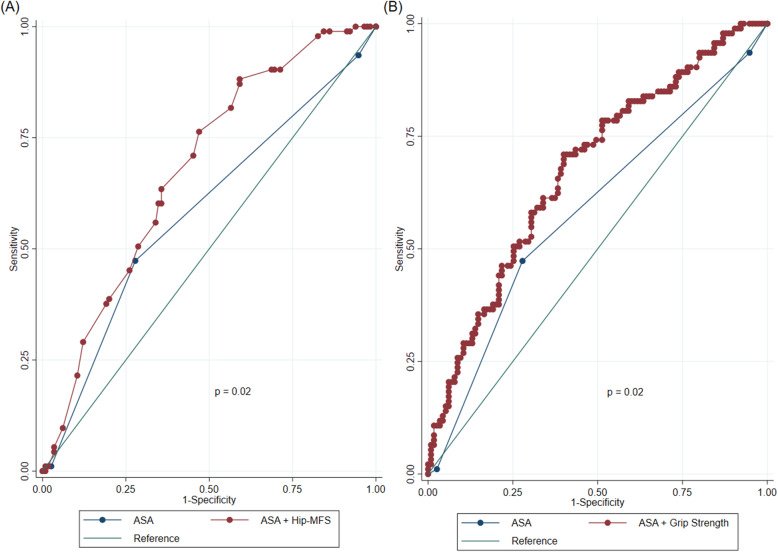
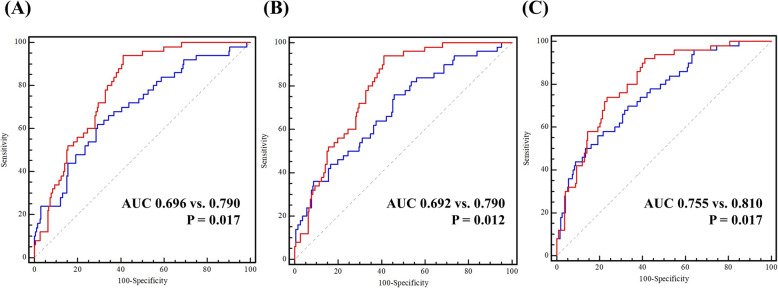
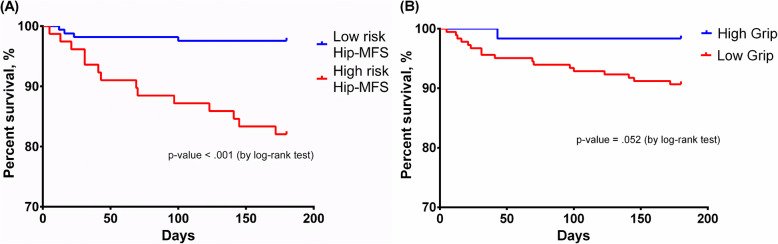
그림 출처: PubMed Central 공개 논문 (PMC8028224)
Conflict of interest statement
All authors state that they have no competing interests.
그 밖의 정보
- 출판 형태
- Journal Article, Research Support, Non-U.S. Gov't
- 저널
- BMC geriatrics · eISSN 1471-2318
- 전자 출판
- 2021-04-07
- MeSH
- Aged · Aged, 80 and over · Female · Frailty* / diagnosis · Geriatric Assessment · Hand Strength · Hip Fractures* / diagnosis / surgery · Humans · Male · Postoperative Complications · Retrospective Studies · Risk Factors
- 연구비
- Seoul National University Bundang Hospital 14-2017-023
- 참고문헌
- 29편