
BMC Cardiovasc Disord. 2021;21(1):187.
Prognostic implications of left ventricular mass-geometry in patients with no or nonobstructive coronary artery disease.
제1저자 최유정 · 교신저자 박준빈
소속 (6)
- Division of Cardiology, Department of Internal Medicine/Cardiovascular Center, Seoul National University Hospital, 101 Daehak-ro, Jongno-gu, Seoul, 03080, Republic of Korea.
- Division of Cardiology, Department of Internal Medicine/Cardiovascular Center, Seoul National University Hospital, 101 Daehak-ro, Jongno-gu, Seoul, 03080, Republic of Korea. nanumy1@gmail.com.
- Department of Internal Medicine, Seoul National University College of Medicine, Seoul National University, Seoul, Republic of Korea. nanumy1@gmail.com.
- Graduated School of Medical Science and Engineering, Korea Advanced Institute of Science and Technology, Daejeon, Republic of Korea.
- Cardiovascular Center, Seoul National University Bundang Hospital, Seongnam, Gyeonggi-do, Republic of Korea.
- Department of Internal Medicine, Seoul National University College of Medicine, Seoul National University, Seoul, Republic of Korea.
Abstract
BACKGROUND Coronary computed tomography angiography (CCTA) is widely used as a first-line noninvasive modality that frequently exhibits no or nonobstructive coronary artery disease (CAD) in clinical practice, along with abnormal left ventricular (LV) geometry on echocardiography. However, the combined prognostic value of these findings has not been well elucidated. Therefore, we aimed to evaluate the prognostic implications of abnormal LV geometry in individuals with no or nonobstructive CAD.
METHODS A total of 5806 subjects with no CAD or nonobstructive CAD (luminal narrowing < 50%) on CCTA were included in the study. The major exclusion criteria were structural heart disease and a history of myocardial infarction or coronary revascularization. Abnormal LV geometry on echocardiography was defined as LV mass index > 95 g/m2 in women and > 115 g/m2 in men, and/or relative wall thickness > 0.42. The primary outcome was all-cause mortality.
RESULTS A total of 5803 subjects without significant obstructive CAD (age, 56.6 ± 8.87 years; men, 3884 [66.9%]). Of them, 4045 (69.7%) subjects had normal LV geometry and 1758 (30.3%) had abnormal LV geometry respectively. During a mean follow-up of 6.2 ± 1.48 years, 84 (1.44%) subjects died in the study population. Of these, 56 subjects were from the normal LV geometry group (1.24%) and 28 were from the abnormal LV geometry group (2.32%). Subjects with abnormal LV geometry had significantly worse survival rates (log-rank, p < 0.001). After adjustment for confounding factors, abnormal LV geometry was an independent predictor of all-cause mortality (adjusted hazard ratio, 1.64; 95% confidence interval, 1.04-2.58; p = 0.034). Moreover, abnormal LV geometry was significantly worse in survival when classified as those with no CAD (log-rank, p = 0.024) and nonobstructive CAD (Log-rank, p < 0.001).
CONCLUSIONS Abnormal LV geometry portends a worse prognosis in subjects with no or nonobstructive CAD. These findings suggest that LV geometry assessment can help improve the stratification of individuals with these CCTA findings.
Keywords
Coronary artery diseaseCoronary computed tomography angiographyLeft ventricular remodelingMortality
Figures
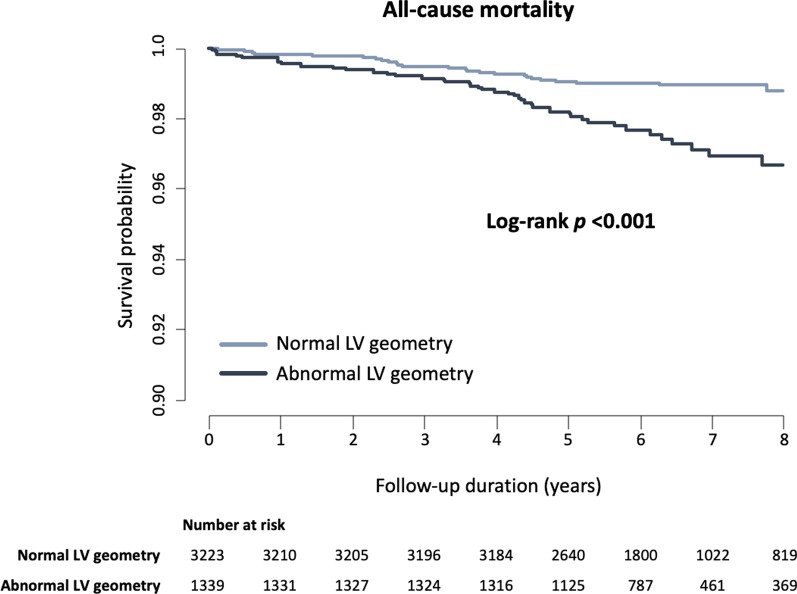
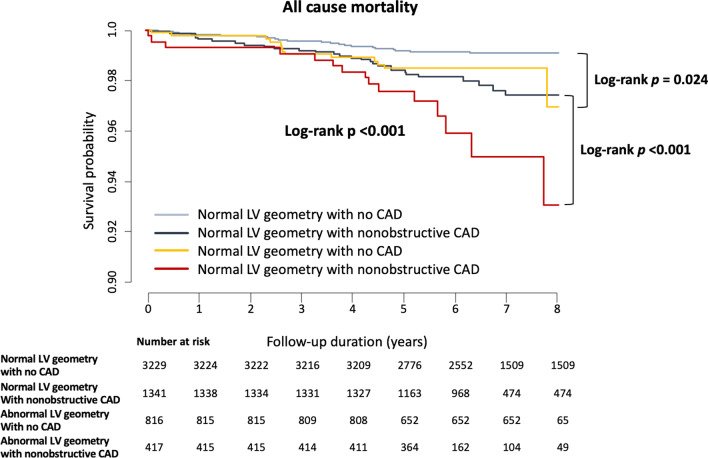
그림 출처: PubMed Central 공개 논문 (PMC8051046)
Conflict of interest statement
The authors declare that they have no competing interests.
그 밖의 정보
- 출판 형태
- Journal Article, Multicenter Study, Observational Study, Research Support, Non-U.S. Gov't
- 저널
- BMC cardiovascular disorders · eISSN 1471-2261
- 전자 출판
- 2021-04-15
- MeSH
- Aged · Computed Tomography Angiography · Coronary Angiography · Coronary Artery Disease / diagnostic imaging / mortality / physiopathology · Echocardiography · Female · Humans · Hypertrophy, Left Ventricular / diagnostic imaging / mortality / physiopathology · Male · Middle Aged · Multidetector Computed Tomography · Prognosis · Retrospective Studies · Risk Assessment · Risk Factors · Seoul · Time Factors · Ventricular Function, Left* · Ventricular Remodeling*
- 참고문헌
- 32편