
Cardiovasc Diabetol. 2022;21(1):251.
Impact of mental disorders on the risk of atrial fibrillation in patients with diabetes mellitus: a nationwide population-based study.
제1저자 배난영, 이소령 · 교신저자 최의근
소속 (7)
- Department of Internal Medicine, Seoul National University Hospital, 101 Daehak-ro, Jongno-gu, Seoul, 03080, Republic of Korea.
- Department of Internal Medicine, Seoul National University Hospital, 101 Daehak-ro, Jongno-gu, Seoul, 03080, Republic of Korea. choiek17@snu.ac.kr.
- Department of Internal Medicine, Seoul National University College of Medicine, Seoul, Republic of Korea. choiek17@snu.ac.kr.
- Department of Statistics and Actuarial Science, Soongsil University, Seoul, Republic of Korea.
- Department of Internal Medicine, Seoul National University College of Medicine, Seoul, Republic of Korea.
- Liverpool Centre for Cardiovascular Science, University of Liverpool and Liverpool Chest & Heart Hospital, Liverpool, UK.
- Department of Clinical Medicine, Aalborg University, Aalborg, Denmark.
Abstract
BACKGROUND It is unclear whether mental disorders are an independent risk factor for atrial fibrillation (AF) in patients with diabetes. We aimed to investigate whether patients with diabetes who have mental disorders have an increased risk for AF.
METHODS Using the Korea National Health Insurance Service database, we enrolled 2,512,690 patients diagnosed with diabetes without AF between 2009 and 2012. We assessed five mental disorders: depression, insomnia, anxiety, bipolar disorder, and schizophrenia. Newly diagnosed AF was identified during the follow-up period, and multivariate Cox regression analysis was performed.
RESULTS Among the 2,512,690 patients (mean age 57.2 ± 12.3 years; 60.1% men), 828,929 (33.0%) had mental disorders. Among the five mental disorders, anxiety (68.1%) was the most common, followed by insomnia (40.0%). During a median follow-up duration of 7.1 years, new-onset AF was diagnosed in 79,525 patients (4.66 per 1,000 person-years). Patients with diabetes who had mental disorders showed a higher risk for AF (adjusted hazard ratio [HR] 1.19; 95% confidence interval [CI] 1.17-1.21; p-value < 0.001). Depression, insomnia, and anxiety were significantly associated with higher risk for AF (adjusted HR [95% CI]: 1.15 [1.12-1.17], 1.15 [1.13-1.18], and 1.19 [1.67-1.21], respectively; all p-values < 0.001), whereas bipolar disorder and schizophrenia were not.
CONCLUSIONS Mental disorders, especially depression, insomnia, and anxiety, were associated with an increased risk for AF in patients with diabetes. Greater awareness with a prompt diagnosis of AF should be considered for patients with both DM and mental disorders.
© 2022. The Author(s).
Keywords
Atrial fibrillationDiabetes mellitusMental disorders
Figures
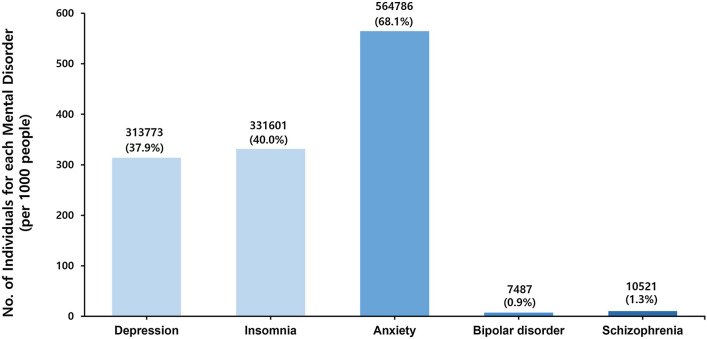
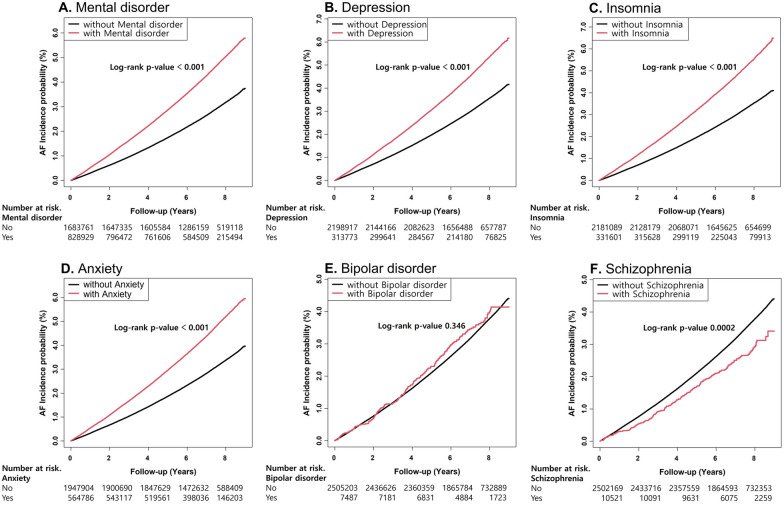
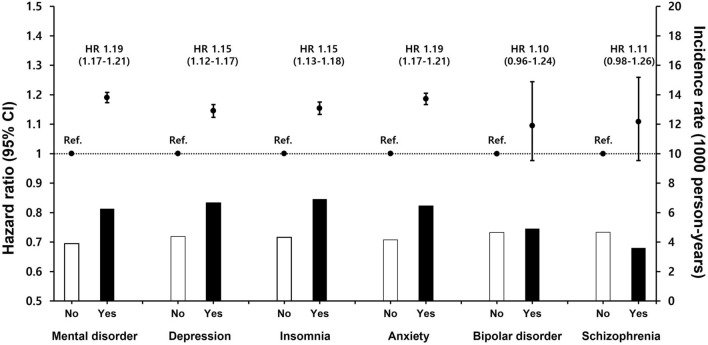
그림 출처: PubMed Central 공개 논문 (PMC9673441)
Conflict of interest statement
N.Y.B., S.-R.L., H.J.A., H.-J.A., S.K., K.-D.H., K.-N.L., S.O.: None. E.-K.C.: Research grants or speaking fees from Abbott, Bayer, BMS/Pfizer, Biosense Webster, Chong Kun Dang, Daewoong Pharmaceutical Co., Daiichi-Sankyo, DeepQure, Dreamtech Co., Ltd., Jeil Pharmaceutical Co. Ltd, Medtronic, Samjinpharm, Seers Technology, and Skylabs. G.Y.H.L.: Consultant and speaker for BMS/Pfizer, Boehringer Ingelheim, and Daiichi-Sankyo. No personal fees were received.
그 밖의 정보
- 출판 형태
- Journal Article, Research Support, Non-U.S. Gov't
- 저널
- Cardiovascular diabetology · eISSN 1475-2840
- 전자 출판
- 2022-11-17
- MeSH
- Male · Humans · Adult · Middle Aged · Aged · Female · Atrial Fibrillation* / diagnosis / epidemiology · Sleep Initiation and Maintenance Disorders* / complications · Diabetes Mellitus* / diagnosis / epidemiology · Mental Disorders* / diagnosis / epidemiology / complications · Risk Factors
- 연구비
- NIEHS NIH HHS 27302C0028
- 참고문헌
- 58편