
BMC Med. 2023;21(1):4.
Lean or diabetic subtypes predict increased all-cause and disease-specific mortality in metabolic-associated fatty liver disease.
제1저자 정고은, 유수종 · 교신저자 한경도, 조은주
소속 (10)
- Department of Internal Medicine and Healthcare Research Institute, Seoul National University Hospital Healthcare System Gangnam Center, Seoul, Republic of Korea.
- Department of Internal Medicine and Liver Research Institute, Seoul National University College of Medicine, 101 Daehak-No, Jongno-Gu, Seoul, 03080, Republic of Korea.
- Department of Gastroenterology and Hepatology, Soonchunhyang University Bucheon Hospital, Bucheon, Gyeonggi-Do, Republic of Korea.
- Center for Liver and Pancreatobiliary Cancer, National Cancer Center, Goyang, Republic of Korea.
- Department of Biomedicine and Health Science, Catholic University, Seoul, Republic of Korea.
- Department of Family Medicine and Supportive Care Center, Samsung Medical Center, Sungkyunkwan University School of Medicine, Seoul, Republic of Korea.
- Department of Clinical Research Design and Evaluation and Department of Digital Health, Samsung Advanced Institute for Health Science, Seoul, Republic of Korea.
- Division of Gastroenterology and Hepatology, Stanford University School of Medicine, Stanford, CA, USA.
- Department of Statistics and Actuarial Science, Soongsil University, Seoul, Republic of Korea. hkd917@naver.com.
- Department of Internal Medicine and Liver Research Institute, Seoul National University College of Medicine, 101 Daehak-No, Jongno-Gu, Seoul, 03080, Republic of Korea. creatioex@gmail.com.
Abstract
BACKGROUND Metabolic-associated fatty liver disease (MAFLD) encompasses diverse disease groups with potentially heterogeneous clinical outcomes. We investigated the risk of all-cause and disease-specific mortality in MAFLD subgroups.
METHODS Using the Korean National Health Insurance Service database, participants were divided into four subgroups: no MAFLD, MAFLD-diabetes, MAFLD-overweight/obese, and MAFLD-lean. Hazard ratios (HRs) and 95% confidence interval (CI) values for all-cause and disease-specific mortality according to MAFLD subgroups were analyzed using Cox proportional hazards models.
RESULTS Among 9,935,314 participants, those with MAFLD-diabetes showed the highest risk of all-cause and disease-specific mortality. The HRs (95% CI) for all-cause mortality were 1.61 (1.59-1.63), 1.36 (1.34-1.38), and 1.19 (1.18-1.20) in the MAFLD-diabetes, MAFLD-lean, and MAFLD-overweight/obese groups, respectively. The magnitude of cardiovascular disease and cancer-related risk showed the same pattern. The risk of liver-related mortality in the MAFLD-lean group (HR: 2.84, 95% CI: 2.72-2.97) was comparable with that in the MAFLD-diabetes group (HR: 2.85, 95% CI: 2.75-2.95). When stratified by body mass index, liver-related mortality was the highest in MAFLD-lean individuals in the underweight group (HR, 5.03, 95% CI: 4.23-5.97).
CONCLUSIONS The MAFLD-lean and MAFLD-diabetes groups had a higher risk of all-cause and disease-specific mortality than did the MAFLD-overweight/obese group. Classifying MAFLD subgroups based on metabolic phenotypes might help risk stratification of patients with MAFLD.
© 2022. The Author(s).
Keywords
LeanMetabolic dysfunctionMortalitySteatosis
Figures
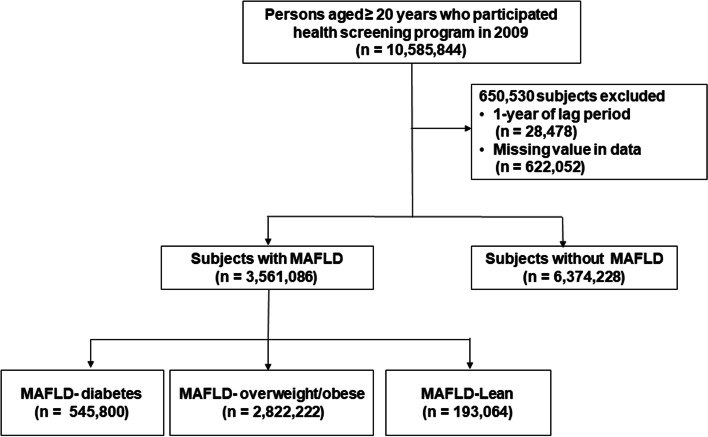
그림 출처: PubMed Central 공개 논문 (PMC9814304)
Conflict of interest statement
The authors declare that they have no competing interests.
그 밖의 정보
- 출판 형태
- Journal Article, Research Support, Non-U.S. Gov't
- 저널
- BMC medicine · eISSN 1741-7015
- 전자 출판
- 2023-01-04
- MeSH
- Humans · Overweight · Non-alcoholic Fatty Liver Disease* · Diabetes Mellitus* · Obesity / complications
- 연구비
- Seoul National University Hospital 04-2022-3140
- 참고문헌
- 55편