
J Nutr Health Aging. 2016;20(3):341-6.
Low Hemoglobin A1c Increases the Risk of Disability in Community-dwelling Older Non-diabetics Adults.
제1저자 김광일 · 교신저자 진호준
소속 (1)
- Ho Jun Chin, MD, PhD, Department of Internal Medicine, Seoul National University College of Medicine, Seoul National University Bundang Hospital, Gumi-ro 166, Bundang-gu, Seongnam-si, Kyeongi-do, 463-707, Republic of Korea, E-mail: mednep@snubh.org, Telephone: 82-31-787-7025, Fax: 82-31-787-4052.
Abstract
OBJECTIVE To describe the health characteristics of individuals with low HbA1c levels and evaluate the association between HbA1c level and disability or all-cause mortality in non-diabetic older adults.
DESIGN Prospective observational cohort study.
SETTING Seongnam, Gyeongi Province, Korea.
PARTICIPANTS Among the 1,000 community-dwelling Koreans ≥ 65 years of age who were followed for 5 years, 760 non-diabetic individuals were analyzed.
MEASUREMENTS Activities of Daily Living (ADL) and Instrumental ADL (IADL) were evaluated and mortality data were obtained from the National Statistics Office of Korea.
RESULTS The mean age was 76.3 (SD 9.0) years, and 319 subjects (42.0%) were male. Lower level of HbA1c was associated with less frequent hypertension and less frequent use of aspirin or statin, and lower values of body mass index, hematocrit, total iron-binding capacity, albumin, and cholesterol level. The participants were categorized into 3 groups according to their HbA1c (group I, < 5.5%; group II, 5.5~5.9%; and group III, 6.0 ~ 6.4%). Although, there was no significant difference in functional status according to baseline HbA1c level, disability was more frequently observed as the HbA1c level decrease (18.3% in group I, 12.5% in group II, and 5.3% in group III, p=0.029) at the 5-year follow-up evaluation. There were 172 deaths (22.6%) during the follow-up period. There was no significant difference in mortality among the groups, however, group I had a 2.071-fold higher risk for the incident disability or mortality over group III after adjusting age, gender, and possible confounder (95% CI: 1.040 ~ 4.124, p=0.038).
CONCLUSIONS Lower level of HbA1c was associated with an increased risk of disability in non-diabetic older adults.
Figures
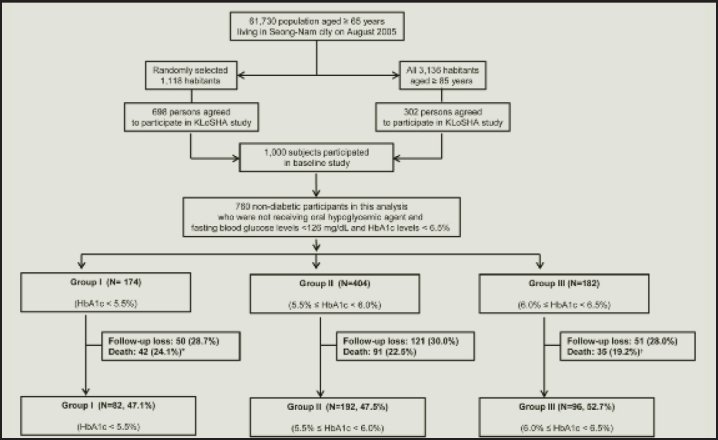
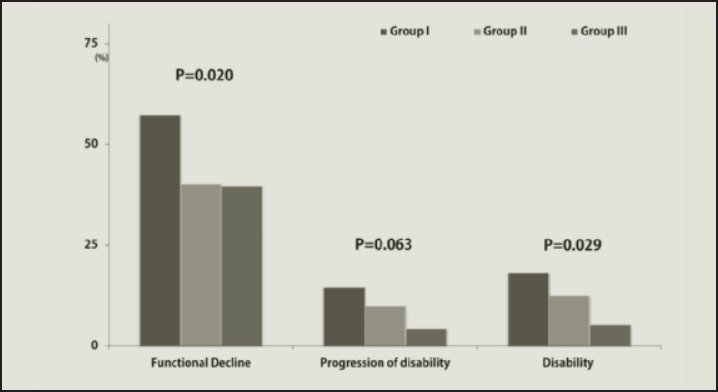
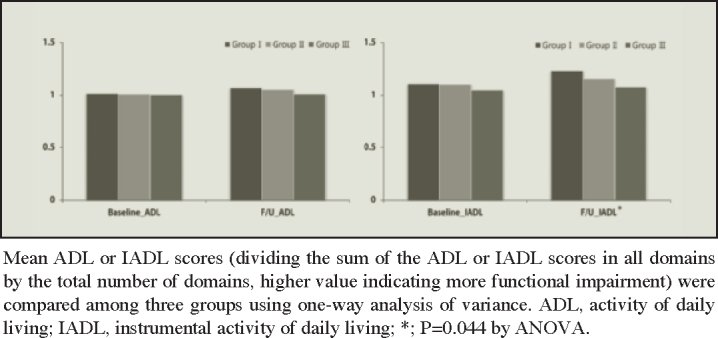
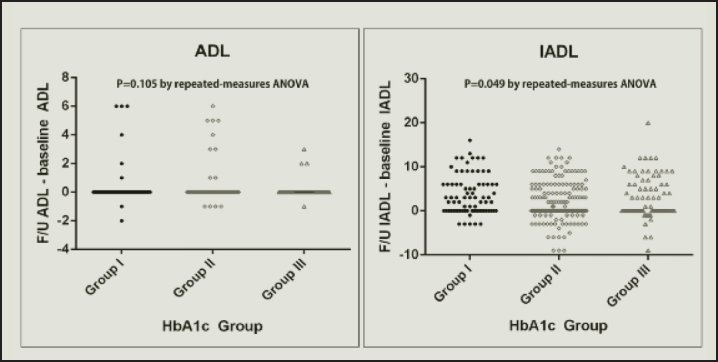
그림 출처: PubMed Central 공개 논문 (PMC12877585)
그 밖의 정보
- 출판 형태
- Journal Article, Research Support, Non-U.S. Gov't
- 저널
- The journal of nutrition, health & aging · eISSN 1760-4788
- MeSH
- Activities of Daily Living · Aged · Body Mass Index · Persons with Disabilities / statistics & numerical data · Female · Glycated Hemoglobin / analysis · Humans · Male · Mortality · Prospective Studies · Republic of Korea / epidemiology · Risk
- Substances
- Glycated Hemoglobin
- 참고문헌
- 23편