
BMC Cancer. 2020;20(1):813.
Treatment strategy and outcomes in locally advanced head and neck squamous cell carcinoma: a nationwide retrospective cohort study (KCSG HN13-01).
제1저자 이윤규, 강은주 · 교신저자 김범석, 윤환중
소속 (15)
- Department of Internal Medicine, Kangbuk Samsung Hospital, Sungkyunkwan University School of Medicine, Seoul, Republic of Korea.
- Department of Internal Medicine, Korea University Guro Hospital, Seoul, Republic of Korea.
- Department of Internal Medicine, Seoul National University Hospital, 101 Daehak-ro, Jongno-gu, Seoul, 03080, Republic of Korea. bhumsuk@snu.ac.kr.
- Department of Hematology-Oncology, Ajou University Hospital, Suwon, Republic of Korea.
- Department of Internal Medicine, SMG-SNU Boramae Medical Center, Seoul, Republic of Korea.
- Department of Hemato-Oncology, Keimyung University Dongsan Medical Center, Daegu, Republic of Korea.
- Department of Hematology and Oncology, Ewha Womans University Hospital, Seoul, Republic of Korea.
- Department of Internal Medicine, Hallym University College of Medicine, Kangdong Sacred Heart Hospital, Seoul, Republic of Korea.
- Department of Internal Medicine, Seoul National University Bundang Hospital, Seongnam, Republic of Korea.
- Department of Hematology-Oncology, Yeungnam University Medical Center, Daegu, Republic of Korea.
- Department of Internal Medicine, Gachon University Gil Medical Center, Incheon, Republic of Korea.
- Department of Internal Medicine, Kosin University Gospel Hospital, Busan, Republic of Korea.
- Department of Internal Medicine, Yonsei Cancer Center, Yonsei University College of Medicine, Seoul, Republic of Korea.
- Department of Internal Medicine, Asan Medical Center, University of Ulsan College of Medicine, Seoul, Republic of Korea.
- Department of Internal Medicine, Chungnam National University Hospital, 282 Munhwa-ro, Jung-gu, Daejeon, 35015, Republic of Korea. hjyun@cnuh.co.kr.
Abstract
BACKGROUND By investigating treatment patterns and outcomes in locally advanced head and neck squamous cell carcinoma (LA-HNSCC), we aimed at providing valuable insights into the optimal therapeutic strategy for physicians in real-world practice.
METHODS This is a multi-institutional study enrolled the patients with stage III to IVB LA-HNSCC, except for nasopharyngeal carcinoma, from 2004 to 2015 in thirteen referral hospitals capable of multidisciplinary care.
RESULTS A total of 445 LA-HNSCC patients were analyzed. The median age was 61 years (range, 24-89). The primary tumor location was the oropharynx in 191 (43%), oral cavity in 106 (24%), hypopharynx in 64 (14%), larynx in 57 (13%) and other sites in 27 (6%). The most common stage was T2 in 172 (39%), and N2 in 245 (55%). Based on treatment intents, 229 (52%) of the patients received definitive concurrent chemoradiotherapy (CCRT) and 187 (42%) underwent surgery. Approximately 158 (36%) of the study population received induction chemotherapy (IC). Taken together, 385 (87%) of the patients underwent combined therapeutic modalities. The regimen for definitive CCRT was weekly cisplatin in 58%, 3-weekly cisplatin in 28% and cetuximab in 3%. The preferred regimen for IC was docetaxel with cisplatin in 49%, and docetaxel, cisplatin plus fluorouracil in 27%. With a median follow-up of 39 months, one-year and two-year survival rates were 89 and 80%, respectively. Overall survival was not significantly different between CCRT and surgery group (p = 0.620).
CONCLUSIONS In patients with LA-HNSCC, the majority of patients received combined therapeutic modalities. Definitive CCRT, IC then definitive CCRT, and surgery followed by adjuvant CCRT or radiotherapy are the preferred multidisciplinary strategies in real-world practice.
Keywords
Locally advanced head and neck cancerMultidisciplinary treatmentSquamous cell carcinomaStrategy
Figures
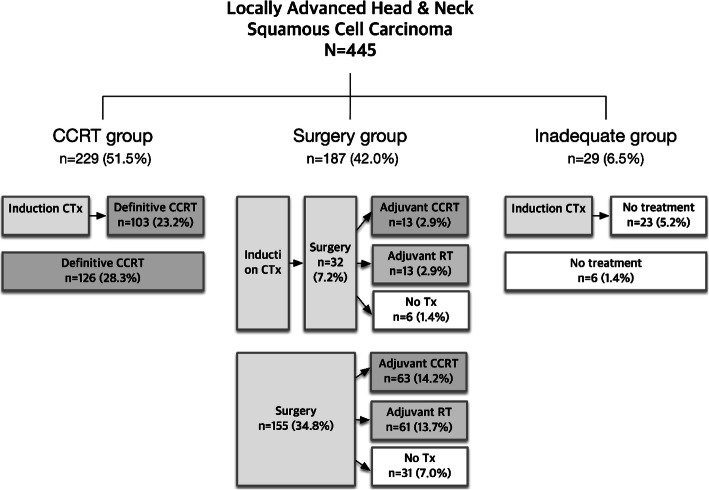
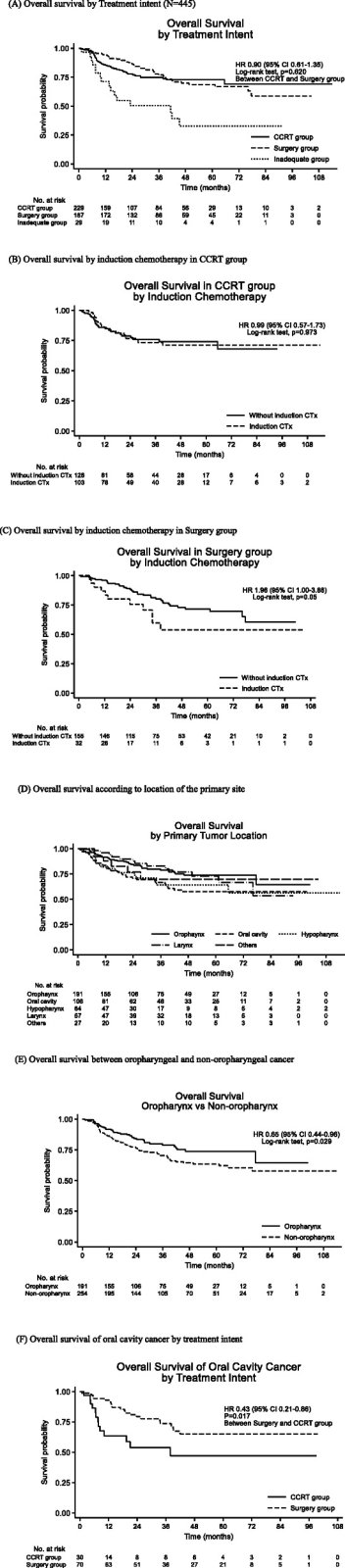
그림 출처: PubMed Central 공개 논문 (PMC7450571)
Conflict of interest statement
The authors of this manuscript declare no relationships with any companies, whose products or services may be related to the subject matter of the article.
그 밖의 정보
- 출판 형태
- Journal Article, Multicenter Study
- 저널
- BMC cancer · eISSN 1471-2407
- 전자 출판
- 2020-08-27
- MeSH
- Adult · Aged · Aged, 80 and over · Antimetabolites, Antineoplastic / therapeutic use · Antineoplastic Agents, Immunological / therapeutic use · Antineoplastic Combined Chemotherapy Protocols / therapeutic use · Cetuximab / therapeutic use · Chemoradiotherapy / methods · Cisplatin / therapeutic use · Combined Modality Therapy / methods · Docetaxel / therapeutic use · Female · Fluorouracil / therapeutic use · Follow-Up Studies · Head and Neck Neoplasms / drug therapy / mortality / surgery · Humans · Induction Chemotherapy / methods · Male · Middle Aged · Progression-Free Survival · Retrospective Studies · Squamous Cell Carcinoma of Head and Neck / drug therapy / mortality / surgery · Survival Rate · Young Adult
- Substances
- Antimetabolites, Antineoplastic · Antineoplastic Agents, Immunological · Docetaxel · Cetuximab · Cisplatin · Fluorouracil
- 연구비
- National R&D Program for Cancer Control, Ministry of Health and Welfare HA16C0015
- 참고문헌
- 24편