
Cardiovasc Diabetol. 2021;20(1):20.
Cumulative burden of metabolic syndrome and its components on the risk of atrial fibrillation: a nationwide population-based study.
제1저자 안효정, 한경도 · 교신저자 최의근
소속 (8)
- Department of Internal Medicine, Seoul National University Hospital, 101 Daehak-ro, Jongno-gu, Seoul, 03080, Republic of Korea.
- Department of Statistics and Actuarial Science, Soongsil University, Seoul, Republic of Korea.
- Department of Internal Medicine, Seoul National University Hospital, 101 Daehak-ro, Jongno-gu, Seoul, 03080, Republic of Korea. choiek17@snu.ac.kr.
- Department of Internal Medicine, Seoul National University College of Medicine, Seoul, Republic of Korea. choiek17@snu.ac.kr.
- Department of Medical Statistics, College of Medicine, The Catholic University of Korea, Seoul, Republic of Korea.
- Department of Internal Medicine, Seoul National University College of Medicine, Seoul, Republic of Korea.
- Liverpool Centre for Cardiovascular Science, University of Liverpool and Liverpool Chest & Heart Hospital, Liverpool, UK.
- Department of Clinical Medicine, Aalborg University, Aalborg, Denmark.
Abstract
BACKGROUND The metabolic syndrome (MetS) and its components are associated with the development of atrial fibrillation (AF). However, the impact of time-burden of MetS on the risk of AF is unknown. We investigated the effect of the cumulative longitudinal burden of MetS on the development of AF.
METHODS We included 2 885 189 individuals without AF who underwent four annual health examinations during 2009-2013 from the database of the Korean national health insurance service. Metabolic burdens were evaluated in the following three ways: (1) cumulative number of MetS diagnosed at each health examination (0-4 times); (2) cumulative number of each MetS component diagnosed at each health examination (0-4 times per MetS component); and (3) cumulative number of total MetS components diagnosed at each health examination (0 to a maximum of 20). The risk of AF according to the metabolic burden was estimated using Cox proportional-hazards models.
RESULTS Of all individuals, 62.4%, 14.8%, 8.7%, 6.5%, and 7.6% met the MetS diagnostic criteria 0, 1, 2, 3, and 4 times, respectively. During a mean follow-up of 5.3 years, the risk of AF showed a positive association with the cumulative number of MetS diagnosed over four health examinations: adjusted hazard ratios (HRs) with 95% confidence intervals (CIs) of 1, 2, 3, and 4 times compared to 0 times were 1.18 (1.13-1.24), 1.31 (1.25-1.39), 1.46 (1.38-1.55), and 1.72 (1.63-1.82), respectively; P for trend < 0.001. All five components of MetS, when diagnosed repeatedly, were independently associated with an increased risk of AF: adjusted HR (95% CI) from 1.22 (1.15-1.29) for impaired fasting glucose to 1.96 (1.87-2.07) for elevated blood pressure. As metabolic components were accumulated from 0 to 20 counts, the risk of AF also gradually increased up to 3.1-fold (adjusted HR 3.11, 95% CI 2.52-3.83 in those with 20 cumulative components of MetS), however, recovery from MetS was linked to a decreased risk of AF.
CONCLUSIONS Given the positive correlations between the cumulative metabolic burdens and the risk of incident AF, maximal effort to detect and correct metabolic derangements even before MetS development might be important to prevent AF and related cardiovascular diseases.
Keywords
Atrial fibrillationMetabolic burdenMetabolic syndrome
Figures
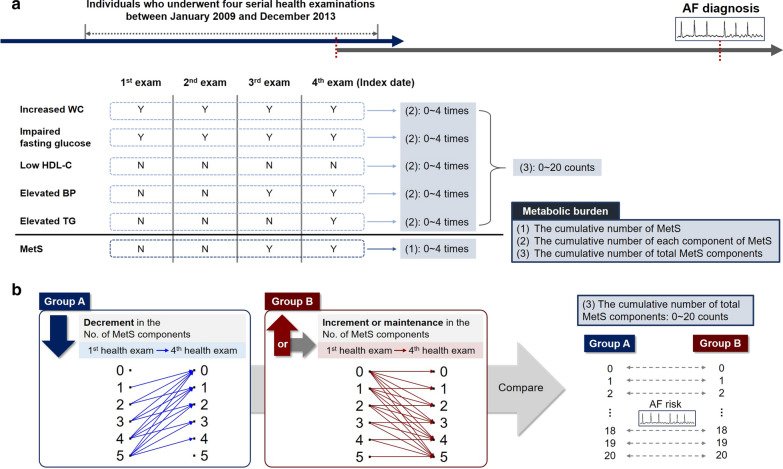
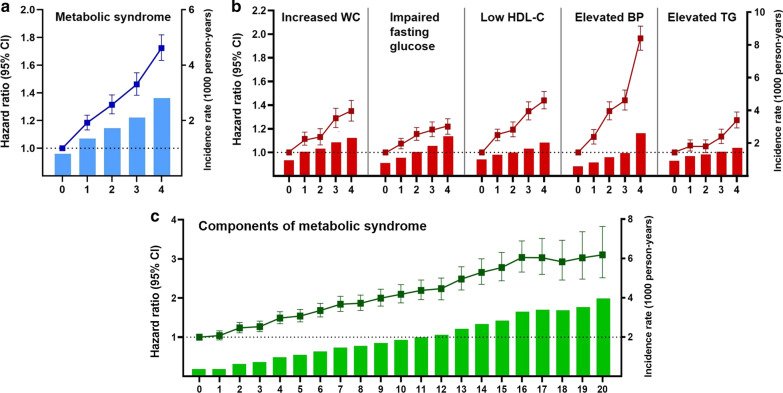
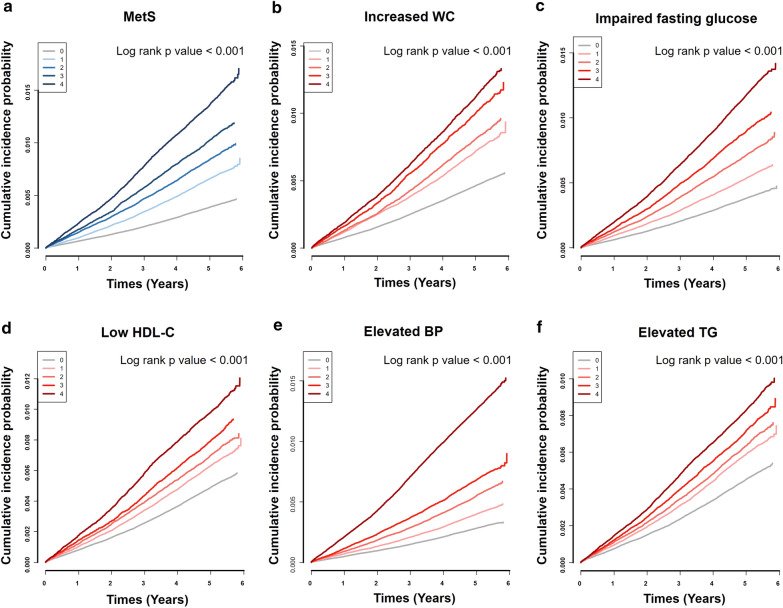
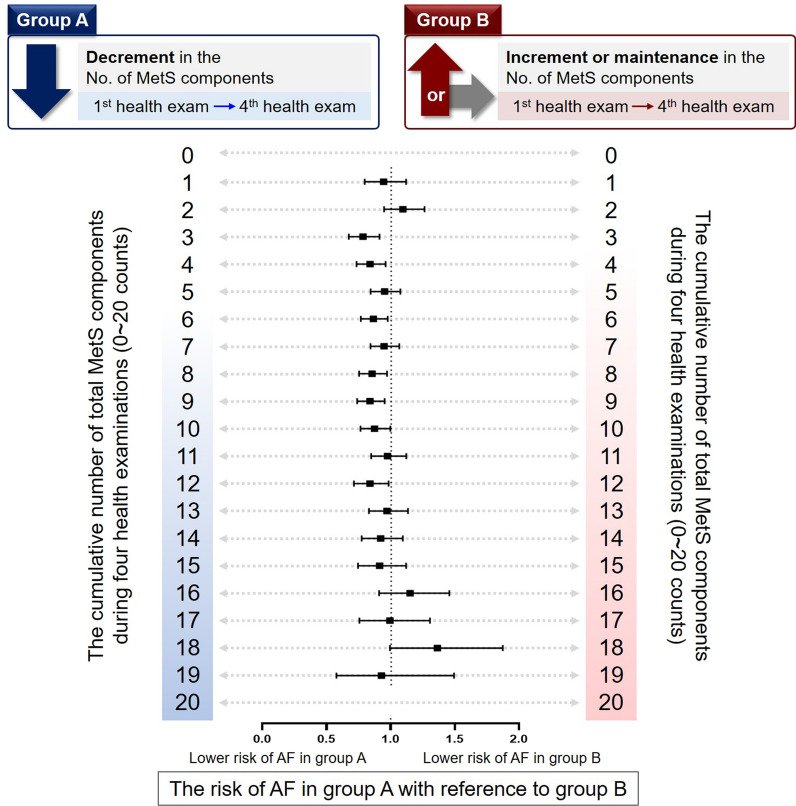
그림 출처: PubMed Central 공개 논문 (PMC7816376)
Conflict of interest statement
HJA, KDH, SRL, JHJ, SK, SO: None to disclose. EKC: Research grants from Bayer, BMS/Pfizer, Biosense Webster, Chong Kun Dang, Daiichi-Sankyo, Samjinpharm, Sanofi-Aventis, Seers Technology, Skylabs, and Yuhan. GYHL: Consultant for Bayer/Janssen, BMS/Pfizer, Medtronic, Boehringer Ingelheim, Novartis, Verseon and Daiichi-Sankyo. Speaker for Bayer, BMS/Pfizer, Medtronic, Boehringer Ingelheim, and Daiichi-Sankyo. No fees are received personally. The external funders and sponsors of the study had no role in study design and conduct of the study; in the collection, analysis, and interpretation of the data; in the preparation, review, or approval of the manuscript; or in the decision to submit the manuscript for publication.
그 밖의 정보
- 출판 형태
- Journal Article, Research Support, Non-U.S. Gov't
- 저널
- Cardiovascular diabetology · eISSN 1475-2840
- 전자 출판
- 2021-01-19
- MeSH
- Adult · Atrial Fibrillation / diagnosis / epidemiology · Cardiometabolic Risk Factors · Comorbidity · Databases, Factual · Diabetes Mellitus / diagnosis / epidemiology · Dyslipidemias / diagnosis / epidemiology · Female · Humans · Hypertension / diagnosis / epidemiology · Incidence · Life Style · Longitudinal Studies · Male · Metabolic Syndrome / diagnosis / epidemiology · Middle Aged · Obesity / diagnosis / epidemiology · Prevalence · Prognosis · Republic of Korea / epidemiology · Risk Assessment · Time Factors
- 참고문헌
- 51편