
BMC Cancer. 2020;20(1):504.
A differential risk assessment and decision model for Transarterial chemoembolization in hepatocellular carcinoma based on hepatic function.
제1저자 남준열, 최아름, 신동현 · 교신저자 이정훈, 김휘영
소속 (8)
- Department of Internal Medicine, College of Medicine, Ewha Womans University, 1071, Anyangcheon-ro, Yangcheon-gu, Seoul, 07985, Republic of Korea.
- Department of Internal Medicine and Liver Research Institute, Seoul National University College of Medicine, 101, Daehak-ro, Jongno-gu, Seoul, 03080, Republic of Korea.
- Department of Internal Medicine, Samsung Medical Center, Sungkyunkwan University School of Medicine, Seoul, Republic of Korea.
- Department of Internal Medicine and Liver Research Institute, Seoul National University College of Medicine, 101, Daehak-ro, Jongno-gu, Seoul, 03080, Republic of Korea. pindra@empal.com.
- Department of Internal Medicine, College of Medicine, Ewha Womans University, 1071, Anyangcheon-ro, Yangcheon-gu, Seoul, 07985, Republic of Korea. hwiyoung@ewha.ac.kr.
- Department of Radiology, Seoul National University College of Medicine, Seoul, Republic of Korea.
- Department of Radiology, College of Medicine, Ewha Womans University, Seoul, Republic of Korea.
- Clinical Trial Center, Ewha Womans University Mokdong Hospital, Seoul, Republic of Korea.
Abstract
BACKGROUND The decision of transarterial chemoembolization (TACE) initiation and/or repetition remains challenging in patients with unresectable hepatocellular carcinoma (HCC). The aim was to develop a prognostic scoring system to guide TACE initiation/repetition.
METHODS A total of 597 consecutive patients who underwent TACE as their initial treatment for unresectable HCC were included. We derived a prediction model using independent risk factors for overall survival (OS), which was externally validated in an independent cohort (n = 739).
RESULTS Independent risk factors of OS included Albumin-bilirubin (ALBI) grade, maximal tumor size, alpha-fetoprotein, and tumor response to initial TACE, which were used to develop a scoring system ("ASAR"). C-index values for OS were 0.733 (95% confidence interval [CI] = 0.570-0.871) in the derivation, 0.700 (95% CI = 0.445-0.905) in the internal validation, and 0.680 (95% CI = 0.652-0.707) in the external validation, respectively. Patients with ASAR< 4 showed significantly longer OS than patients with ASAR≥4 in all three datasets (all P < 0.001). Among Child-Pugh class B patients, a modified model without TACE response, i.e., "ASA(R)", discriminated OS with a c-index of 0.788 (95% CI, 0.703-0.876) in the derivation, and 0.745 (95% CI, 0.646-0.862) in the internal validation, and 0.670 (95% CI, 0.605-0.725) in the external validation, respectively. Child-Pugh B patients with ASA(R) < 4 showed significantly longer OS than patients with ASA(R) ≥ 4 in all three datasets (all P < 0.001).
CONCLUSIONS ASAR provides refined prognostication for repetition of TACE in patients with unresectable HCC. For Child-Pugh class B patients, a modified model with baseline factors might guide TACE initiation.
Keywords
Child-Pugh classificationHepatocellular carcinomaRisk prediction modelTransarterial chemoembolization
Figures
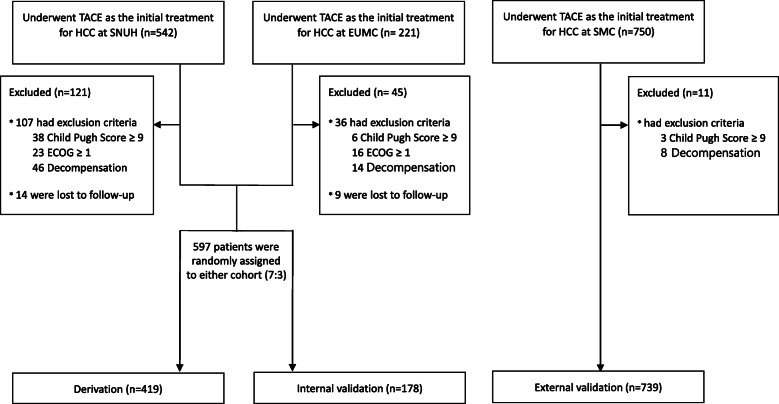
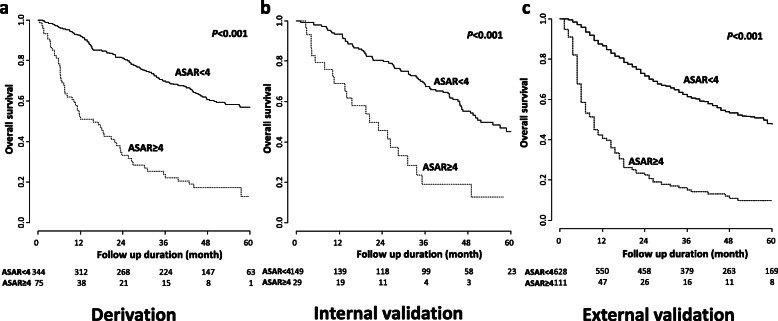
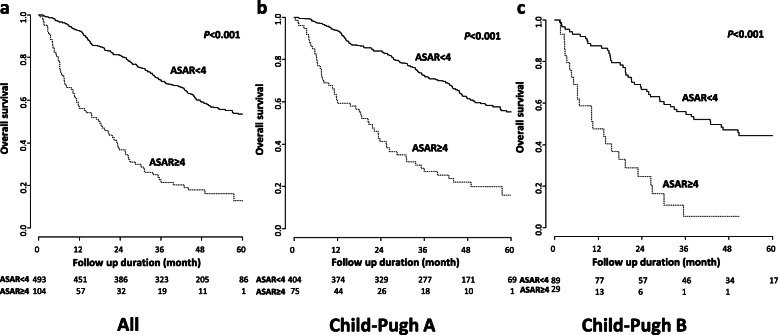
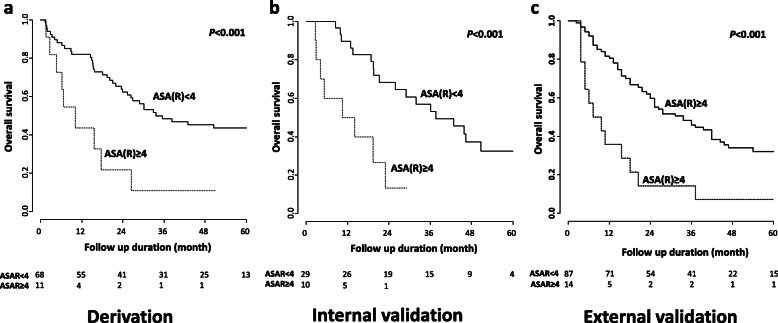
그림 출처: PubMed Central 공개 논문 (PMC7268402)
Conflict of interest statement
The authors declare that they have no competing interests.
그 밖의 정보
- 출판 형태
- Journal Article, Validation Study
- 저널
- BMC cancer · eISSN 1471-2407
- 전자 출판
- 2020-06-01
- MeSH
- Aged · Antineoplastic Agents / administration & dosage · Bilirubin / analysis · Carcinoma, Hepatocellular / blood / pathology / physiopathology / therapy · Chemoembolization, Therapeutic / methods · Clinical Decision-Making / methods · Doxorubicin / administration & dosage · Female · Follow-Up Studies · Humans · Liver / pathology / physiopathology · Liver Cirrhosis / blood / diagnosis / pathology / physiopathology · Liver Function Tests · Liver Neoplasms / blood / pathology / physiopathology / therapy · Male · Middle Aged · Models, Biological · Response Evaluation Criteria in Solid Tumors · Risk Assessment / methods · Risk Factors · Serum Albumin / analysis · Severity of Illness Index · Survival Analysis
- Substances
- Antineoplastic Agents · Serum Albumin · Doxorubicin · Bilirubin
- 참고문헌
- 41편