
Cardiovasc Diabetol. 2021;20(1):180.
Impact of insulin therapy on the mortality of acute heart failure patients with diabetes mellitus.
제1저자 장세용, 장지은 · 교신저자 이해영
소속 (16)
- Department of Internal Medicine, School of Medicine, Kyungpook National University, Daegu, Republic of Korea.
- Department of Preventive Medicine, Korea University College of Medicine, Seoul, Republic of Korea.
- Department of Internal Medicine, Seoul National University Hospital, Seoul, Republic of Korea.
- Department of Internal Medicine, Seoul National University Bundang Hospital, Seongnam, Republic of Korea.
- Department of Internal Medicine, Sungkyunkwan University College of Medicine, Seoul, Republic of Korea.
- Department of Internal Medicine, Asan Medical Center, University of Ulsan College of Medicine, Seoul, Republic of Korea.
- Department of Internal Medicine, Yonsei University College of Medicine, Seoul, Republic of Korea.
- Department of Internal Medicine, College of Medicine, The Catholic University of Korea, Seoul, Republic of Korea.
- Department of Internal Medicine, Chungbuk National University College of Medicine, Cheongju, Republic of Korea.
- Department of Internal Medicine, Yonsei University Wonju College of Medicine, Wonju, Republic of Korea.
- Department of Internal Medicine, Heart Research Center of Chonnam National University, Gwangju, Republic of Korea.
- Department of Preventive Medicine, Seoul National University College of Medicine, Seoul, South Korea.
- Department of Integrated Major in Innovative Medical Science, Seoul National University Graduate School, Seoul, Republic of Korea.
- Cancer Research Institute, Seoul National University Graduate School, Seoul, Republic of Korea.
- Department of Internal Medicine, Seoul National University Hospital, Seoul, Republic of Korea. hylee612@snu.ac.kr.
- Division of Cardiology, Department of Internal Medicine, Seoul National University College of Medicine, 101 Daehak‑ro, Jongno‑gu, Seoul, 03080, South Korea. hylee612@snu.ac.kr.
Abstract
BACKGROUND Patients with diabetes mellitus (DM) have a higher prevalence of heart failure (HF) than those without it. Approximately 40 % of HF patients have DM and they tend to have poorer outcomes than those without DM. This study evaluated the impact of insulin therapy on mortality among acute HF patients.
METHODS A total of 1740 patients from the Korean Acute Heart Failure registry with DM were included in this study. The risk of all-cause mortality according to insulin therapy was assessed using the Cox proportional hazard models with inverse probability of treatment weighting to balance the clinical characteristics (pretreatment covariates) between the groups.
RESULTS DM patients had been treated with either oral hypoglycemic agents (OHAs) alone (n = 620), insulin alone (n = 682), or insulin combined with OHAs (n = 438). The insulin alone group was associated with an increased mortality risk compared with the OHA alone group (HR = 1.41, 95 % CI 1.21-1.66]). Insulin therapy combined with OHAs also showed an increased mortality risk (HR = 1.29, 95 % CI 1.14-1.46) compared with the OHA alone group. Insulin therapy was consistently associated with increased mortality risk, regardless of the left ventricular ejection fraction (LVEF) or HF etiology. A significant increase in mortality was observed in patients with good glycemic control (HbA1c < 7.0 %) receiving insulin, whereas there was no significant association in patients with poor glycemic control (HbA1c ≥ 7.0%).
CONCLUSIONS Insulin therapy was found to be associated with increased mortality compared to OHAs. The insulin therapy was harmful especially in patients with low HbA1c levels which may suggest the necessity of specific management strategies and blood sugar targets when using insulin in patients with HF.
© 2021. The Author(s).
Keywords
Diabetes mellitusHeart failureInsulinMortality
Figures
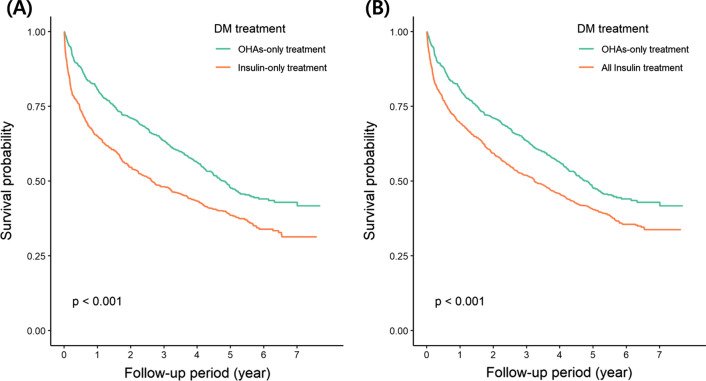
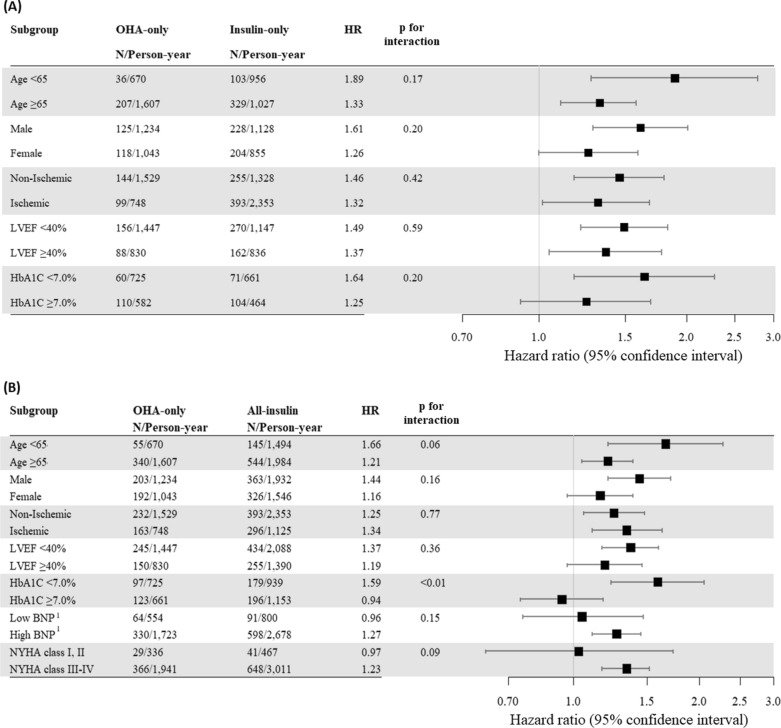
그림 출처: PubMed Central 공개 논문 (PMC8424885)
Conflict of interest statement
The authors have no competing interests.
그 밖의 정보
- 출판 형태
- Comparative Study, Journal Article, Multicenter Study, Observational Study, Research Support, Non-U.S. Gov't
- 저널
- Cardiovascular diabetology · eISSN 1475-2840
- 전자 출판
- 2021-09-08
- MeSH
- Acute Disease · Aged · Aged, 80 and over · Biomarkers / blood · Blood Glucose / drug effects / metabolism · Diabetes Mellitus / blood / diagnosis / drug therapy / mortality · Female · Glycated Hemoglobin / metabolism · Glycemic Control* / adverse effects / mortality · Heart Failure / diagnosis / mortality / physiopathology · Humans · Hypoglycemic Agents / adverse effects / therapeutic use · Insulin / adverse effects / therapeutic use · Male · Middle Aged · Prospective Studies · Registries · Republic of Korea · Risk Assessment · Risk Factors · Time Factors · Treatment Outcome
- Substances
- Biomarkers · Blood Glucose · Glycated Hemoglobin · Hypoglycemic Agents · Insulin · hemoglobin A1c protein, human
- 연구비
- Korea Centers for Disease Control and Prevention 2010-E63003-00 · Korea Centers for Disease Control and Prevention 2011-E63002-00 · Korea Centers for Disease Control and Prevention 2012-E63005-00 · Korea Centers for Disease Control and Prevention 2013-E63003-00 · Korea Centers for Disease Control and Prevention 2013-E63003-01 · Korea Centers for Disease Control and Prevention 2013-E63003-02 · Korea Centers for Disease Control and Prevention 2016-ER6303-00
- 참고문헌
- 29편