
Sci Rep. 2019;9(1):4911.
Long-term outcomes according to additional treatments after endoscopic resection for rectal small neuroendocrine tumors.
제1저자 차재황 · 교신저자 이현정
소속 (7)
- Department of Internal Medicine, Dong-A University College of Medicine, Busan, 49201, Korea.
- Department of Internal Medicine, Gangnam Severance Hospital, Yonsei University College of Medicine, Seoul, 06273, Korea. jungdh@cha.ac.kr.
- Department of Internal Medicine, CHA Bundang Medical Center, CHA University, Seongnam, 13496, Korea. jungdh@cha.ac.kr.
- Department of Internal Medicine, Gangnam Severance Hospital, Yonsei University College of Medicine, Seoul, 06273, Korea.
- Department of Internal Medicine, Institute of Gastroenterology, Yonsei University College of Medicine, Seoul, 03722, Korea.
- Department of Internal Medicine, Institute of Gastroenterology, Yonsei University College of Medicine, Seoul, 03722, Korea. guswjd80@gmail.com.
- Department of Internal Medicine and Liver Research Institute, Seoul National University College of Medicine, Seoul, 03080, Korea. guswjd80@gmail.com.
Abstract
The present study aimed to investigate treatment strategies determining additional treatment after endoscopic resection (ER) of rectal neuroendocrine tumor (NET)s and long-term outcomes of endoscopically resected rectal NETs. We analyzed a total of 322 patients medical records of patients who underwent ER for rectal NETs. Rectal NETs initially resected as polyps and treated with conventional endoscopic mucosal resection (EMR) were observed more frequently in the non-curative group (P = 0.041 and P = 0.012, respectively). After ER, only 44 of the 142 patients (31.0%) who did not meet the criteria for curative resection received additional salvage treatment. In multivariate analysis, lesions diagnosed via biopsies (OR, 0.096; P = 0.002) or suspected as NETs initially (OR, 0.04; P = 0.001) were less likely to undergo additional treatment. Positive lymphovascular invasion (OR 61.971; P < 0.001), positive (OR 75.993; P < 0.001), or indeterminate (OR 13.203; P = 0.001) resection margins were more likely to undergo additional treatment. Although lymph node metastasis was found in 6 patients, none experienced local or metastatic tumor recurrence during the median follow-up of 40.49 months. Long-term outcomes after ER for rectal NETs were excellent. The prognosis showed favorable outcomes regardless of whether patients receive additional salvage treatments.
Figures
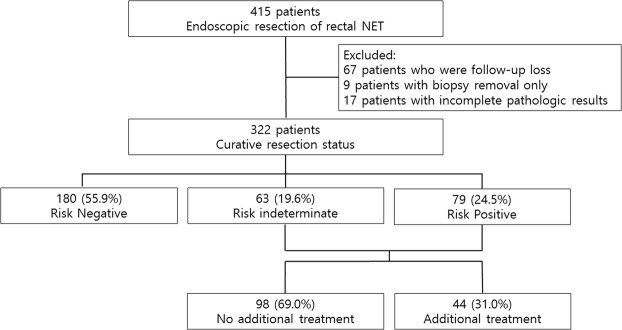
그림 출처: PubMed Central 공개 논문 (PMC6426846)
Conflict of interest statement
The authors declare no competing interests.
그 밖의 정보
- 출판 형태
- Journal Article
- 저널
- Scientific reports · eISSN 2045-2322
- 전자 출판
- 2019-03-20
- MeSH
- Adult · Endoscopic Mucosal Resection / methods · Female · Humans · Lymphatic Metastasis · Male · Middle Aged · Neuroendocrine Tumors / diagnosis / pathology / surgery · Prognosis · Rectal Neoplasms / diagnosis / pathology / surgery · Retrospective Studies · Treatment Outcome
- 참고문헌
- 24편