
BMC Cancer. 2019;19(1):523.
Adjuvant cytokine-induced killer cell immunotherapy for hepatocellular carcinoma: a propensity score-matched analysis of real-world data.
제1저자 윤준식, 송병근 · 교신저자 이정훈
소속 (6)
- Department of Internal Medicine and Liver Research Institute, Seoul National University College of Medicine, Seoul, South Korea.
- Department of Internal Medicine, Busan Paik Hospital, Inje University College of Medicine, Busan, South Korea.
- Department of Medicine, Samsung Medical Center, Sungkyunkwan University School of Medicine, Seoul, South Korea.
- Department of Internal Medicine and Liver Research Institute, Seoul National University College of Medicine, Seoul, South Korea. pindra@empal.com.
- Department of Internal Medicine, Eulji General Hospital, Eulji University School of Medicine, Seoul, South Korea.
- Department of Internal Medicine, Digestive Disease Center, Institute for Digestive Research, Soonchunhyang University College of Medicine, Seoul, South Korea.
Abstract
BACKGROUND Several randomized controlled trials have shown that adjuvant immunotherapy with autologous cytokine-induced killer (CIK) cells prolongs recurrence-free survival (RFS) after curative treatment for hepatocellular carcinoma (HCC). We investigated the efficacy of adjuvant immunotherapy with activated CIK cells in real-world clinical practice.
METHODS A total of 59 patients who had undergone curative surgical resection or radiofrequency ablation for stage I or II HCC, and subsequently received adjuvant CIK cell immunotherapy at two large-volume centers in Korea were retrospectively included. Propensity score matching with a 1:1 ratio was conducted to avoid possible bias, and 59 pairs of matched control subjects were also generated. The primary endpoint was RFS and the secondary endpoints were overall survival and safety.
RESULTS The median follow-up duration was 28.0 months (interquartile range, 22.9-42.3 months). In a univariable analysis, the immunotherapy group showed significantly longer RFS than the control group (hazard ratio [HR], 0.42; 95% CI, 0.22-0.80; log-rank P = 0.006). The median RFS in the control group was 29.8 months, and the immunotherapy group did not reach a median RFS. A multivariable Cox proportional hazard analysis showed that immunotherapy was an independent predictor for HCC recurrence (adjusted HR, 0.38; 95% CI, 0.20-0.73; P = 0.004). The overall incidence of adverse events in the immunotherapy group was 16/59 (27.1%) and no patient experienced a grade 3 or 4 adverse event.
CONCLUSIONS The adjuvant immunotherapy with autologous CIK cells after curative treatment safely prolonged the RFS of HCC patients in a real-world setting.
Keywords
Adjuvant immunotherapyCytokine-induced killer cellHepatocelluar carcinomaOverall survivalRecurrence-free survival
Figures
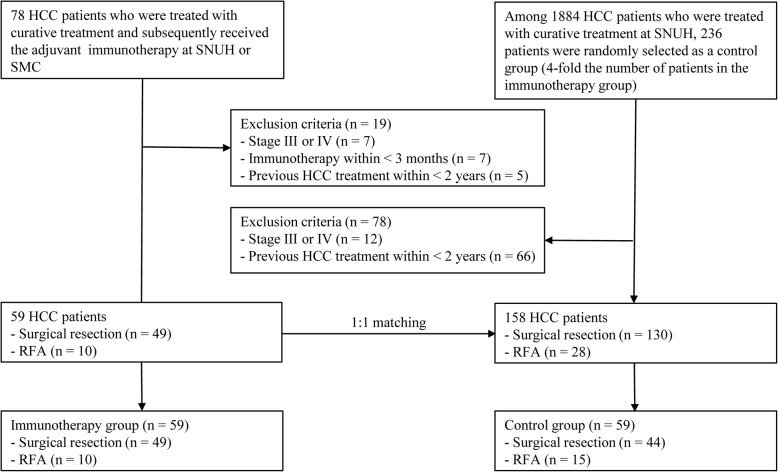
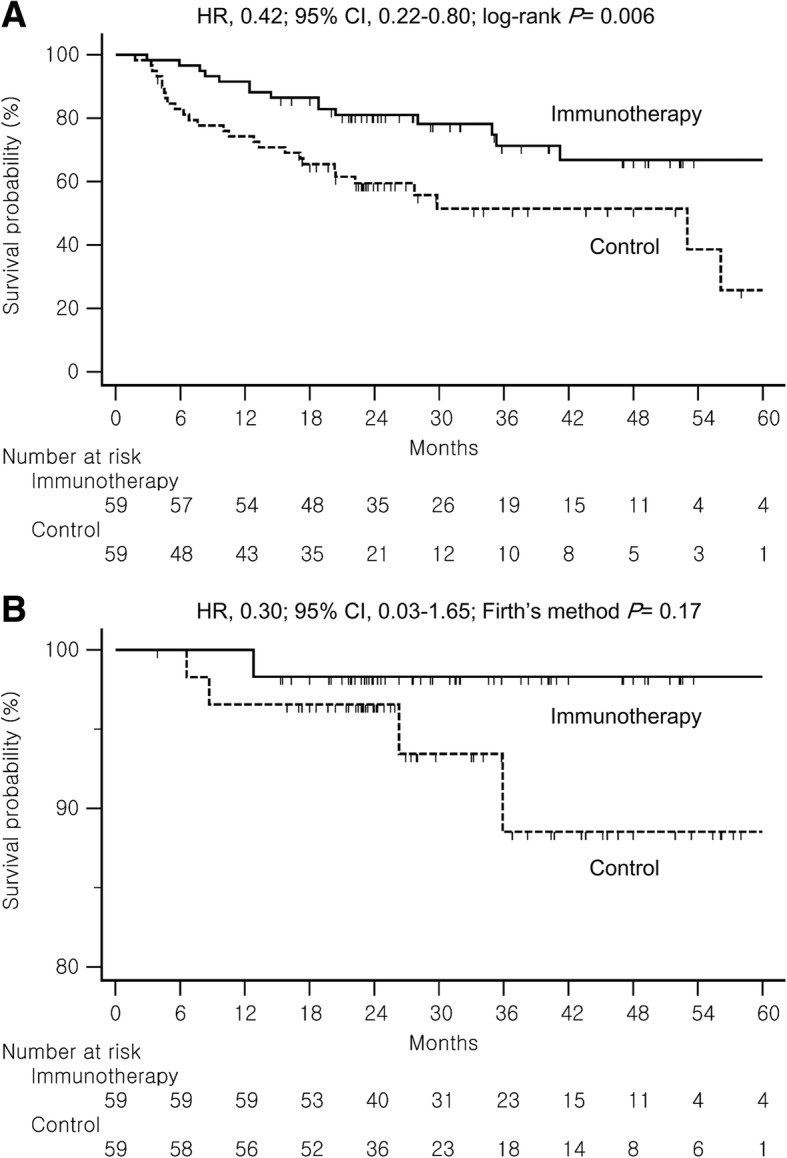
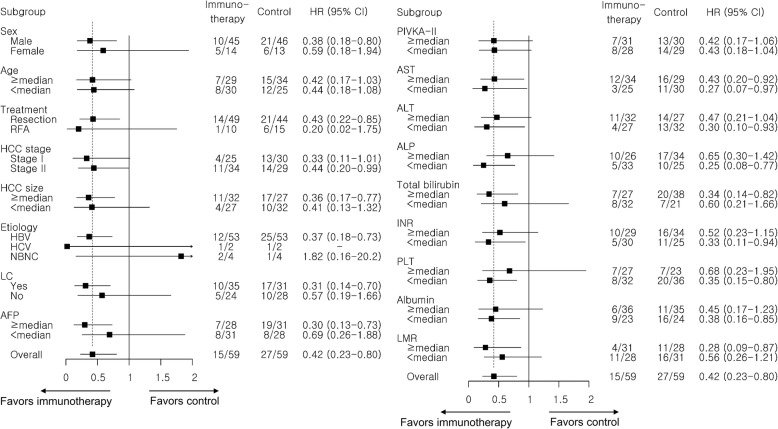
그림 출처: PubMed Central 공개 논문 (PMC6543598)
Conflict of interest statement
The authors declare that they have no competing interests.
그 밖의 정보
- 출판 형태
- Comparative Study, Journal Article
- 저널
- BMC cancer · eISSN 1471-2407
- 전자 출판
- 2019-05-31
- MeSH
- Aged · Carcinoma, Hepatocellular / pathology / surgery / therapy · Combined Modality Therapy · Cytokine-Induced Killer Cells / transplantation · Disease-Free Survival · Female · Humans · Immunotherapy, Adoptive / adverse effects / methods · Liver Neoplasms / pathology / surgery / therapy · Male · Middle Aged · Propensity Score · Republic of Korea · Retrospective Studies · Survival Rate · Transplantation, Autologous
- 참고문헌
- 34편