
Cardiovasc Diabetol. 2020;19(1):78.
High variability in bodyweight is associated with an increased risk of atrial fibrillation in patients with type 2 diabetes mellitus: a nationwide cohort study.
제1저자 이현정 · 교신저자 최의근
소속 (5)
- Department of Internal Medicine, Seoul National University Hospital, 101 Daehak-ro, Jongno-gu, Seoul, 03080, Republic of Korea.
- Department of Internal Medicine, Seoul National University Hospital, 101 Daehak-ro, Jongno-gu, Seoul, 03080, Republic of Korea. choiek17@snu.ac.kr.
- Department of Statistics and Actuarial Science, Soongsil University, Seoul, Republic of Korea.
- Liverpool Centre for Cardiovascular Science, University of Liverpool and Liverpool Heart and Chest Hospital, Liverpool, UK.
- Aalborg Thrombosis Research Unit, Department of Clinical Medicine, Aalborg University, Aalborg, Denmark.
Abstract
BACKGROUND Bodyweight variability is a risk factor for atrial fibrillation (AF). We aimed to examine the relationship between bodyweight variability and the risk of AF in patients with type 2 diabetes mellitus (DM), and whether this relationship was affected by baseline body mass index (BMI), weight change, or advanced diabetic stage.
METHODS A nationwide population-based cohort of 670,797 patients with type 2 DM from the Korean National Health Insurance Service database without a history of AF and with ≥ 3 measurements of bodyweight over a 5-year period were followed up for AF development. Intra-individual bodyweight variability was calculated using variability independent of mean, and high bodyweight variability was defined as the quintile with the highest variability with the lower four quintiles as reference.
RESULTS During a median of 7.0 years of follow-up, 22,019 patients (3.3%) newly developed AF. After multivariate adjustment, those in the highest quintile of bodyweight variability showed a higher risk of incident AF (HR 1.16, 95% CI 1.12-1.20) compared to those in the lower 4 quintiles with reference bodyweight variability, irrespective of baseline BMI group and direction of overall weight change. This association was greater in magnitude in subjects with lower BMI, those on insulin, and those with a DM duration of greater than 5 years. In sensitivity analyses, high bodyweight variability was consistently associated with AF development using other indices of variability and adjusting for glycemic variability.
CONCLUSIONS High variability in bodyweight was associated with AF development, independently of traditional cardiovascular risk factors and baseline BMI. This association was stronger in underweight patients and with advanced diabetic stage. Weight fluctuation may interfere with the beneficial effects of weight loss and should be avoided when possible in weight control regimens for DM patients.
Keywords
Atrial fibrillationBodyweightDiabetes mellitusObesityVariability
Figures
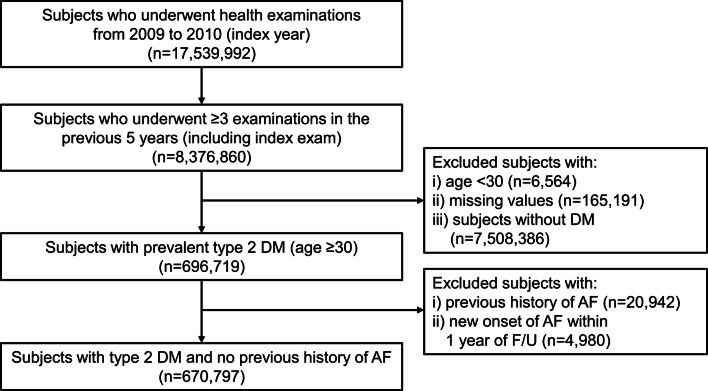
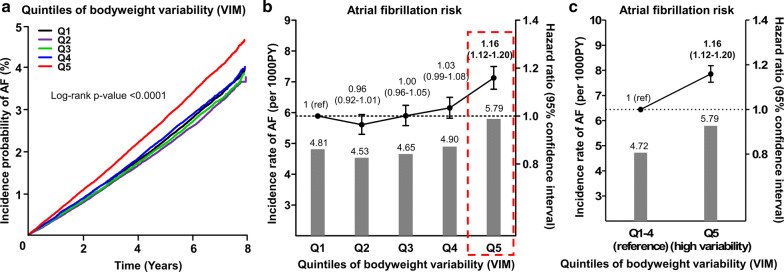
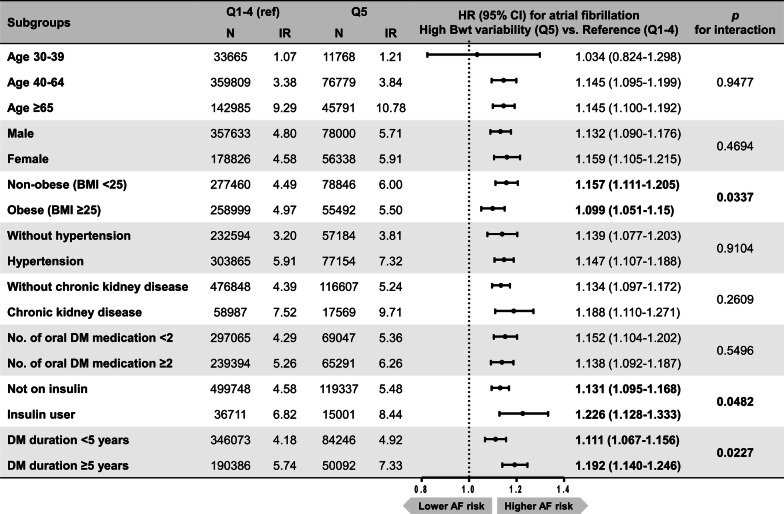
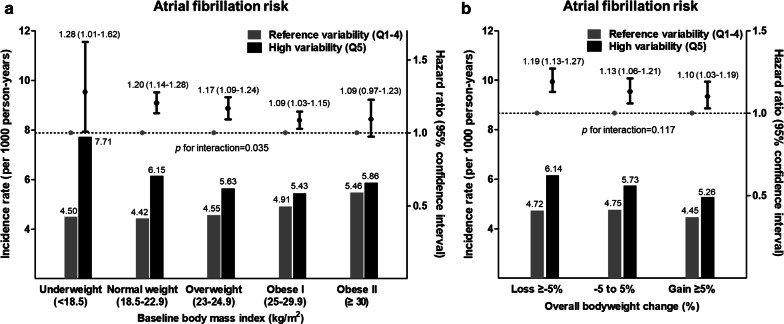
그림 출처: PubMed Central 공개 논문 (PMC7293783)
Conflict of interest statement
EKC reports research grants from Sanofi-Aventis, Chong Kun Dang, Daiichi-Sankyo, BMS/Pfizer, Biosense Webster, and Skylabs. GYHL reports activities as consultant for Bayer/Janssen, BMS/Pfizer, Medtronic, Boehringer Ingelheim, Novartis, Verseon, Daiichi-Sankyo, and as speaker for Bayer, BMS/Pfizer, Medtronic, Boehringer Ingelheim, and Daiichi-Sankyo. No fees are received personally. All other authors report none.
그 밖의 정보
- 출판 형태
- Comparative Study, Journal Article
- 저널
- Cardiovascular diabetology · eISSN 1475-2840
- 전자 출판
- 2020-06-13
- MeSH
- Adult · Aged · Atrial Fibrillation / diagnosis / epidemiology / physiopathology · Body Mass Index · Body-Weight Trajectory* · Databases, Factual · Diabetes Mellitus, Type 2 / diagnosis / epidemiology · Female · Heart Rate* · Humans · Incidence · Male · Middle Aged · Obesity / diagnosis / epidemiology / physiopathology · Prognosis · Republic of Korea / epidemiology · Risk Assessment · Risk Factors · Time Factors
- 참고문헌
- 45편