
Cardiovasc Diabetol. 2020;19(1):69.
Different effects of SGLT2 inhibitors according to the presence and types of heart failure in type 2 diabetic patients.
제1저자 황인창 · 교신저자 조구영
소속 (5)
- Cardiovascular Center and Department of Internal Medicine, Seoul National University Bundang Hospital, Seongnam, Gyeonggi, South Korea.
- Department of Internal Medicine, Seoul National University College of Medicine, Seoul, South Korea.
- Cardiovascular Center and Department of Internal Medicine, Seoul National University Bundang Hospital, Seongnam, Gyeonggi, South Korea. cardioch@snu.ac.kr.
- Department of Internal Medicine, Seoul National University College of Medicine, Seoul, South Korea. cardioch@snu.ac.kr.
- Cardiovascular Center and Department of Internal Medicine, Seoul National University Hospital, Seoul, South Korea.
Abstract
BACKGROUND The effects of sodium-glucose cotransporter 2 inhibitor (SGLT2i) on cardiac function are not fully understood. We investigated the changes in cardiac function in diabetic patients according to the presence and types of heart failure (HF).
METHODS We retrospectively identified 202 diabetic patients who underwent echocardiography before, and 6 to 24 months after the initiation of SGLT2i. After propensity score matching with diabetic patients without SGLT2i, the study population (n = 304) were categorized into group 1 (without HF nor SGLT2i; n = 76), group 2 (without HF and received SGLT2i; n = 78), group 3 (with HF but without SGLT2i; n = 76), and group 4 (with HF and received SGLT2i; n = 74). Changes in echocardiographic parameters were compared between these 4 groups, and between HF patients with reduced versus preserved ejection fraction (EF).
RESULTS After a median 13 months of follow-up, HF patients with SGLT2i showed a significant decrease in left ventricular end-diastolic dimension (LV-EDD; from 57.4 mm [50.0-64.9] to 53.0 mm [48.0-60.0]; p < 0.001) and improvement in LV-EF (from 36.1% [25.6-47.5] to 45.0% [34.8-56.3]; p < 0.001). LV mass index and diastolic parameters also showed improvements in HF patients with SGLT2i. The SGLT2i-induced improvements in cardiac function were more prominent in HF patients than those without HF, and in HFrEF patients than HFpEF patients.
CONCLUSIONS Use of SGLT2i improved cardiac function in diabetic patients, regardless of the presence of HF. The improvements were more prominent in HF patients, especially in those with HFrEF. These improvements in cardiac function would contribute to the clinical benefit of SGLT2i.
Keywords
DiabetesEchocardiographyHeart failureSGLT2 inhibitorSodium-glucose cotransporter 2 inhibitor
Figures
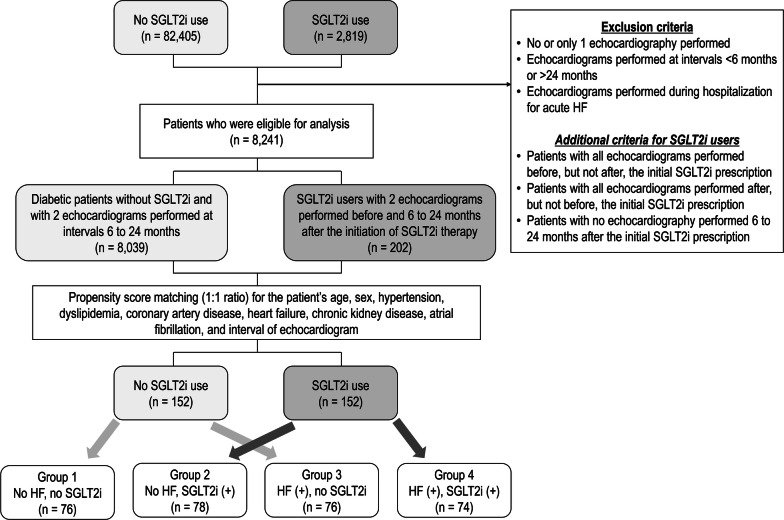
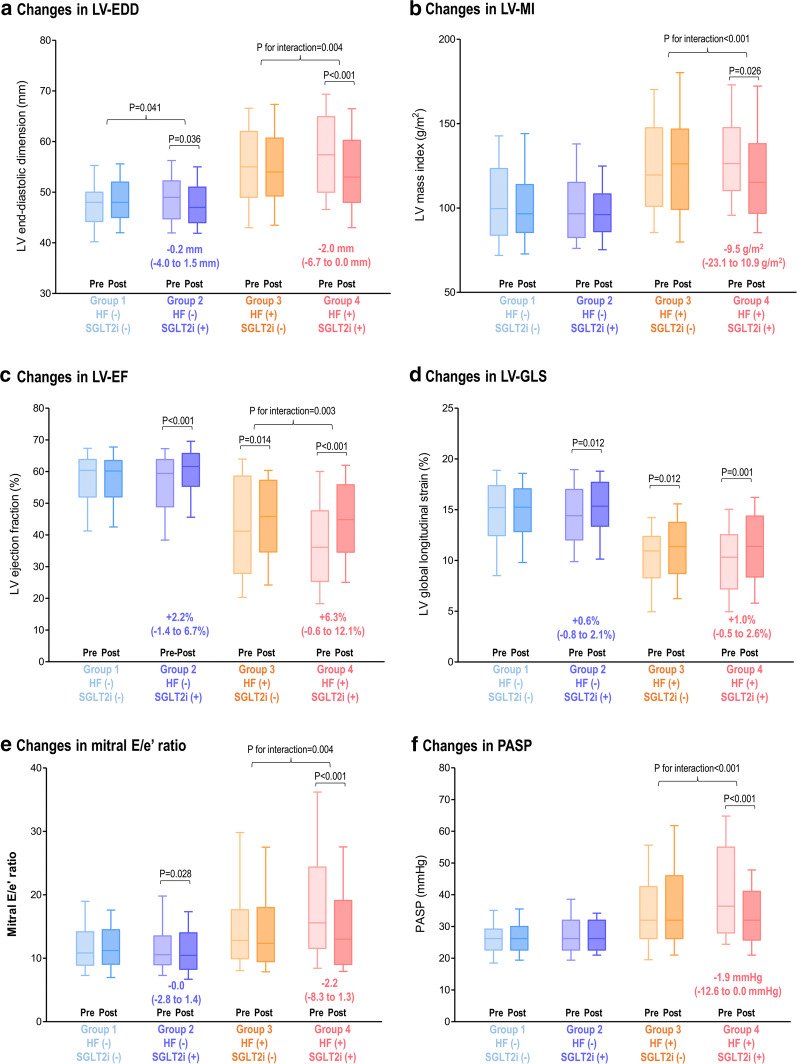
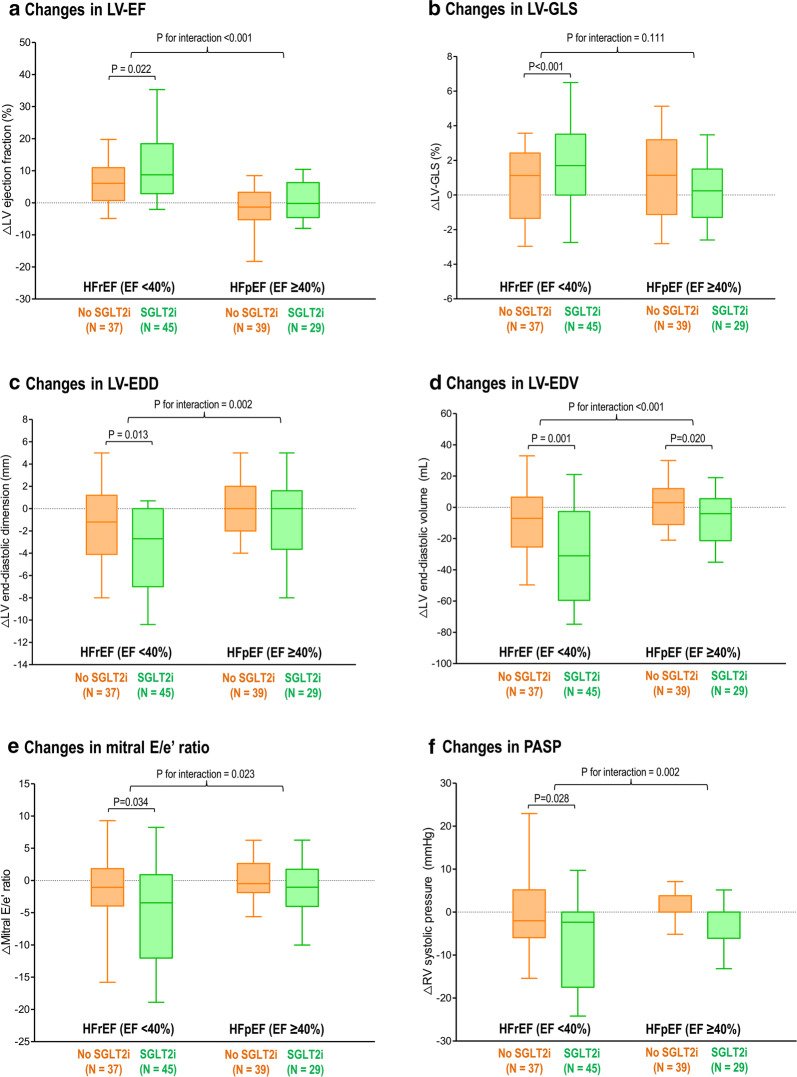
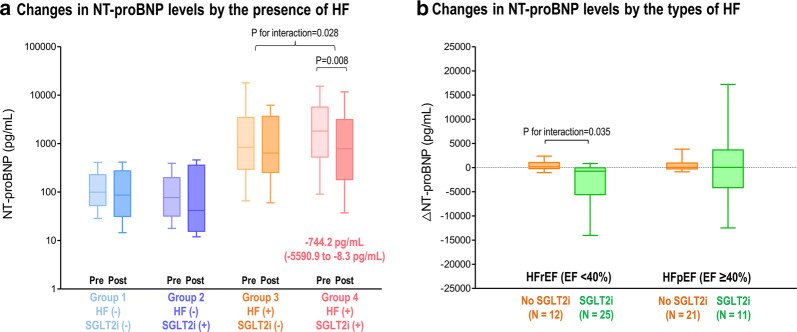
그림 출처: PubMed Central 공개 논문 (PMC7254690)
Conflict of interest statement
The authors declare that they have no competing interests.
그 밖의 정보
- 출판 형태
- Comparative Study, Journal Article
- 저널
- Cardiovascular diabetology · eISSN 1475-2840
- 전자 출판
- 2020-05-28
- MeSH
- Aged · Diabetes Mellitus, Type 2 / blood / diagnosis / drug therapy · Female · Heart Failure / diagnostic imaging / drug therapy / physiopathology · Humans · Male · Middle Aged · Recovery of Function · Retrospective Studies · Sodium-Glucose Transporter 2 Inhibitors / adverse effects / therapeutic use · Stroke Volume / drug effects · Time Factors · Treatment Outcome · Ventricular Function, Left / drug effects
- Substances
- Sodium-Glucose Transporter 2 Inhibitors
- 참고문헌
- 37편