
PLoS One. 2024;19(1):e0294362.
In-hospital real-time prediction of COVID-19 severity regardless of disease phase using electronic health records.
제1저자 박형준 · 교신저자 박형준
소속 (7)
- Division of pulmonology and Critical Care Medicine, Department of Internal Medicine, Gumdan top hospital, Incheon, South Korea.
- Division of Pulmonology and Critical Care Medicine, Department of Internal Medicine, Asan Medical Center, University of Ulsan College of Medicine, Seoul, South Korea.
- Division of Oncology, Department of Internal Medicine, University of Ulsan College of Medicine, Asan Medical Center, Seoul, South Korea.
- Department of Anesthesiology and Pain Medicine, Asan Medical Center, Ulsan College of Medicine, Seoul, South Korea.
- Department of Internal Medicine, Seoul National University College of Medicine, Seoul, South Korea.
- Division of Gastroenterology, Department of Internal Medicine, Seoul Metropolitan Government Seoul National University Boramae Medical Center, Seoul, South Korea.
- Division of Pulmonary and Critical Care Medicine, Department of Internal Medicine, Seoul Metropolitan Government Seoul National University Boramae Medical Center, Seoul, South Korea.
Abstract
Coronavirus disease 2019 (COVID-19) has strained healthcare systems worldwide. Predicting COVID-19 severity could optimize resource allocation, like oxygen devices and intensive care. If machine learning model could forecast the severity of COVID-19 patients, hospital resource allocation would be more comfortable. This study evaluated machine learning models using electronic records from 3,996 COVID-19 patients to forecast mild, moderate, or severe disease up to 2 days in advance. A deep neural network (DNN) model achieved 91.8% accuracy, 0.96 AUROC, and 0.90 AUPRC for 2-day predictions, regardless of disease phase. Tree-based models like random forest achieved slightly better metrics (random forest: 94.1% of accuracy, 0.98 AUROC, 0.95 AUPRC; Gradient boost: 94.1% of accuracy, 0.98 AUROC, 0.94 AUPRC), prioritizing treatment factors like steroid use. However, the DNN relied more on fixed patient factors like demographics and symptoms in aspect to SHAP value importance. Since treatment patterns vary between hospitals, the DNN may be more generalizable than tree-based models (random forest, gradient boost model). The results demonstrate accurate short-term forecasting of COVID-19 severity using routine clinical data. DNN models may balance predictive performance and generalizability better than other methods. Severity predictions by machine learning model could facilitate resource planning, like ICU arrangement and oxygen devices.
Copyright: © 2024 Park et al. This is an open access article distributed under the terms of the Creative Commons Attribution License, which permits unrestricted use, distribution, and reproduction in any medium, provided the original author and source are credited.
Figures
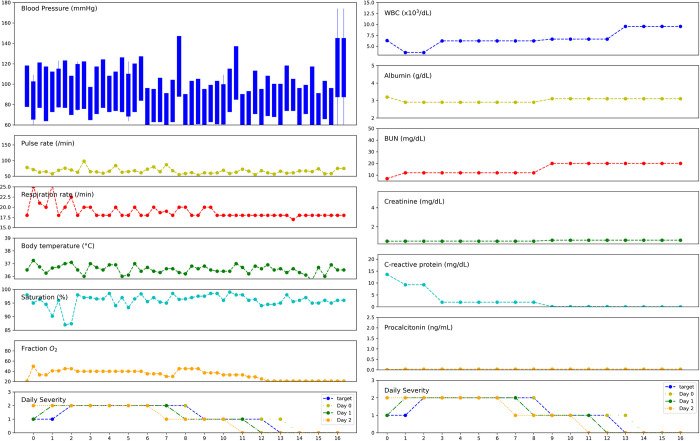
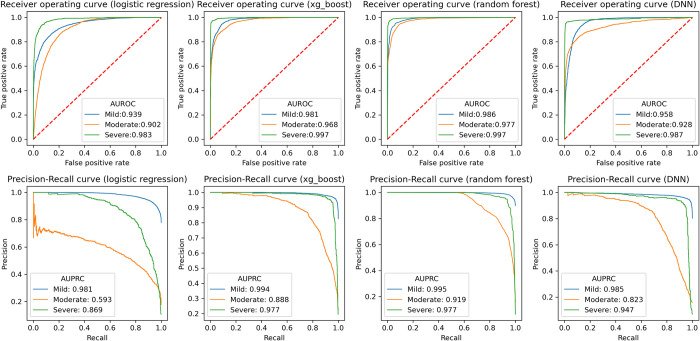
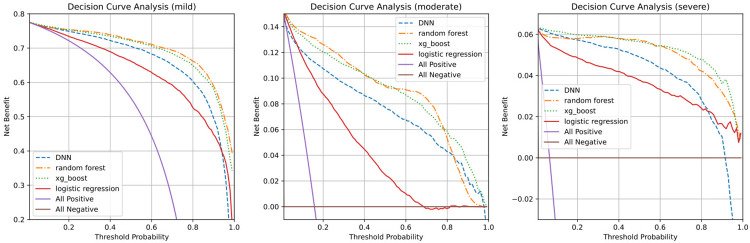
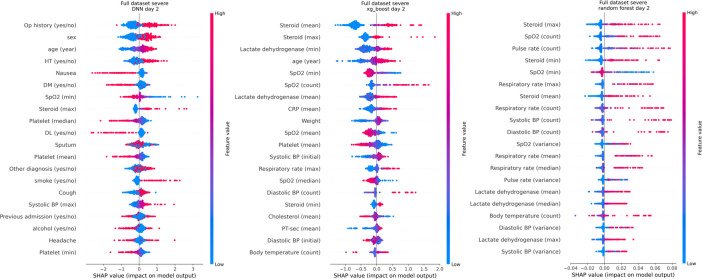
그림 출처: PubMed Central 공개 논문 (PMC10810421)
Conflict of interest statement
The authors have declared that no competing interests exist.
그 밖의 정보
- 출판 형태
- Journal Article, Research Support, Non-U.S. Gov't
- 저널
- PloS one · eISSN 1932-6203
- 전자 출판
- 2024-01-25
- MeSH
- Humans · Electronic Health Records* · COVID-19* / diagnosis / epidemiology · Benchmarking · Hospitals · Oxygen
- Substances
- Oxygen
- 참고문헌
- 31편