
BMC Nephrol. 2018;19(1):203.
The association between socioeconomic disparities and left ventricular hypertrophy in chronic kidney disease: results from the KoreaN Cohort Study for Outcomes in Patients With Chronic Kidney Disease (KNOW-CKD).
제1저자 강은정 · 교신저자 오국환
소속 (11)
- Department of Internal Medicine, Seoul National University College of Medicine, Seoul, Korea.
- School of Medicine, Inha University, Incheon, Korea.
- Department of Prevention and Management, Inha University Hospital, Incheon, Korea.
- Department of Internal Medicine, Dongguk University Gyeongju Hospital, Gyeongju, Korea.
- Department of Internal Medicine, Pusan National University Hospital, Pusan, Korea.
- Department of Internal Medicine, Chonnam National University Medical School, Gwangju, Korea.
- Division of Nephrology, Kangbuk Samsung Hospital, Sungkyunkwan University School of Medicine, Seoul, Korea.
- Department of Internal Medicine, Nowon Eulji Medical Center, Eulji University, Seoul, Korea.
- Department of Internal Medicine, Yonsei University College of Medicine, Seoul, Korea.
- Department of Internal Medicine, Gachon University Gil Medical Center, Gachon University School of Medicine, Incheon, Korea.
- Department of Internal Medicine, Seoul National University College of Medicine, Seoul, Korea. khoh@snu.ac.kr.
Abstract
BACKGROUND Left ventricular hypertrophy (LVH) is one of the risk factors for cardiovascular (CV) disease and mortality. However, the relationship between socioeconomic status (SES) and LVH in chronic kidney disease remains unclear.
METHODS Data were collected from the KoreaN Cohort Study for Outcome in Patients With Chronic Kidney Disease (KNOW-CKD, NCT01630486 at http://www.clinicaltrials.gov ). Subjects with CKD and aged ≥50 were included. SES was characterized based on monthly income and educational attainment, each of which was divided into three strata. LVH was defined as LV mass/height2.7 ≥ 47 g/m2.7 in female and ≥ 50 g/m2.7 in male. Age, sex, diabetes, CKD stage, body mass index, blood pressure and physical activity were included as covariates.
RESULTS A total of 1361 patients were included. Mean age was 60.9 ± 6.9 years, and 63.2% were men. Higher education level was associated with higher monthly income (P for trend < 0.001). The lowest education level was independently associated with LVH (lower than high school, adjusted odds ratio [OR] 1.485, 95% CI 1.069-2.063, P = 0.018; completed high school, adjusted OR 1.150, 95% confidence interval [CI] 0.834-1.584, P = 0.394; highest education level as the reference). Monthly income level was marginally associated with LVH after adjusting for covariates ($1500-4500, adjusted OR 1.230, 95% CI 0.866-1.748, P = 0.247; < $1500, adjusted OR 1.471, 95% CI 1.002-2.158, P = 0.049; > $4500; reference).
CONCLUSIONS In the CKD population, lower SES, defined by educational attainment and low income level exhibited a significant association with LVH, respectively. Longitudinal follow-up will reveal whether lower SES is associated with poor CKD outcomes.
Keywords
Chronic kidney diseaseEducationIncomeLeft ventricular hypertrophySocioeconomic status
Figures
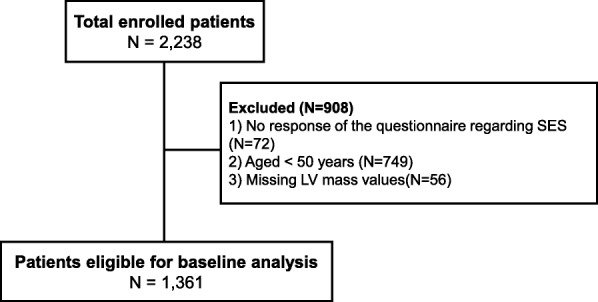
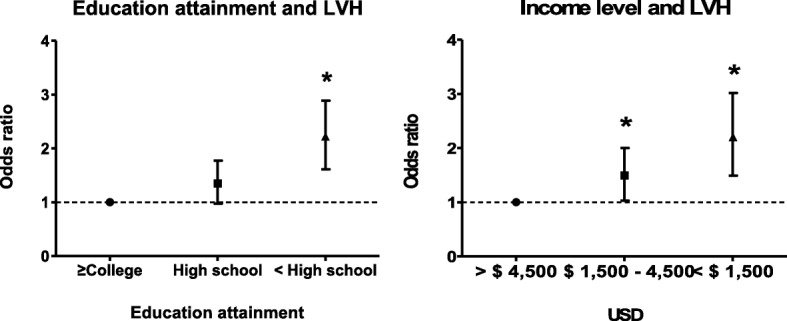
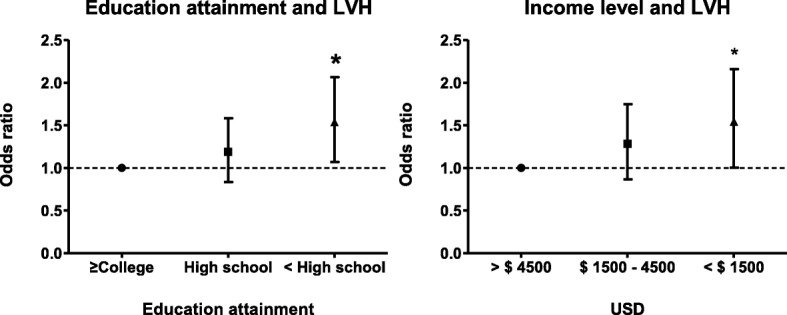
그림 출처: PubMed Central 공개 논문 (PMC6097450)
Comment · 정정
Conflict of interest statement
ETHICS APPROVAL AND CONSENT TO PARTICIPATE: Ethics approval obtained from the Institutional Review Board at each participating clinical center — i.e., Seoul National University Hospital (1104–089-359), Seoul National University Bundang Hospital (B-1106/129–008), Yonsei University Severance Hospital (4–2011-0163), Kangbuk Samsung Medical Center (2011–01-076), Seoul St. Mary’s Hospital (KC11OIMI0441), Gil Hospital (GIRBA2553), Eulji General Hospital (201105–01), Chonnam National University Hospital (CNUH-2011-092), and Pusan Paik Hospital (11–091) in 2011. Written informed consent was obtained from the participants. CONSENT FOR PUBLICATION: Not applicable. COMPETING INTERESTS: The authors declare that they have no competing interests. PUBLISHER’S NOTE: Springer Nature remains neutral with regard to jurisdictional claims in published maps and institutional affiliations.
그 밖의 정보
- 출판 형태
- Journal Article, Multicenter Study, Research Support, Non-U.S. Gov't
- 저널
- BMC nephrology · eISSN 1471-2369
- 전자 출판
- 2018-08-16
- MeSH
- Aged · Cohort Studies · Female · Healthcare Disparities / economics · Humans · Hypertrophy, Left Ventricular / diagnosis / economics / epidemiology · Male · Middle Aged · Prospective Studies · Renal Insufficiency, Chronic / diagnosis / economics / epidemiology · Republic of Korea / epidemiology · Social Class* · Treatment Outcome
- 데이터
- ClinicalTrials.gov: NCT01630486
- 참고문헌
- 51편