
PLoS One. 2023;18(6):e0280586.
Efficacy, safety and clinical outcome associated with statin use for primary prevention in Korean patients with low-density lipoprotein cholesterol level ≥ 190 mg/dL: A retrospective cohort study.
제1저자 김학령 · 교신저자 김상현
소속 (1)
- Division of Cardiology, Department of Internal Medicine, Boramae Medical Center, Seoul National University College of Medicine, Seoul, Korea.
Abstract
BACKGROUND Although the current guideline recommends the use of high-intensity statin to reduce the low-density lipoprotein cholesterol (LDL-C) level by 50% in patients with baseline value of ≥ 190 mg/dL, direct application of this recommendation to Asian populations is still questionable. This study was performed to investigate the statin response of LDL-C in Korean patients with LDL-C ≥ 190 mg/dL.
METHODS A total of 1,075 Korean patients (age 60.7 ± 12.2 years, women 68%) with baseline LDL-C ≥ 190 mg/dL without cardiovascular disease was retrospectively reviewed. Lipid profiles at 6 months, side effects and clinical outcomes during the follow-up period after statin treatment were assessed according to statin intensity.
RESULTS Most of the patients (76.3%) were treated with moderate-intensity statins, 11.4% with high-intensity statins, and 12.3% with a statin + ezetimibe. The reductions in LDL-C percentage at 6 months were 48.0%, 56.0% and 53.3% in patients treated with moderate-intensity statins, high-intensity statins and statin + ezetimibe, respectively (P < 0.001). Side effects requiring dose reduction, medication switch or drug interruption were observed in 1.3%, 4.9% and 2.3% of patients treated with moderate-intensity statin, high-intensity statin and statin + ezetimibe, respectively (P = 0.024). During the median follow-duration of 815 days (interquartile range, 408-1,361 days), the incidences of cardiovascular events were not different among the 3 groups (log-rank P = 0.823).
CONCLUSIONS Compared to high-intensity statin, moderate-intensity statin was effective enough in reaching target goal of LDL-C without increase in cardiovascular risk and with fewer side effects in Korean patients with LDL-C ≥ 190 mg/dL.
Copyright: © 2023 Kim et al. This is an open access article distributed under the terms of the Creative Commons Attribution License, which permits unrestricted use, distribution, and reproduction in any medium, provided the original author and source are credited.
Figures

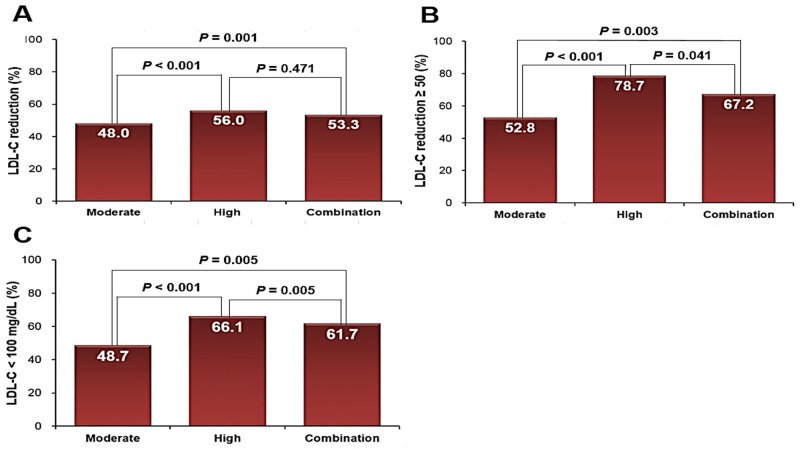


그림 출처: PubMed Central 공개 논문 (PMC10259785)
Conflict of interest statement
The authors have declared that no competing interests exist.
그 밖의 정보
- 출판 형태
- Journal Article
- 저널
- PloS one · eISSN 1932-6203
- 전자 출판
- 2023-06-12
- MeSH
- Humans · Female · Middle Aged · Aged · Hydroxymethylglutaryl-CoA Reductase Inhibitors* · Retrospective Studies · Cholesterol, LDL · Drug-Related Side Effects and Adverse Reactions* · Ezetimibe · Primary Prevention · Republic of Korea
- Substances
- Hydroxymethylglutaryl-CoA Reductase Inhibitors · Cholesterol, LDL · Ezetimibe
- 참고문헌
- 24편