
BMC Nephrol. 2017;18(1):104.
Factors affecting the long-term outcomes of idiopathic membranous nephropathy.
제1저자 허혁 · 교신저자 임춘수
소속 (6)
- Department of Internal Medicine, Seoul National University Hospital, Seoul, Republic of Korea.
- Department of Internal Medicine, Seoul National University Boramae Medical Center, 20 Boramae-ro 5-gil, Dongjak-gu, Seoul, 07061, Republic of Korea.
- Department of Internal Medicine, Seoul National University College of Medicine, Seoul, Republic of Korea.
- Department of Biostatistics, Seoul National University Boramae Medical Center, Seoul, Republic of Korea.
- Department of Internal Medicine, Seoul National University Boramae Medical Center, 20 Boramae-ro 5-gil, Dongjak-gu, Seoul, 07061, Republic of Korea. cslimjy@snu.ac.kr.
- Department of Internal Medicine, Seoul National University College of Medicine, Seoul, Republic of Korea. cslimjy@snu.ac.kr.
Abstract
BACKGROUND We attempted to describe the clinical features and determine the factors associated with renal survival in idiopathic membranous nephropathy (iMN) patients with nephrotic syndrome (NS) and to determine the factors associated with spontaneous complete remission (sCR) and progression to NS in iMN patients with subnephrotic proteinuria.
METHODS This retrospective study involved 166 iMN patients with NS and 65 patients with subnephrotic proteinuria. The primary end point was a doubling of serum creatinine or initiation of dialysis. In patients with subnephrotic proteinuria, we determined the factors associated with sCR and factors associated with progression to NS.
RESULTS Remission of NS was achieved in 125 out of 166 patients (75.3%). Of those who reached remission, 26 patients (20.8%) experienced relapse that was followed by second remission. The relapse or persistence of proteinuria was associated with the primary end points (hazard ratio [HR] = 12.40, P = 0.037, HR = 173, P < 0.001, respectively). In patients with subnephrotic proteinuria, sCR occurred in 35.4% of the patients. The patients with sCR had lower proteinuria and serum creatinine levels and higher serum albumin concentrations at baseline. The serum albumin level at diagnosis was a prognostic factor for progression to NS (Odds ratio [OR] = 0.015, P < 0.001).
CONCLUSIONS The occurrence of relapse or persistence of proteinuria had negative effects on renal survival in iMN patients with NS, and low serum albumin levels at baseline were associated with non-achievement of sCR and progression to NS.
Keywords
Idiopathic membranous nephropathyNephrotic syndromePrognosisProteinuriaRenal survival
Figures
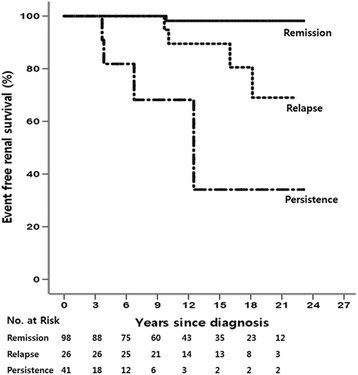
그림 출처: PubMed Central 공개 논문 (PMC5369217)
그 밖의 정보
- 출판 형태
- Journal Article
- 저널
- BMC nephrology · eISSN 1471-2369
- 전자 출판
- 2017-03-27
- MeSH
- Adrenergic beta-Antagonists / therapeutic use · Adult · Aged · Angiotensin Receptor Antagonists / therapeutic use · Angiotensin-Converting Enzyme Inhibitors / therapeutic use · Antihypertensive Agents / therapeutic use · Calcium Channel Blockers / therapeutic use · Conservative Treatment · Creatinine / metabolism · Disease Progression · Female · Glomerular Filtration Rate · Glomerulonephritis, Membranous / complications / metabolism / therapy · Humans · Hydroxymethylglutaryl-CoA Reductase Inhibitors / therapeutic use · Male · Middle Aged · Nephrotic Syndrome / etiology / metabolism / therapy · Prognosis · Proportional Hazards Models · Proteinuria / etiology / metabolism / therapy · Recurrence · Remission, Spontaneous · Renal Dialysis / statistics & numerical data · Retrospective Studies · Risk Factors · Serum Albumin / metabolism
- Substances
- Adrenergic beta-Antagonists · Angiotensin Receptor Antagonists · Angiotensin-Converting Enzyme Inhibitors · Antihypertensive Agents · Calcium Channel Blockers · Hydroxymethylglutaryl-CoA Reductase Inhibitors · Serum Albumin · Creatinine
- 참고문헌
- 25편