
Respir Res. 2017;18(1):107.
Which bronchodilator reversibility criteria can predict severe acute exacerbation in chronic obstructive pulmonary disease patients?
제1저자 김정현 · 교신저자 이창훈
소속 (14)
- Division of Pulmonary and Critical Care Medicine, Department of Internal Medicine, National Medical Center, Seoul, Republic of Korea.
- Department of Internal Medicine and Environmental Health Center, Kangwon National University Hospital, Chuncheon, Republic of Korea.
- Division of Pulmonary and Critical Care Medicine, Department of Internal Medicine, Seoul National University Hospital, 101 Daehak-Ro, Jongno-Gu, Seoul, 03080, Republic of Korea. kauri670@empal.com.
- Department of Internal Medicine, The Catholic University of Korea, St. Paul's Hospital, Seoul, Republic of Korea.
- Division of Pulmonary, Allergy & Critical Care Medicine, Hallym University Chuncheon Sacred Heart Hospital, Chuncheon, Republic of Korea.
- Division of Pulmonology and Allergy, Regional Center for Respiratory Disease, Yeungnam University Medical Center, Daegu, Republic of Korea.
- Division of Pulmonary and Critical Care Medicine, Department of Internal Medicine, Konkuk University Medical Center, Konkuk University School of Medicine, Seoul, Korea.
- Division of Respiratory and Critical Care Medicine, Department of Internal Medicine, CHA Bundang Medical Center, CHA University, Seongnam, Republic of Korea.
- Division of Pulmonary and Critical Care Medicine, Department of Medicine, Kangbuk Samsung Hospital, Sungkyunkwan University School of Medicine, Seoul, Republic of Korea.
- Department of Pulmonary Medicine, Soonchunhyang University Cheonan Hospital, Cheonan-si, Republic of Korea.
- Department of Medicine, Soonchunhyang University Gumi's Hospital, Gumi, North Kyungsang Province, Republic of Korea.
- Division of Pulmonary and Critical Care Medicine, Department of Internal Medicine, Seoul National University Hospital, 101 Daehak-Ro, Jongno-Gu, Seoul, 03080, Republic of Korea.
- Division of Pulmonary Medicine, Department of Internal Medicine, Hallym University Sacred Heart Hospital, Hallym University Medical School, Anyang, Republic of Korea.
- Division of Pulmonary and Critical Care Medicine, Department of Internal Medicine, Asan Medical Center, University of Ulsan College of Medicine, Seoul, Republic of Korea.
Abstract
BACKGROUND It is unclear whether various bronchodilator reversibility (BDR) criteria affect the prognosis of chronic obstructive pulmonary disease (COPD). The aim of this study is to evaluate the impact of positive BDR defined according to various BDR criteria on the risk of severe acute exacerbation (AE) in COPD patients.
METHODS Patients from four prospective COPD cohorts in South Korea who underwent follow-up for at least 1 year were enrolled in this study. The assessed BDR criteria included the Global Initiative for Chronic Obstructive Lung Disease (GOLD), American Thoracic Society (ATS), American College of Chest Physicians, (ACCP), major criteria of the Spanish definition of asthma-COPD overlap syndrome (ACOS), criteria compatible with ACOS in the Global Initiative for Asthma (GINA), and European Respiratory Society (ERS). The rate of patients with severe AE who required hospitalization within 1 year due to BDR results according to each set of criteria was analyzed using logistic regression models.
RESULTS Among a total of 854 patients, the BDR-positive cases varied according to the criteria used. There was a 3.5% positive BDR rate according to GINA and a 29.9% rate according to the ATS criteria. Positive BDR according to the GOLD criteria was significantly associated with a decreased risk of severe AE (adjusted odds ratio (aOR) = 0.38; 95% Confidence interval (CI) = 0.15-0.93). This result remained statistically significant even in a sensitivity analysis that included only participants with a smoking history of at least 10 pack-years and in the analysis for the propensity score-matched participants.
CONCLUSIONS Among different criteria for positive BDR, the use of the GOLD ones was significantly associated with a decreased risk of severe AE in COPD patients. Increase use of ICS/LABA may have affected this relationship.
Keywords
Bronchodilator reversibilityCOPDSevere acute exacerbation
Figures
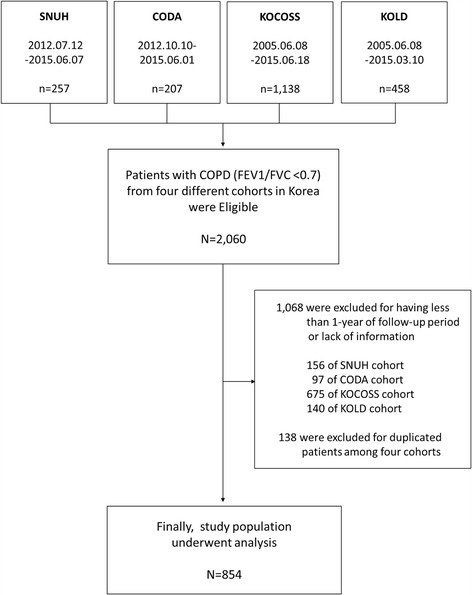
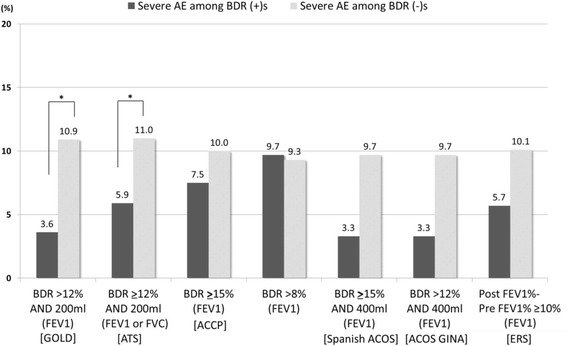
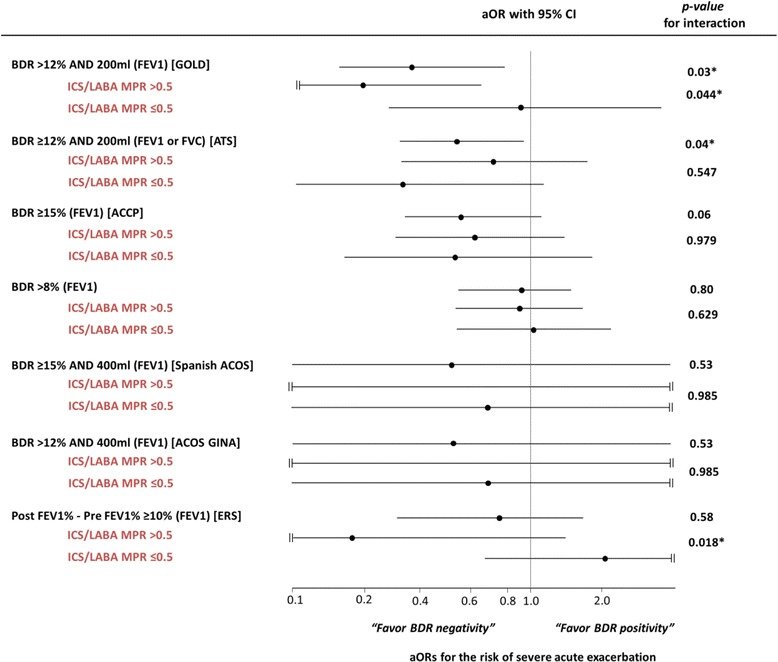
그림 출처: PubMed Central 공개 논문 (PMC5450062)
그 밖의 정보
- 출판 형태
- Journal Article, Multicenter Study
- 저널
- Respiratory research · eISSN 1465-993X
- 전자 출판
- 2017-05-30
- MeSH
- Aged · Bronchodilator Agents / therapeutic use · Chi-Square Distribution · Disease Progression · Female · Forced Expiratory Volume · Hospitalization · Humans · Logistic Models · Lung / drug effects / physiopathology · Male · Middle Aged · Multivariate Analysis · Odds Ratio · Propensity Score · Prospective Studies · Pulmonary Disease, Chronic Obstructive / diagnosis / drug therapy / physiopathology · Registries · Republic of Korea · Risk Factors · Severity of Illness Index · Smoking / adverse effects · Time Factors · Treatment Outcome · Vital Capacity
- Substances
- Bronchodilator Agents
- 참고문헌
- 28편