
Trials. 2017;18(1):501.
Long-term Effects of high-doSe pitavaStatin on Diabetogenicity in comparison with atorvastatin in patients with Metabolic syndrome (LESS-DM): study protocol for a randomized controlled trial.
제1저자 박준빈 · 교신저자 김형관
소속 (7)
- Division of Cardiology, Seoul National University College of Medicine, Seoul, South Korea.
- Cardiovascular Center, Seoul National University Hospital, 101 Daehak-ro, Jongro-gu, Seoul, 110-744, South Korea.
- Cardiovascular Center, Seoul National University Bundang Hospital, Seongnam, South Korea.
- Cardiovascular Center, SNU-SMG Boramae Medical Center, Seoul, South Korea.
- Division of Cardiology, Seoul National University College of Medicine, Seoul, South Korea. hkkim73@snu.ac.kr.
- Cardiovascular Center, Seoul National University Hospital, 101 Daehak-ro, Jongro-gu, Seoul, 110-744, South Korea. hkkim73@snu.ac.kr.
- Department of Internal Medicine, Seoul National University College of Medicine, 101 Daehak-ro, Jongno-gu, Seoul, 03080, South Korea. hkkim73@snu.ac.kr.
Abstract
BACKGROUND The diabetogenic action of statins remains a concern, particularly in patients at high risk for diabetes receiving intensive statin therapy. Despite the risk of diabetes with statin use being considered a potential class effect, recent studies have suggested that pitavastatin exerts neutral or favorable effects on diabetogenicity. However, no randomized trial has compared the long-term effects of pitavastatin with those of other statins on glycemic control in populations at high risk for diabetes. Hence, we aim to assess the long-term effects of pitavastatin in comparison with atorvastatin on glucose metabolism in patients with metabolic syndrome (MetS).
METHODS/DESIGN The Long-term Effects of high-doSe pitavaStatin on Diabetogenicity in comparison with atorvastatin in patients with Metabolic syndrome (LESS-DM) trial is a prospective, randomized, open-label, active control clinical trial of patients with MetS. We plan to randomize 500 patients with MetS (1:1) to receive high-dose pitavastatin (4 mg) or atorvastatin (20 mg) daily for 24 months. The primary endpoint will be the change in hemoglobin A1c after statin treatment. Secondary endpoints will include the following: (1) changes in biochemical markers, including insulin, C-peptide, homeostasis model assessment of insulin resistance and insulin secretion, and adiponectin; (2) changes in imaging parameters, including carotid elasticity metrics and indices of cardiac function; and (3) the incidence of clinical events, including new-onset diabetes and cardiovascular disease.
DISCUSSION In this trial, we will explore whether pitavastatin 4 mg does not disturb glucose metabolism in patients with MetS. It will also provide mechanistic information on statin type-dependent diabetogenic effects and surrogate data regarding vascular and cardiac changes achieved by intensive statin therapy.
TRIAL REGISTRATION ClinicalTrials.gov, NCT02940366 . Registered on 19 October 2016.
Keywords
AdiponectinCardiac functionCarotid elasticityGlucose metabolismMetabolic syndromeStatin
Figures
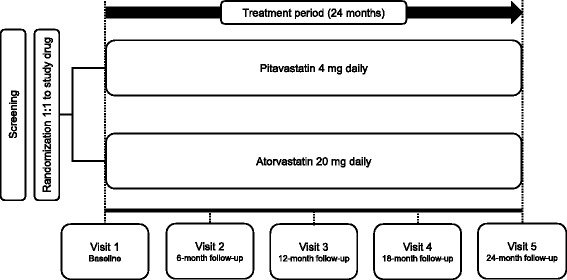
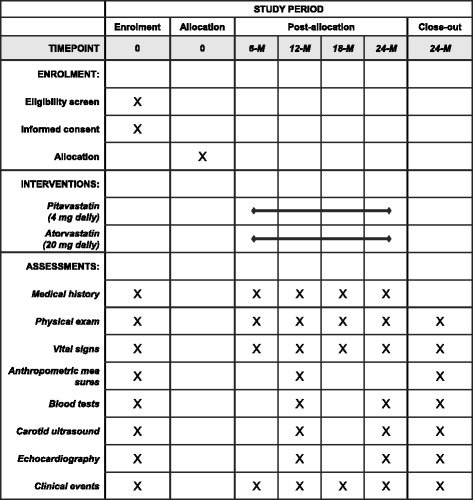
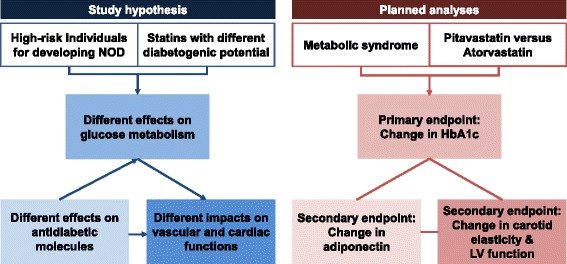
그림 출처: PubMed Central 공개 논문 (PMC5659042)
Conflict of interest statement
ETHICS APPROVAL AND CONSENT TO PARTICIPATE: The protocol of this prospective study was approved by the institutional review board of Seoul National University Hospital (1406-027-584). This study will be conducted in accordance with the Declaration of Helsinki and the International Conference on Harmonization good clinical practice guidelines. All participants will need to sign a written informed consent form explaining the details of this study. This form also states that participation is voluntary and that the patients can withdraw from participation at any point without any adverse consequence or disadvantage. CONSENT FOR PUBLICATION: Not applicable. COMPETING INTERESTS: The authors declare that they have no competing interests. PUBLISHER’S NOTE: Springer Nature remains neutral with regard to jurisdictional claims in published maps and institutional affiliations.
그 밖의 정보
- 출판 형태
- Comparative Study, Journal Article, Multicenter Study, Randomized Controlled Trial
- 저널
- Trials · eISSN 1745-6215
- 전자 출판
- 2017-10-27
- MeSH
- Atorvastatin / administration & dosage / adverse effects · Biomarkers / blood · Blood Glucose / drug effects / metabolism · C-Peptide / blood · Cardiovascular Diseases / blood / diagnosis / prevention & control · Clinical Protocols · Diabetes Mellitus / blood / chemically induced / diagnosis · Glycated Hemoglobin / metabolism · Humans · Hydroxymethylglutaryl-CoA Reductase Inhibitors / administration & dosage / adverse effects · Insulin / blood · Metabolic Syndrome / blood / diagnosis / drug therapy · Prospective Studies · Quinolines / administration & dosage / adverse effects · Republic of Korea · Research Design · Risk Factors · Time Factors · Treatment Outcome
- Substances
- Atorvastatin · Biomarkers · Blood Glucose · C-Peptide · Glycated Hemoglobin · Hydroxymethylglutaryl-CoA Reductase Inhibitors · Insulin · Quinolines · hemoglobin A1c protein, human · pitavastatin
- 데이터
- ClinicalTrials.gov: NCT02940366
- 참고문헌
- 58편