
BMC Palliat Care. 2019;18(1):93.
Identification of a potentially avoidable cardiopulmonary resuscitation in hematology and oncology wards.
제1저자 최연주 · 교신저자 김진원
소속 (5)
- Division of Hematology and Medical Oncology, Department of Internal Medicine, Seoul National University Bundang Hospital, Seoul National University College of Medicine, 82 Gumi-ro 173 beon-gil, Bundang-gu, Seongnam, 13620, Republic of Korea.
- Division of Hematology and Medical Oncology, Department of Internal Medicine, Seoul National University Hospital, Seoul National University College of Medicine, Seoul, Republic of Korea.
- Present Address: Department of Investigational Cancer Therapeutics, The MD Anderson Cancer Center, Houston, TX, USA.
- Division of Hematology and Medical Oncology, Department of Internal Medicine, Seoul National University Bundang Hospital, Seoul National University College of Medicine, 82 Gumi-ro 173 beon-gil, Bundang-gu, Seongnam, 13620, Republic of Korea. jwkim@snubh.org.
- Present Address: CHA Bundang Medical Center, CHA University, Seongnam, Republic of Korea.
Abstract
BACKGROUND In-hospital cardiopulmonary resuscitation (CPR) is one of undesirable situations. We tried to identify and characterize a potentially avoidable CPR in cancer patients who were hospitalized in hematology and oncology wards.
METHODS A potentially avoidable CPR was determined based on chemotherapy setting, disease status and clinical situation at the time when a cardiopulmonary arrest occurred, by using a consensus-driven medical records review of two physicians.
RESULTS One hundred thirty-seven patients among 12,437 patients hospitalized at hematology and oncology wards between March 2003 and June 2015 (1.1%) underwent a CPR. Eighty-eight patients (64.2%) were men. The majority of patients with a CPR had lung cancer (41, 29.9%), hematologic malignancy (24, 17.5%), stomach cancer (23, 16.8%) or lymphoma (20, 14.6%). A potentially avoidable CPR was identified in 51 patients (37.2%). In a multivariate analysis, advanced diseases and certain tumor types (e.g., lung cancer, lymphoma) were significant risk factors for a potentially avoidable CPR. Of patients who received a potentially avoidable CPR, 29 patients (56.9%) did not have a do-not-resuscitate documentation. A first return of spontaneous circulation rate (ROSC) and in-hospital survival rate (IHSR) were much lower in patients with a potentially avoidable CPR than those with a CPR that was not avoidable (ROSC: 39.2% vs 53.5%, P = 0.106; IHSR: 2.0% vs 12.8%, P = 0.032, respectively).
CONCLUSIONS A potentially avoidable CPR was common at hematology and oncology wards. A potentially avoidable CPR frequently occurred in advanced diseases and certain tumor types. Furthermore, cancer patients who received a potentially avoidable CPR showed the worse prognosis.
Keywords
CancerCardiopulmonary arrestPotentially avoidablePrognosisResuscitation
Figures
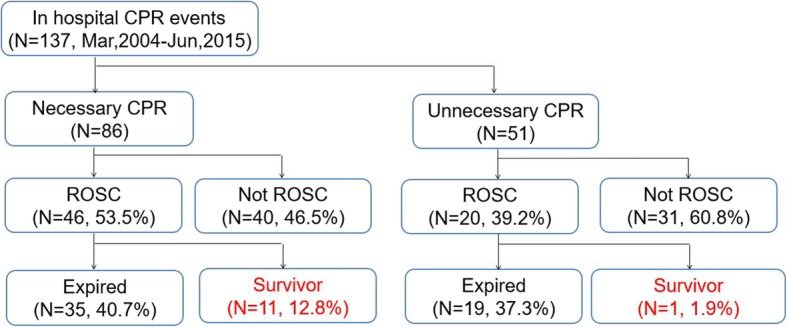
그림 출처: PubMed Central 공개 논문 (PMC6829942)
Conflict of interest statement
The authors declare that they have no competing interest.
그 밖의 정보
- 출판 형태
- Journal Article
- 저널
- BMC palliative care · eISSN 1472-684X
- 전자 출판
- 2019-11-04
- MeSH
- Aged · Aged, 80 and over · Cardiopulmonary Resuscitation / statistics & numerical data · Female · Health Status · Heart Arrest / etiology / therapy · Hematologic Neoplasms / complications · Hospice Care · Hospital Mortality · Hospitals / statistics & numerical data · Humans · Male · Middle Aged · Neoplasms / complications · Republic of Korea · Resuscitation Orders · Risk Factors · Sex Factors
- 참고문헌
- 19편