
BMC Infect Dis. 2018;18(1):178.
Effect of an intervention targeting inappropriate continued empirical parenteral vancomycin use: a quasi-experimental study in a region of high MRSA prevalence.
제1저자 최평균, 구혜림 · 교신저자 김남중
소속 (5)
- Department of Internal Medicine, Seoul National University College of Medicine, 103 Daehak-ro Jongno-gu, Seoul, 03080, Republic of Korea.
- Infection Control Office, Seoul National University Hospital, Seoul, Republic of Korea.
- Present address: Department of Internal Medicine, Chonbuk National University Medical School, Jeonju, Republic of Korea.
- Department of Internal Medicine, Seoul National University College of Medicine, 103 Daehak-ro Jongno-gu, Seoul, 03080, Republic of Korea. molder@unitel.co.kr.
- Infection Control Office, Seoul National University Hospital, Seoul, Republic of Korea. molder@unitel.co.kr.
Abstract
BACKGROUND Despite vancomycin use is a major risk factor for the emergence of vancomycin resistance, it is frequently inappropriately prescribed, especially as empirical treatment. We evaluated the effect of an antimicrobial stewardship intervention targeting for inappropriate continued empirical vancomycin use.
METHODS This was a quasi-experimental study comparing vancomycin use in a 6-month pre-intervention and 6-month intervention period. If empirical vancomycin was continued for more than 96 h without documentation of beta-lactam-resistant gram-positive microorganisms, it was considered inappropriate continued empirical vancomycin use. The intervention consisted of the monitoring of appropriateness by a pharmacist and direct discussion with the prescribing physicians by infectious disease specialists when empirical vancomycin was continued inappropriately. An interrupted time series analysis was used to compare vancomycin use before and during the intervention.
RESULTS Following implementation of the intervention, overall vancomycin consumption decreased by 14.6%, from 37.6 defined daily doses (DDDs)/1000 patient-days in the pre-intervention period to 32.1 DDDs/1000 patient-days in the intervention period (P < 0.001). The inappropriate consumption of vancomycin also declined from 8.0 DDDs/1000 patient-days to 5.8 DDDs/1000 patient-days (P = 0.009).
CONCLUSION Interventions such as direct communication with prescribing physicians and infectious disease clinicians can help reduce the inappropriate continued use of vancomycin.
Keywords
Antimicrobial stewardshipInappropriate useInfectious disease specialistInterventionPharmacistVancomycin
Figures
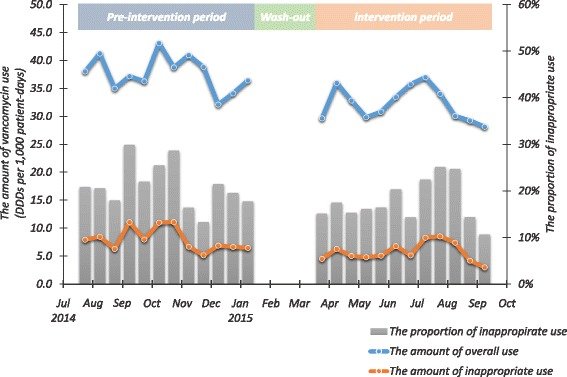
그림 출처: PubMed Central 공개 논문 (PMC5902846)
Conflict of interest statement
ETHICS APPROVAL AND CONSENT TO PARTICIPATE: The institutional review board of Seoul National University Hospital reviewed the study protocol and provided study approval. It waived the requirement for written consent (IRB registration number 1407–043-593). COMPETING INTERESTS: The authors declare that they have no competing interest. PUBLISHER’S NOTE: Springer Nature remains neutral with regard to jurisdictional claims in published maps and institutional affiliations.
그 밖의 정보
- 출판 형태
- Journal Article, Research Support, Non-U.S. Gov't
- 저널
- BMC infectious diseases · eISSN 1471-2334
- 전자 출판
- 2018-04-16
- MeSH
- Aged · Anti-Bacterial Agents / therapeutic use · Antibiotic Prophylaxis / statistics & numerical data · Drug Prescriptions / statistics & numerical data · Female · Humans · Interrupted Time Series Analysis · Male · Methicillin-Resistant Staphylococcus aureus / isolation & purification · Middle Aged · Practice Patterns, Physicians' / organization & administration / statistics & numerical data · Prevalence · Republic of Korea / epidemiology · Staphylococcal Infections / drug therapy / epidemiology / microbiology · Vancomycin / therapeutic use · Vancomycin Resistance
- Substances
- Anti-Bacterial Agents · Vancomycin
- 참고문헌
- 22편