
PLoS One. 2022;17(6):e0269911.
Augmented risk of dementia in hypertrophic cardiomyopathy: A propensity score matching analysis using the nationwide cohort.
제1저자 이희선 · 교신저자 김형관
소속 (5)
- Department of Internal Medicine, Seoul National University College of Medicine, Seoul, Korea.
- Healthcare System Gangnam Center, Seoul National University Hospital, Seoul, Korea.
- Cardiovascular Center, Seoul National University Hospital, Seoul, Korea.
- Department of Statistics and Actuarial Science, Soongsil University, Seoul, Korea.
- Department of Cardiology, Cardiovascular Center, Seoul National University Bundang Hospital, Seongnam, Gyeonggi, Korea.
Abstract
BACKGROUND Dementia is a big medical and socioeconomic problem on aging society, and cardiac diseases have already shown a significant contribution to developing dementia. However, the risk of dementia related to hypertrophic cardiomyopathy (HCM), the most common inherited cardiomyopathy, has never been evaluated.
METHODS In a large-scale longitudinal cohort using National Health Insurance database, 4,645 subjects with HCM aged ≥50 years between 2010 and 2016 were collected and matched with 13,935 controls, based on propensity scores (1:3). We investigated the incidence and risk of dementia, Alzheimer's disease (AD), and vascular dementia (VaD) between groups.
RESULTS During follow-up (median 3.9 years after 1-year lag), incident dementia occurred in 739 subjects (4.0%): 78.2% for AD and 13.0% for VaD. The incidence of dementia, AD, and VaD were 23.0, 18.0, and 2.9/1,000 person-years, respectively, and was generally more prevalent in HCM. HCM group had a 50% increased risk of dementia, particularly AD, whereas there was no difference in the risk of VaD. The impact of HCM on AD (HR 1.52, 95% CI 1.26-1.84, p<0.001) was comparable with that of diabetes mellitus and smoking. Increased risk of AD in relation to HCM was consistent in various subgroups including younger healthier population.
CONCLUSIONS This is the first to demonstrate the increased risk of dementia, mainly AD rather than VaD, in subjects with HCM. Early surveillance and active prevention for cognitive impairment could help for a better quality of life in an era that HCM is considered a chronic manageable disease with low mortality.
Figures

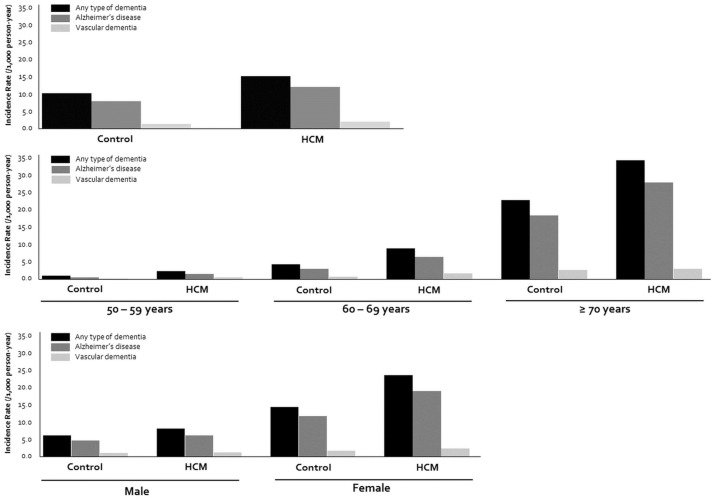


그림 출처: PubMed Central 공개 논문 (PMC9202937)
Conflict of interest statement
The authors have declared that no competing interests exist.
그 밖의 정보
- 출판 형태
- Journal Article, Research Support, Non-U.S. Gov't
- 저널
- PloS one · eISSN 1932-6203
- 전자 출판
- 2022-06-16
- MeSH
- Alzheimer Disease* / epidemiology · Cardiomyopathy, Hypertrophic* / complications / epidemiology · Cohort Studies · Dementia, Vascular* / epidemiology · Humans · Incidence · Propensity Score · Quality of Life · Risk Factors
- 참고문헌
- 41편