
PLoS One. 2022;17(4):e0267614.
Integrated approach of brachial-ankle pulse wave velocity and cardiovascular risk scores for predicting the risk of cardiovascular events.
제1저자 김혜미 · 교신저자 김학령
소속 (2)
- Division of Cardiology, Department of Internal Medicine, Chung-Ang University Hospital, Chung-Ang University College of Medicine, Seoul, South Korea.
- Division of Cardiology, Department of Internal Medicine, Boramae Medical Center, Seoul National University College of Medicine, Seoul, South Korea.
Abstract
BACKGROUND The 2013 American College of Cardiology (ACC)/American Heart Association (AHA) atherosclerotic cardiovascular disease (ASCVD) risk score may be insufficient for accurate prediction of major adverse cardiac events (MACE) in Asians. This study was performed to investigate whether brachial-ankle pulse wave velocity (baPWV) has additional prognostic value to the risk score estimated by the ACC/AHA pooled cohort equations (PCEs).
METHODS A total of 6,359 patients (3,534 men and 2,825 women) aged 40-79 years without documented cardiovascular disease who underwent baPWV measurement were retrospectively analyzed. Cardiovascular risk scores were calculated using the 2013 ACC/AHA PCEs. Cardiovascular events, including cardiac death, non-fatal myocardial infarction, coronary revascularization and ischemic stroke, were assessed.
RESULTS During a median follow-up period of 4.0 years (interquartile range 1.7-6.1 years), cardiovascular events occurred in 129 patients (2.0%). The receiver operating characteristic curve analysis showed that baPWV was stronger in the detection of cardiovascular events than the 2013 ACC/AHA risk score (area under the curve: 0.70 versus 0.62, p<0.001). In the multivariable Cox regression analysis, both baPWV and 2013 ACC/AHA risk score were independently associated with the occurrence of clinical events (p <0.001 for each). The baPWV had incremental prognostic value to the 2013 ACC/AHA risk score in predicting clinical events (global chi-square from 21.23 to 49.51, p<0.001).
CONCLUSION The baPWV appears to be a strong predictor of the risk of cardiovascular events in Koreans. Measuring baPWV in addition to the 2013 ACC/AHA risk score helps identify individuals at risk for MACE aged 40-79 years without previous cardiovascular diseases.
Figures
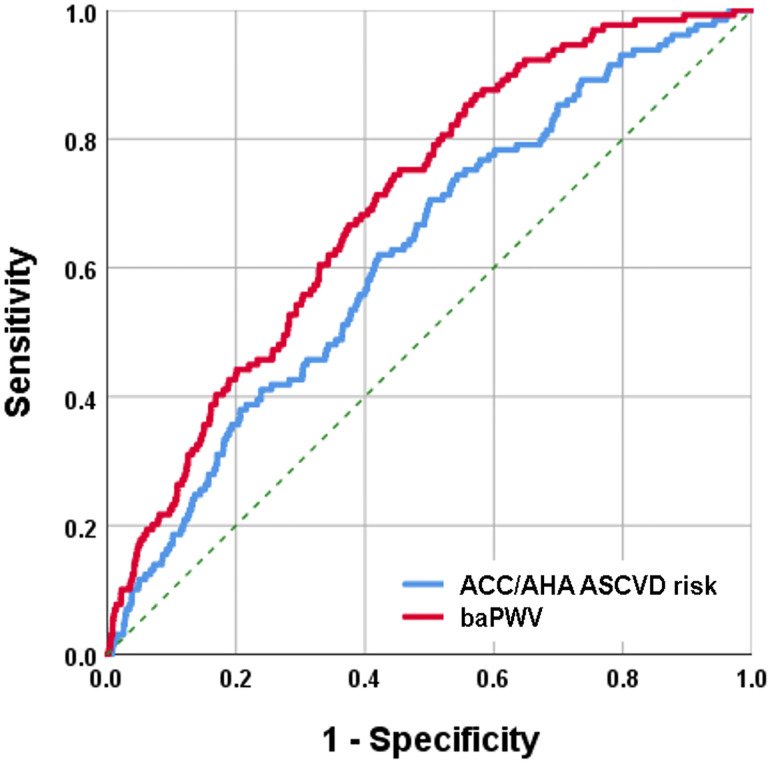
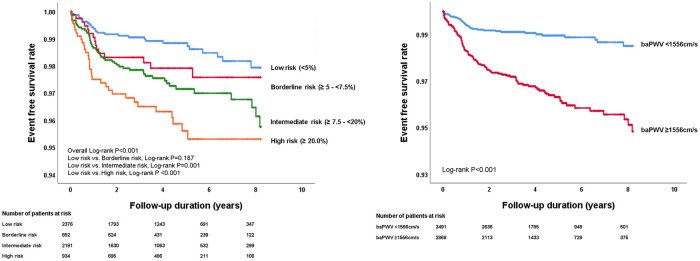
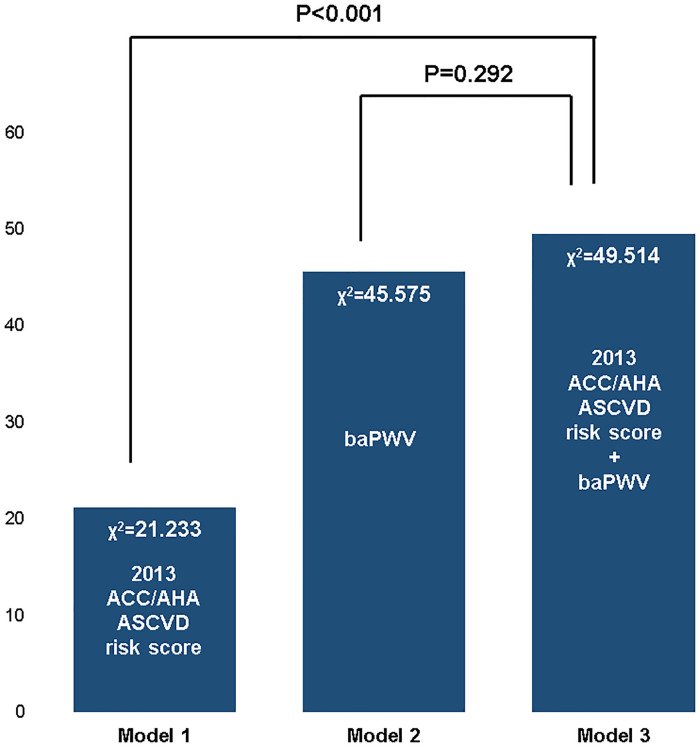
그림 출처: PubMed Central 공개 논문 (PMC9045657)
Conflict of interest statement
The authors have declared that no competing interests exist.
그 밖의 정보
- 출판 형태
- Journal Article
- 저널
- PloS one · eISSN 1932-6203
- 전자 출판
- 2022-04-27
- MeSH
- Ankle Brachial Index · Cardiovascular Diseases* / diagnosis · Female · Heart Disease Risk Factors · Humans · Male · Pulse Wave Analysis* · Retrospective Studies · Risk Factors · United States
- 참고문헌
- 39편