
PLoS One. 2022;17(4):e0267467.
Performance of clinician prediction of survival in oncology outpatients with advanced cancer.
제1저자 김유정, 윤석준 · 교신저자 서상연
소속 (9)
- Division of Hematology and Medical Oncology, Department of Internal Medicine, Seoul National University College of Medicine, Seoul National University Bundang Hospital, Seongnam, South Korea.
- Department of Family Medicine, Chungnam National University Hospital, Daejeon, South Korea.
- Department of Family Medicine, Dongguk University Ilsan Hospital, Goyang, South Korea.
- Department of Medicine, Dongguk University Medical School, Seoul, South Korea.
- Department of Palliative Medicine, Takeda General Hospital, Aizu Wakamatsu, Japan.
- Department of Palliative Medicine, Tohoku University School of Medicine, Sendai, Japan.
- Division of Medical Oncology, Bundang Medical Center, CHA University, Seongnam, South Korea.
- Division of Medical Oncology, Department of Internal Medicine, Yonsei University College of Medicine, Yonsei Cancer Center, Seoul, South Korea.
- Department of Statistics, Dongguk University Medical School, Seoul, South Korea.
Abstract
BACKGROUND We aimed to investigate the performance of clinician prediction of survival (CPS) and the association between CPS and the prognostic confidence of clinicians in ambulatory medical oncology outpatients.
METHODS Eight medical oncologists estimated the expected survival of their patients in a prospective cohort study. They were asked to provide a temporal type of CPS in weeks, together with their level of confidence for each prediction (0-100%). We analyzed the accuracy of CPS, the association between CPS and the prognostic confidence, and the characteristics of patients showing inaccurate CPS.
RESULTS A total of 200 advanced cancer patients were enrolled and the median overall survival was 7.6 months. CPS was accurate in 67 (33.5%) patients, underestimated in 87 (43.5%), and overestimated in 46 (23.0%). The overall accuracy of CPS for 12-week, 24-week, 36-week, and 48-week survival was 83.0%, 72.0%, 75.5%, and 74.0%, respectively. The specificity was highest for 12-week survival (90.2%) and the sensitivity was highest for 48-week survival (96.1%). The sensitivity of 12-week CPS was 51.4% and the area under the receiver operating characteristic (AUROC) curve was 0.79 (95% confidence interval [CI] 0.71-0.87). The prognostic confidence of clinicians was not significantly associated with the accuracy of prediction (P = 0.359). Patients with overestimated survival had significantly poorer global health status and physical/role/emotional functioning in the European Organization for Research and Treatment of Cancer Quality of Life Questionnaire Core 30 (EORTC QLQ-C30). Additionally, they showed significantly higher levels of fatigue, nausea/vomiting, pain, dyspnea, and loss of appetite.
CONCLUSION The overall accuracy of CPS in predicting 12-week to 48-week survival was high in medical oncology outpatients. However the sensitivity of 12-week CPS was low and prognostic confidence was not associated with the accuracy of CPS. Patients with overestimated CPS showed poorer quality of life and higher symptom burden.
Figures

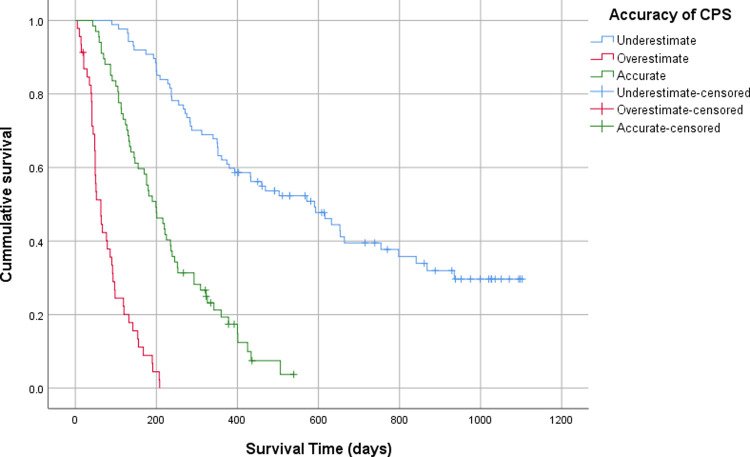
그림 출처: PubMed Central 공개 논문 (PMC9022805)
Conflict of interest statement
The authors have declared that no competing interests exist.
그 밖의 정보
- 출판 형태
- Journal Article, Research Support, Non-U.S. Gov't
- 저널
- PloS one · eISSN 1932-6203
- 전자 출판
- 2022-04-21
- MeSH
- Humans · Medical Oncology · Neoplasms* / therapy · Outpatients · Palliative Care* · Prospective Studies · Quality of Life · Surveys and Questionnaires
- 참고문헌
- 19편