
PLoS One. 2022;17(2):e0264538.
Comparison of early clinical outcomes between dual antiplatelet therapy and triple antithrombotic therapy in patients with atrial fibrillation undergoing percutaneous coronary intervention.
제1저자 박지석 · 교신저자 최의근
소속 (6)
- Department of Internal Medicine, Seoul National University Hospital, Seoul, Republic of Korea.
- Department of Internal Medicine, Seoul National University College of Medicine, Seoul, Republic of Korea.
- Department of Medical Statistics, College of Medicine, The Catholic University of Korea, Seoul, Republic of Korea.
- Department of Statistics and Actuarial Science, Soongsil University, Seoul, Republic of Korea.
- Liverpool Centre for Cardiovascular Science, University of Liverpool and Liverpool Chest & Heart Hospital, Liverpool, United Kingdom.
- Department of Clinical Medicine, Aalborg University, Aalborg, Denmark.
Abstract
BACKGROUND AND OBJECTIVE Most Asian patients with atrial fibrillation (AF) who undergo percutaneous coronary intervention (PCI) receive only dual antiplatelet therapy (DAPT) without oral anticoagulants (vitamin K antagonists [VKA] or non-VKA oral anticoagulants [NOAC]). However, it has not been fully investigated whether the DAPT results in better clinical outcomes in the early period after PCI than the standard triple therapy with VKA or NOAC.
METHODS We analyzed the claims records of 11,039 Korean AF population who had PCI between 2013 and 2018. Patients were categorized according to the post-PCI antithrombotic therapy as VKA-based triple therapy (VKA-TT), NOAC-based triple therapy (NOAC-TT), and DAPT groups. After baseline adjustment using inverse probability weighting, we compared the risks of ischemic endpoints (ischemic stroke, myocardial infarction, and all-cause mortality) and major bleeding at 3 months post-PCI.
RESULTS Ischemic stroke, MI, and all-cause mortality occurred in 105, 423, and 379 patients, respectively, and 138 patients experienced major bleeding. The DAPT group was associated with a lower risk of ischemic stroke and major bleeding (hazard ratio [HR] 0.55, 95% confidence interval [CI] 0.37-0.84) compared to the VKA-TT group, despite no significant differences in the risks of MI and all-cause mortality. In contrast, the DAPT group demonstrated no significant difference in the risks for ischemic endpoints compared to the NOAC-TT group. Additionally, the DAPT group had a numerically lower risk of major bleeding than the NOAC-TT group but this was not statistically significant (HR 0.69, 95% CI 0.45-1.07).
CONCLUSIONS An outcome benefit of DAPT was observed in the early period after PCI compared to the VKA-TT, but not against NOAC-TT users among the Asian AF population. Given the potential long-term benefits of NOACs, greater efforts should be made to increase compliance in clinical practice with proper combination therapy with NOAC after PCI.
Figures

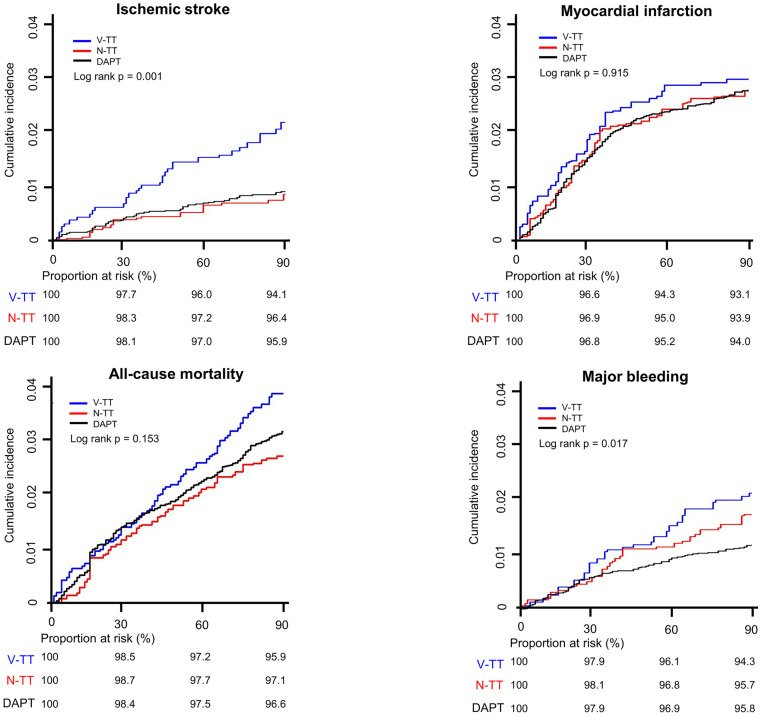


그림 출처: PubMed Central 공개 논문 (PMC8880831)
Conflict of interest statement
JP, JHJ, SWL, SK, SRL, JK, KDH, KWP, SO: None to disclose. EKC: Research grants from Bayer, BMS/Pfizer, Biosense Webster, Chong Kun Dang, Daiichi-Sankyo, Samjinpharm, Sanofi-Aventis, Seers Technology, Skylabs, and Yuhan. GYHL: Consultant and speaker for BMS/Pfizer, Boehringer Ingelheim, and Daiichi-Sankyo. No fees are received personally. This does not alter our adherence to PLOS ONE policies on sharing data and materials. Except for the above statements, there are none to declare with these commercial funders, relating to employment, consultancy, patents, product in development, and marketing products.”
그 밖의 정보
- 출판 형태
- Clinical Trial, Comparative Study, Journal Article, Research Support, Non-U.S. Gov't
- 저널
- PloS one · eISSN 1932-6203
- 전자 출판
- 2022-02-25
- MeSH
- Administration, Oral · Aged · Atrial Fibrillation / drug therapy / surgery · Databases, Factual · Drug Therapy, Combination · Dual Anti-Platelet Therapy · Female · Fibrinolytic Agents / therapeutic use · Hemorrhage / diagnosis / etiology · Humans · Ischemic Stroke / diagnosis / etiology · Kaplan-Meier Estimate · Male · Myocardial Infarction / diagnosis / etiology / mortality · Percutaneous Coronary Intervention / adverse effects · Platelet Aggregation Inhibitors / therapeutic use · Proportional Hazards Models · Risk Factors · Treatment Outcome
- Substances
- Fibrinolytic Agents · Platelet Aggregation Inhibitors
- 참고문헌
- 26편