
Diabetes Ther. 2026;17(2):201-216.
The Expanding Role of Continuous Glucose Monitoring in the Management and Prevention of Type 2 Diabetes.
제1저자 손희준 · 교신저자 조영민
소속 (4)
- Division of Endocrinology, Department of Internal Medicine, Chung-Ang University Hospital, Seoul, Republic of Korea.
- Division of Endocrinology and Metabolism, Department of Internal Medicine, Kangbuk Samsung Hospital, Sungkyunkwan University School of Medicine, Seoul, Republic of Korea.
- Division of Endocrinology and Metabolism, Department of Internal Medicine, Seoul National University Hospital, Seoul, Republic of Korea. ymchomd@snu.ac.kr.
- Department of Internal Medicine, Seoul National University College of Medicine, 101, Daehak-ro, Jongno-gu, Seoul, South Korea. ymchomd@snu.ac.kr.
Abstract
Continuous glucose monitoring (CGM) has transformed diabetes management by providing continuous, high-resolution insight into glucose dynamics. Initially developed for type 1 diabetes, CGM now demonstrates substantial clinical and behavioral benefits for individuals with type 2 diabetes across diverse therapeutic settings. This narrative review synthesizes current evidence on the expanding role of CGM in optimizing glycemic control and promoting patient-driven lifestyle modification.Across randomized and real-world studies, CGM consistently improves glycosylated hemoglobin, increases time in range, and reduces glycemic variability, regardless of insulin use. Beyond metabolic outcomes, CGM enhances treatment satisfaction, psychological well-being, and self-efficacy, particularly when combined with structured education and feedback. By enabling individuals to visualize real-time glucose responses to daily behaviors, CGM serves as a powerful catalyst for sustained behavioral change and personalized self-management.In addition to its therapeutic applications, CGM also provides diagnostic insight by revealing unrecognized glucose excursions that conventional monitoring may miss, facilitating earlier identification of dysglycemia in at-risk individuals. Yet significant barriers persist, including device costs, limited insurance coverage, and the difficulty of translating raw data into actionable insights for patients and clinicians.In conclusion, CGM has evolved from a glucose-monitoring device to a comprehensive platform that supports both clinical decision-making and behavioral empowerment, bridging the continuum from diabetes prevention to long-term management.
© 2025. The Author(s).
Keywords
Continuous glucose monitoringDigital healthGlycemic controlType 2 diabetes
Figures
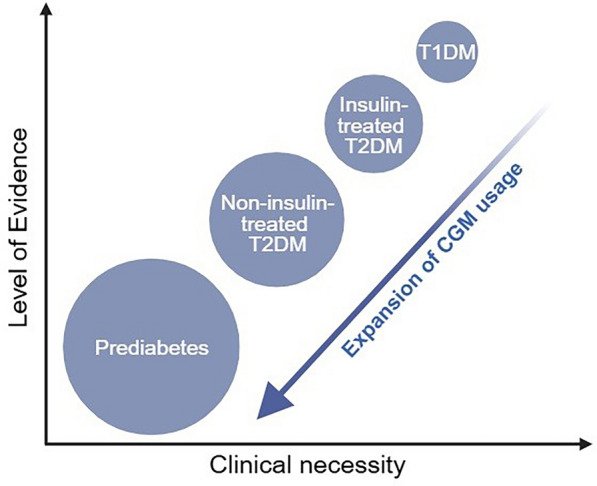
그림 출처: PubMed Central 공개 논문 (PMC12909652)
Conflict of interest statement
Declarations. Conflict of interest: Young Min Cho received consultation fees from LG Chemical and Hanmi, research grants from Sanofi, AstraZeneca, and Daewoong Pharmaceuticals. Young Min Cho is an outside director of Daewoong Pharmaceuticals. Heejun Son and Sun-Joon Moon have no conflict of interest to disclose. Ethical Approval: This article is based on previously conducted studies and does not contain any new studies with human participants or animals performed by any of the authors. We thank the investigators and participants of the studies that formed the evidence base for this review.
그 밖의 정보
- 출판 형태
- Journal Article, Review
- 저널
- Diabetes therapy : research, treatment and education of diabetes and related disorders · ISSN 1869-6953
- 전자 출판
- 2025-12-19
- 참고문헌
- 58편