
Respir Res. 2016;17(1):131.
Predicting survival of patients with idiopathic pulmonary fibrosis using GAP score: a nationwide cohort study.
제1저자 이상훈 · 교신저자 박무석
소속 (17)
- Department of Internal Medicine, Seoul National University College of Medicine, Division of Pulmonary and Critical Care Medicine, Seoul National University Bundang Hospital, 166, Gumi-ro, Bundang-gu, 463-707, Seongnam-si, Gyeonggi-do, Republic of Korea.
- Division of Pulmonology, Department of Internal Medicine, Severance Hospital, Institute of Chest Diseases, Yonsei University College of Medicine, 50-1, Yonsei-ro, Seodaemun-gu, Seoul, 120-752, South Korea.
- Division of Pulmonary and Critical Care Medicine, University of Ulsan College of Medicine, Asan Medical Center, Seoul, South Korea.
- Division of Pulmonary and Critical Care Medicine, Department of Internal Medicine and Lung Institute, Seoul National University College of Medicine, Seoul, South Korea.
- Division of Pulmonary and Critical Care Medicine, Samsung Medical Center, Sungkyunkwan University School of Medicine, Seoul, South Korea.
- Division of Allergy and Respiratory Medicine, Department of Internal Medicine, Soonchunhyang University Seoul Hospital, Seoul, South Korea.
- Division of Allergy and Respiratory Medicine, Department of Internal Medicine, Soonchunhyang University Bucheon Hospital, Seoul, South Korea.
- Division of Pulmonology, Department of Internal Medicine, Gachon University Gil Medical Center, Incheon, South Korea.
- Division of Pulmonary, Allergy & Critical Care Medicine, Department of Internal Medicine, Hallym University Kangdong Sacred Heart Hospital, Chuncheon, South Korea.
- Pulmonary Division, Department of Internal Medicine, Inha University Hospital, Incheon, South Korea.
- Division of Pulmonary Medicine, Department of Internal medicine, Chung Ang University College of Medicine, Seoul, South Korea.
- Division of Respiratory and Critical Care Medicine, Department of Internal Medicine, Korea University Anam Hospital, Korea University College of Medicine, Seoul, South Korea.
- Department of Internal Medicine, Ewha Womans University School of Medicine, Ewha Medical Research Institute, Seoul, South Korea.
- Division of Pulmonary Medicine, Department of Internal Medicine, Ulsan University Hospital, University of Ulsan College of Medicine, Ulsan, South Korea.
- Division of Critical Care and Pulmonary Medicine, Department of Internal Medicine, Inje University Pusan Paik Hospital, Gimhae, South Korea.
- Division of Allergy and Pulmonology, Department of Internal Medicine, Bucheon St. Mary's Hospital, The Catholic University of Korea School of Medicine, Seoul, South Korea.
- Division of Pulmonology, Department of Internal Medicine, Severance Hospital, Institute of Chest Diseases, Yonsei University College of Medicine, 50-1, Yonsei-ro, Seodaemun-gu, Seoul, 120-752, South Korea. pms70@yuhs.ac.
Abstract
BACKGROUND The clinical course of idiopathic pulmonary fibrosis (IPF) varies widely. Although the GAP model is useful for predicting mortality, survivals have not yet been validated for each GAP score. We aimed to elucidate how prognosis is related to GAP score and GAP stage in IPF patients.
METHODS The Korean Interstitial Lung Disease Study Group conducted a national survey to evaluate various characteristics in IPF patients from 2003 to 2007. Patients were diagnosed according to the 2002 criteria of the ATS/ERS. We enrolled 1,685 patients with IPF; 1,262 had undergone DLCO measurement. Patients were stratified based on GAP score (0-7): GAP score Group 0 (n = 26), Group 1 (n = 150), Group 2 (n = 208), Group 3 (n = 376), Group 4 (n = 317), Group 5 (n = 138), Group 6 (n = 39), and Group 7 (n = 8).
RESULTS Higher GAP score and GAP stage were associated with a poorer prognosis (p < 0.001, respectively). Survival time in Group 3 was lower than those in Groups 1 and 2 (p = 0.043 and p = 0.039, respectively), and higher than those in groups 4, 5, and 6 (p = 0.043, p = 0.032, and p = 0.003, respectively). Gender, age, and DLCO (%) differed significantly between Groups 2 and 3. All four variables in the GAP model differed significantly between Groups 3 and 4.
CONCLUSION The GAP system showed significant predictive ability for mortality in IPF patients. However, prognosis in IPF patients with a GAP score of 3 were significantly different from those in the other stage I groups and stage II groups of Asian patients.
Keywords
GAP stageIdiopathic pulmonary fibrosisPrognosis
Figures
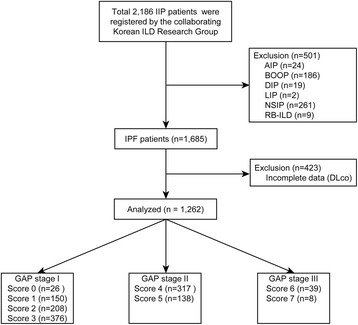
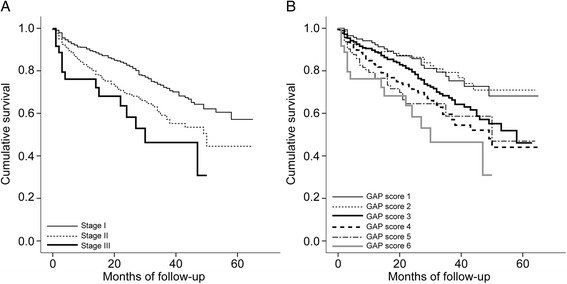
그림 출처: PubMed Central 공개 논문 (PMC5069824)
그 밖의 정보
- 출판 형태
- Comparative Study, Journal Article, Multicenter Study
- 저널
- Respiratory research · eISSN 1465-993X
- 전자 출판
- 2016-10-18
- MeSH
- Aged · Female · Humans · Idiopathic Pulmonary Fibrosis / diagnosis / epidemiology / mortality / physiopathology · Kaplan-Meier Estimate · Lung / physiopathology · Male · Middle Aged · Predictive Value of Tests · Prognosis · Proportional Hazards Models · Republic of Korea / epidemiology · Risk Factors · Severity of Illness Index · Time Factors
- 참고문헌
- 32편