SCI 발표논문

SCI 발표논문

← SCI 발표논문 목록

Nat Rev Endocrinol. 2021;17(1):11-30.

COVID-19 and diabetes mellitus: from pathophysiology to clinical management.

, , ,

제1저자 임수 · 교신저자 임수

소속 (4)
  1. Department of Internal Medicine, Seoul National University Bundang Hospital, Seoul National University College of Medicine, Seongnam, South Korea. limsoo@snu.ac.kr.
  2. Department of Internal Medicine, Korea University Anam Hospital, Korea University College of Medicine, Seoul, South Korea.
  3. Department of Internal Medicine, Yeouido St Mary's Hospital, The Catholic University of Korea, Seoul, South Korea.
  4. Diabetes Division, Katholisches Klinikum Bochum, St Josef-Hospital (Ruhr-Universität Bochum), Bochum, Germany. michael.nauck@rub.de.

Abstract

Initial studies found increased severity of coronavirus disease 2019 (COVID-19), caused by infection with severe acute respiratory syndrome coronavirus 2 (SARS-CoV-2), in patients with diabetes mellitus. Furthermore, COVID-19 might also predispose infected individuals to hyperglycaemia. Interacting with other risk factors, hyperglycaemia might modulate immune and inflammatory responses, thus predisposing patients to severe COVID-19 and possible lethal outcomes. Angiotensin-converting enzyme 2 (ACE2), which is part of the renin-angiotensin-aldosterone system (RAAS), is the main entry receptor for SARS-CoV-2; although dipeptidyl peptidase 4 (DPP4) might also act as a binding target. Preliminary data, however, do not suggest a notable effect of glucose-lowering DPP4 inhibitors on SARS-CoV-2 susceptibility. Owing to their pharmacological characteristics, sodium-glucose cotransporter 2 (SGLT2) inhibitors might cause adverse effects in patients with COVID-19 and so cannot be recommended. Currently, insulin should be the main approach to the control of acute glycaemia. Most available evidence does not distinguish between the major types of diabetes mellitus and is related to type 2 diabetes mellitus owing to its high prevalence. However, some limited evidence is now available on type 1 diabetes mellitus and COVID-19. Most of these conclusions are preliminary, and further investigation of the optimal management in patients with diabetes mellitus is warranted.

Figures
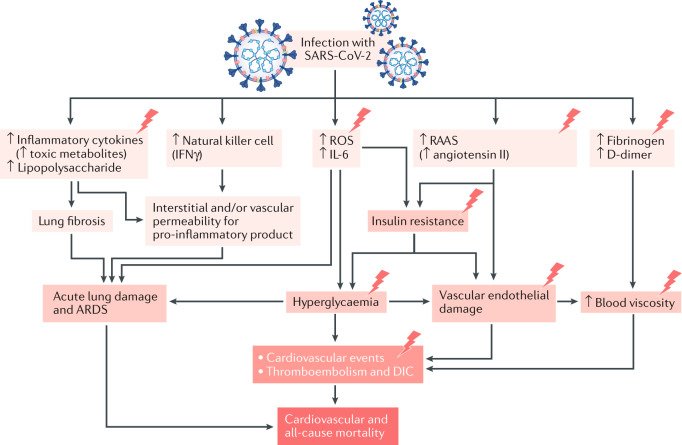
Fig. 1
Fig. 1 Potential pathogenic mechanisms in patients with T2DM and COVID-19. Lightning bolts indicate mechanisms that are accentuated in patients with type 2 diabetes mellitus (T2DM). Infection with severe acute respiratory syndrome coronavirus 2 (SARS-CoV-2)7,239 can lead to increased levels of inflammatory mediators in the blood, including lipopolysaccharide240,241, inflammatory cytokines9,43,242,243 and toxic metabolites. Modulation of natural killer cell activity (increased9,39,50 or decreased242,244) and IFNγ production can increase the interstitial and/or vascular permeability for pro-inflammatory products243,245,246. In addition, infection with SARS-CoV-2 leads to increased reactive oxygen species (ROS) production243,247,248. These effects lead to lung fibrosis249, acute lung damage and acute respiratory distress syndrome (ARDS)9,250. ROS production and viral activation of the renin–angiotensin–aldosterone system (RAAS)249,251 (via increased angiotensin II expression) cause insulin resistance39,252, hyperglycaemia253 and vascular endothelial damage243,254,255, all of which contribute to cardiovascular events, thromboembolism and disseminated intravascular coagulation (DIC). Infection also causes increases in the clotting components fibrinogen60,256 and D-dimer43,242,257, leading to increases in blood viscosity146,243 and vascular endothelial damage, and associated cardiovascular events, thromboembolism and DIC. COVID-19, coronavirus disease 2019.
Fig. 2
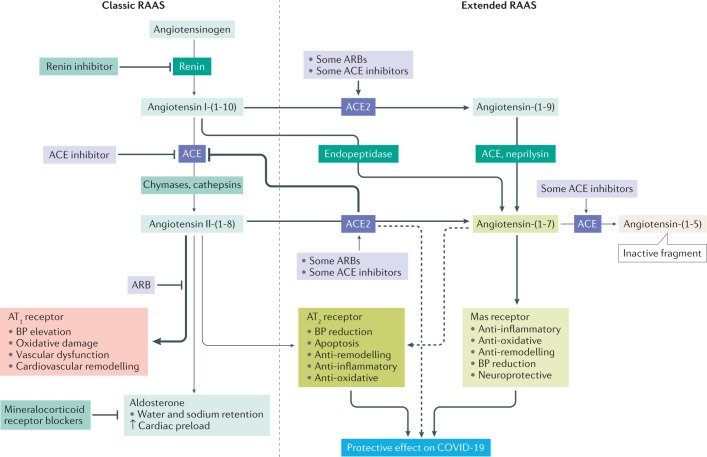
Fig. 2 The role of ACE2 within the RAAS. Because angiotensin-converting enzyme 2 (ACE2) is considered an important severe acute respiratory syndrome coronavirus 2 (SARS-CoV-2) receptor facilitating infection of relevant cells, such as pneumocytes, it is important to understand its normal physiological function. Inhibition of ACE blocks metabolism of angiotensin-(1–7) to angiotensin-(1–5) and can lead to elevation of angiotensin-(1–7) levels in plasma and tissues258. In animal models, angiotensin-(1–7) enhances vasodilation and inhibits vascular contractions to angiotensin II258. An ex vivo study using human internal mammary arteries showed that angiotensin-(1–7) blocks angiotensin II-induced vasoconstriction and inhibits ACE in human cardiovascular tissues258. In an ex vivo study, angiotensin-(1–7) and some ACE inhibitors, such as quinaprilat and captopril, potentiated bradykinin, resulting in blood pressure reduction by inhibiting ACE259. Thus, angiotensin-(1–7) acts as an ACE inhibitor and might stimulate bradykinin release259. These results show that angiotensin-(1–7) might be an important modulator of the human renin–angiotensin–aldosterone system (RAAS). ARB, angiotensin receptor blocker; AT1, angiotensin type 1; AT2, angiotensin type 2; BP, blood pressure.
Fig. 3
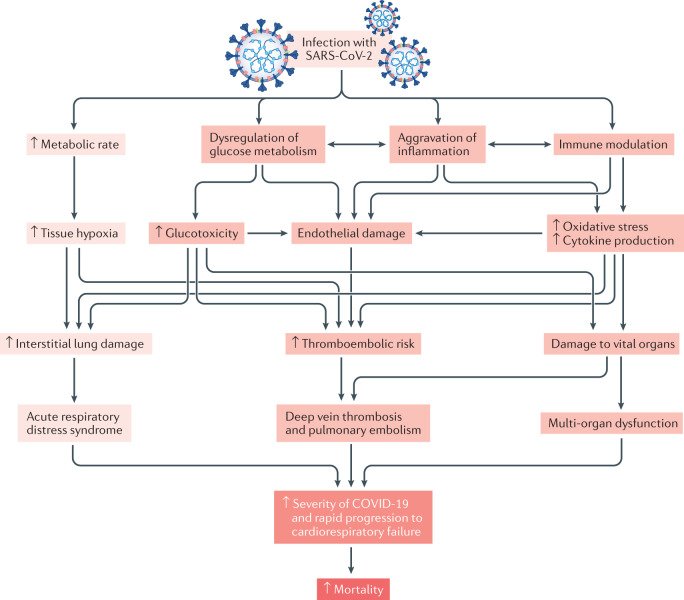
Fig. 3 Potential accentuated clinical processes after SARS-CoV-2 infection in people with diabetes mellitus. Darker red indicates processes that are accentuated in patients with type 2 diabetes mellitus (T2DM). Severe acute respiratory syndrome coronavirus 2 (SARS-CoV-2) infection increases metabolic rate, resulting in tissue hypoxia, which induces interstitial lung damage and acute respiratory distress syndrome9,250. Patients with diabetes mellitus and coronavirus disease 2019 (COVID-19) exhibit dysregulation of glucose homeostasis, aggravation of inflammation and impairment in the function of the immune system9,43,242,243. These conditions increase oxidative stress243,247,248, cytokine production and endothelial dysfunction243,254,255, leading to increased risk of thromboembolism and damage to vital organs. All these factors contribute to increased severity of COVID-19 and rapid progression to cardiorespiratory failure in patients with diabetes mellitus.
Fig. 4
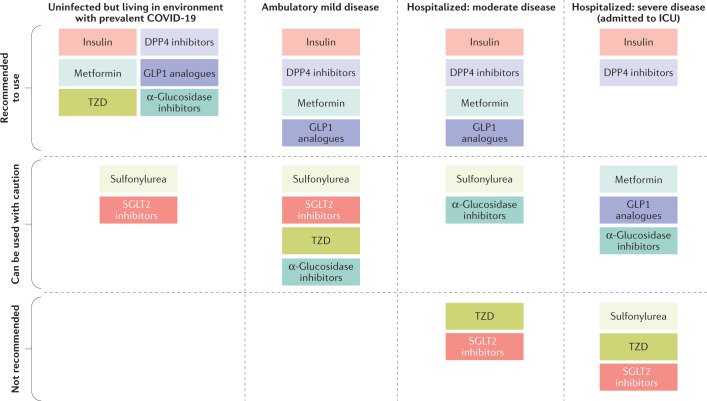
Fig. 4 Use of antidiabetic medications in patients with T2DM and COVID-19. Coronavirus disease 2019 (COVID-19) severity is based on the WHO clinical progression scale116. Insulin is mainly recommended for critically ill patients with diabetes mellitus infected with severe acute respiratory syndrome coronavirus 2 (SARS-CoV-2). Optimal glucose control using insulin infusion statistically significantly reduced inflammatory cytokines and improved severity of COVID-19 (ref.117). Metformin can be used for uninfected patients with type 2 diabetes mellitus (T2DM) or ambulatory patients with mild COVID-19. However, it should be noted that metformin is not encouraged for use in critically ill patients. Sulfonylurea can be used in uninfected patients with T2DM, but it is not recommended in patients with severe COVID-19 because it can provoke hypoglycaemia. Thiazolidinediones have the potential to mediate protective effects on the cardiovascular system114. However, thiazolidinedione therapy induces weight gain and oedema and tends to aggravate heart failure115. These results do not support its use in patients with severe COVID-19. Dipeptidyl peptidase 4 (DPP4) inhibitors are one of the most frequently prescribed medications without serious adverse events. DPP4 inhibitor therapy has proved neutral in terms of major adverse cardiac events in previous cardiovascular outcome trials79,80. Therefore, DPP4 inhibitors can be recommended for use in most patients with a broad spectrum of severity of COVID-19. Given that beneficial roles of glucagon-like peptide 1 (GLP1) analogues for the prevention of cardiovascular disease (CVD) and kidney disease are well established80,102, these drugs could be an ideal option for the treatment of patients with T2DM at risk of CVD and kidney disease103. Sodium–glucose cotransporter 2 (SGLT2) inhibitor treatment induces osmotic diuresis and potentially dehydration109, which has been suggested to be a risk factor for acute kidney injury and ketoacidosis110. As such, the use of SGLT2 inhibitors is not recommended in patients under critical care. ICU, intensive care unit; TZD, thiazolidinedione.

그림 출처: PubMed Central 공개 논문 (PMC7664589)

Comment · 정정

Conflict of interest statement

S.L. has been a member of advisory boards or has consulted with Merck, Sharp & Dohme and NovoNordisk. S.L. has received grant support from AstraZeneca, Merck, Sharp & Dohme and Astellas. S.L. has also served on the speakers’ bureau of AstraZeneca, Boehringer Ingelheim, Eli Lilly & Co., Merck, Sharp & Dohme, CKD Pharmaceutical and NovoNordisk. H.-S.K. has been a member of advisory boards or has consulted with Pfizer, Boehringer Ingelheim, Novartis, Daewoong Pharmaceutical, JW Pharmaceutical and NovoNordisk. H.-S.K. has received grant support from AstraZeneca. H.-S.K. has also served on the speakers’ bureau of Eli Lilly & Co., Merck, Sharp & Dohme, YUHAN, Dong-A Pharmaceutical and NovoNordisk. M.A.N. has been a member of advisory boards or has consulted with AstraZeneca, Boehringer Ingelheim, Eli Lilly & Co., Fractyl, GlaxoSmithKline, Menarini/Berlin-Chemie, Merck, Sharp & Dohme and NovoNordisk. M.A.N. has received grant support from AstraZeneca, Eli Lilly & Co., Menarini/Berlin-Chemie, Merck, Sharp & Dohme, Novartis Pharma and NovoNordisk. M.A.N. has also served on the speakers’ bureau of AstraZeneca, Boehringer Ingelheim, Eli Lilly & Co., Menarini/Berlin-Chemie, Merck, Sharp & Dohme, NovoNordisk and Sun Pharma. J.H.B. declares no competing interests.

그 밖의 정보
출판 형태
Journal Article, Review
저널
Nature reviews. Endocrinology · eISSN 1759-5037
전자 출판
2020-11-13
MeSH
Angiotensin-Converting Enzyme 2 / antagonists & inhibitors / metabolism · Blood Glucose / drug effects / metabolism · COVID-19 / epidemiology / metabolism · Diabetes Mellitus, Type 1 / drug therapy / epidemiology / metabolism · Diabetes Mellitus, Type 2 / drug therapy / epidemiology / metabolism · Disease Management · Humans · Hypoglycemic Agents / administration & dosage / metabolism · Risk Factors · COVID-19 Drug Treatment*
Substances
Blood Glucose · Hypoglycemic Agents · ACE2 protein, human · Angiotensin-Converting Enzyme 2
참고문헌
259편