
PLoS One. 2014;9(1):e84052.
Relationship between changes in body fat and a decline of renal function in the elderly.
제1저자 오세원 · 교신저자 진호준
소속 (6)
- Department of Internal Medicine, Eulji General Hospital, Eulji University College of Medicine, Seoul, Korea.
- Department of Internal Medicine, Seoul National University Bundang Hospital, Kyeong-Kido, Korea ; Department of Internal Medicine, Seoul National University, Seoul, Korea.
- Department of Internal Medicine, Seoul National University Bundang Hospital, Kyeong-Kido, Korea.
- Department of Psychiatry, Seoul National University College of Medicine, Seoul, Korea.
- Department of Internal Medicine, Seoul National University, Seoul, Korea ; Renal Institute, Seoul National University Medical Research Center, Seoul, Korea.
- Department of Internal Medicine, Seoul National University Bundang Hospital, Kyeong-Kido, Korea ; Department of Internal Medicine, Seoul National University, Seoul, Korea ; Renal Institute, Seoul National University Medical Research Center, Seoul, Korea.
Abstract
Obesity is a risk factor for chronic kidney disease, and its prevalence among the elderly is increasing. We investigated the effects of changes in body fat percentage (BFP) on the longitudinal changes in the estimated glomerular filtration rate (eGFR) in the elderly. This prospective cohort study included 390 participants aged >65 years who underwent bioelectrical impedance analysis at baseline and follow-up as a part of the Korean Longitudinal Study on Health and Aging. After a median follow-up period of 5.3 years, BFP was significantly higher than that at the start point (P<0.05). Participants who had the largest increase in BFP had the highest BMI and waist circumference (WC) (P<0.001). The highest tertile had the highest white blood cell count and erythrocyte sedimentation rate, incidence of rapid progression, and decline in eGFR >25% (P≤0.017, P = 0.025, P = 0.005, respectively). The lowest tertile had the lowest triglyceride and highest high-density lipoprotein levels (P<0.05). The adjusted decline rate in eGFR was correlated with a change in BFP (P = 0.039), but not with that in BMI or WC. The highest tertile had a 4.875-fold increase in the risk for rapid progression to a decline in eGFR (95% CI: 1.366-17.397) and a 4.931-fold decrease in the risk to a decline in eGFR>25% (95% CI: 1.617-15.037), when compared with the lowest tertile. In subgroup analysis, the incidence of renal outcomes was significantly increased according to the increase in BFP in patients with lower eGFR (P≤0.010). A change in BFP may be associated with inflammation and dyslipidemia development, and longitudinal changes in body fat are related to a decrease in eGFR in the elderly.
Figures

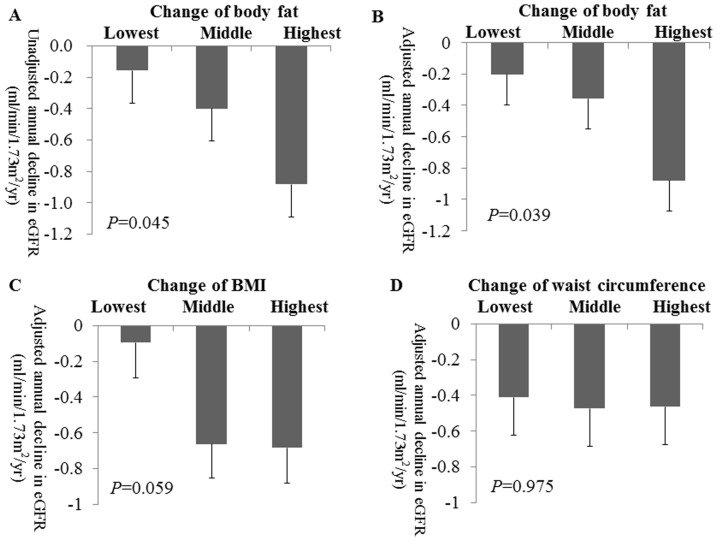

그림 출처: PubMed Central 공개 논문 (PMC3894176)
Conflict of interest statement
Competing Interests:This work was partly supported by an independent Research Grant (IRG) from Pfizer Global Pharmaceuticals. There are no patents, products in development or marketed products to declare. This does not alter the authors' adherence to all the PLOS ONE policies on sharing data and materials, as detailed online in the guide for authors.
그 밖의 정보
- 출판 형태
- Journal Article, Research Support, Non-U.S. Gov't
- 저널
- PloS one · eISSN 1932-6203
- 전자 출판
- 2014-01-16
- MeSH
- Aged · Aging · Body Fat Distribution* · Female · Glomerular Filtration Rate · Humans · Kidney / physiopathology · Male · Prospective Studies · Waist-Hip Ratio
- 참고문헌
- 40편