
PLoS One. 2021;16(6):e0253310.
Risk of upper gastrointestinal bleeding in patients on oral anticoagulant and proton pump inhibitor co-therapy.
제1저자 이현정 · 교신저자 김형관
소속 (2)
- Division of Cardiology, Department of Internal Medicine, Cardiovascular Center, Seoul National University Hospital, Seoul, Korea.
- Department of Statistics and Actuarial Science, Soongsil University, Seoul, Korea.
Abstract
BACKGROUND Proton pump inhibitors (PPIs) are known to reduce the risk of upper gastrointestinal bleeding in patients on oral anticoagulants, and patients are increasingly on oral anticoagulants and PPI co-therapy. However, evidence is lacking on the safety and effectiveness of oral anticoagulants when co-administered with PPIs.
METHODS Among patients initiating oral anticoagulants (warfarin and non-vitamin K antagonist oral anticoagulants [NOACs], i.e. rivaroxaban, dabigatran, apixaban, and edoxaban) during 2013-2017, those concomitantly prescribed PPIs were identified (n = 19,851). The primary endpoint was hospitalization for major upper gastrointestinal bleeding, and secondary endpoints were death and ischemic stroke.
RESULTS During a mean 1.4 years of follow-up, the primary endpoint occurred in 512 (2.58%) patients. Overall, NOACs were associated with lower upper gastrointestinal bleeding risk after adjustment for age, sex, comorbidities and concomitant medications (adjusted hazard ratio 0.78, 95% confidence interval 0.65-0.94), compared to warfarin. There was no significant difference in upper gastrointestinal bleeding risk among the individual NOACs. This trend of reduced risk for upper gastrointestinal bleeding in NOACs compared to warfarin was consistent for both regular and reduced doses, throughout bleeding risk groups, and other subgroup analyses. NOACs were also associated with lower risk of death compared to warfarin. The risk for ischemic stroke was not significantly different among the oral anticoagulants in patients with atrial fibrillation.
CONCLUSION In patients on oral anticoagulant and PPI co-therapy, NOACs were associated with lower risk of upper gastrointestinal bleeding and mortality compared to warfarin, while there was no difference among the oral anticoagulants for stroke prevention. In patients on PPI therapy, NOACs may preferred over warfarin for decreasing risk of upper gastrointestinal bleeding and mortality.
Figures


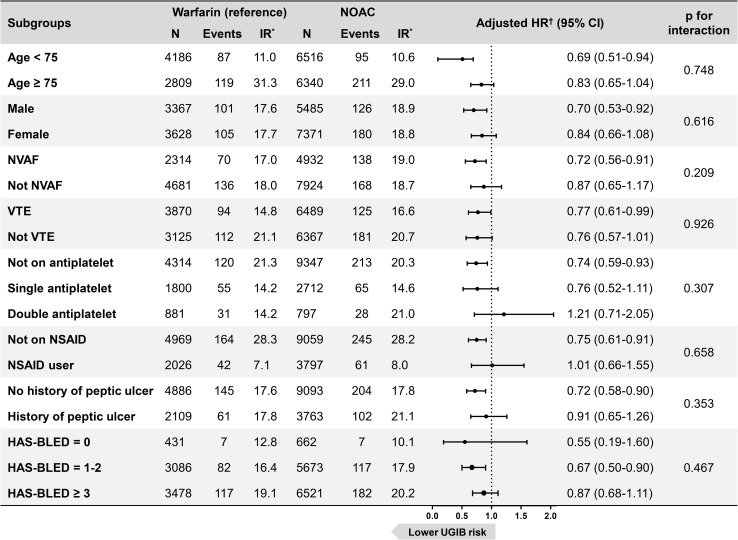
그림 출처: PubMed Central 공개 논문 (PMC8211274)
Conflict of interest statement
HKK reports research grants from Actelion, GSK, Bayer Korea, Handok, Dae-Woong, Hanmi, Ildong, JW pharmaceutical, Samjin and Norvatis. The remaining authors declare no conflict of interest. This does not alter our adherence to PLOS ONE policies on sharing data and materials.
그 밖의 정보
- 출판 형태
- Journal Article, Research Support, Non-U.S. Gov't
- 저널
- PloS one · eISSN 1932-6203
- 전자 출판
- 2021-06-17
- MeSH
- Administration, Oral · Adult · Aged · Aged, 80 and over · Anticoagulants / administration & dosage / adverse effects / therapeutic use · Atrial Fibrillation / drug therapy · Dabigatran / therapeutic use · Databases, Factual · Female · Gastrointestinal Hemorrhage / chemically induced / epidemiology · Humans · Incidence · Ischemic Stroke / epidemiology · Male · Middle Aged · Proton Pump Inhibitors / therapeutic use · Republic of Korea / epidemiology · Risk · Rivaroxaban / therapeutic use · Upper Gastrointestinal Tract / drug effects · Warfarin / adverse effects
- Substances
- Anticoagulants · Proton Pump Inhibitors · Warfarin · Rivaroxaban · Dabigatran
- 참고문헌
- 36편