
PLoS One. 2021;16(1):e0241623.
Smoking, development of or recovery from metabolic syndrome, and major adverse cardiovascular events: A nationwide population-based cohort study including 6 million people.
제1저자 박세훈, 한경도 · 교신저자 김동기
소속 (9)
- Department of Biomedical Sciences, Seoul National University College of Medicine, Seoul, Korea.
- Department of Internal Medicine, Armed Forces Capital Hospital, Gyeonggi-do, Korea.
- Department of Statistics and Actuarial Science, Soongsil University, Seoul, Korea.
- Department of Internal Medicine, Seoul National University Hospital, Seoul, Korea.
- Department of Internal Medicine, Seoul National University College of Medicine, Seoul, Korea.
- Department of Internal Medicine, Keimyung University School of Medicine, Daegu, Korea.
- Department of Medical Statistics, College of Medicine, Catholic University of Korea, Seoul, Korea.
- Kidney Research Institute, Seoul National University, Seoul, Korea.
- Department of Internal Medicine, Seoul National University Boramae Medical Center, Seoul, Korea.
Abstract
Smoking, metabolic syndrome (MetS), and major adverse cardiovascular events (MACEs) are important global health problems. We aimed to investigate the association between smoking, alteration in MetS status, and the consequent risk of MACE. We performed a nationwide observational cohort study based on the claims database of Korea. We included people with ≥ 3 national health screenings from 2009 to 2013. Total 6,099,717 people, including 3,576,236 nonsmokers, 862,210 ex-smokers, 949,586 light-to-moderate smokers, and 711,685 heavy smokers, at the first health screening, were investigated. First, we performed a logistic regression analysis using smoking status at the first screening as the exposure variable and MetS development or recovery as the outcome variable. Second, we performed a Poisson regression using smoking status at the third screening as the exposure variable and the outcome was risk of incident MACEs. Among those previously free from MetS (N = 4,889,493), 347,678 people developed MetS, and among those who had previous MetS (N = 1,210,224), 347,627 people recovered from MetS. Smoking was related to a higher risk of MetS development [for heavy smokers: adjusted OR 1.71 (1.69 to 1.73)] and a lower probability of MetS recovery [for heavy smokers: adjusted OR 0.68 (0.67 to 0.69)]. Elevated triglycerides was the MetS component with the most prominent association with smoking. The risk for incident MACEs (78,640 events during a median follow-up of 4.28 years) was the highest for heavy smokers, followed in order by light-to-moderate, ex-smokers and nonsmokers, for every MetS status. Therefore, smoking may promote MetS or even hinder recovery from MetS. Smoking cessation should be emphasized to reduce MACE risk even for those without MetS.
Figures
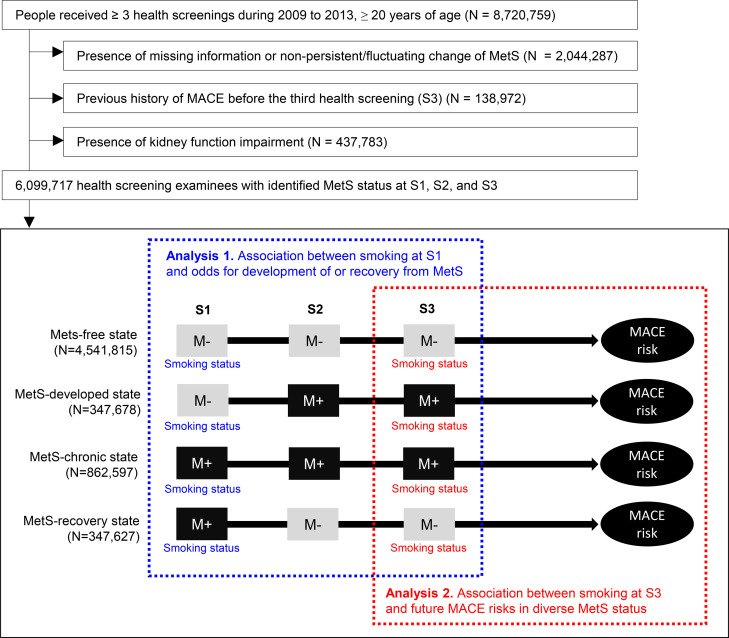
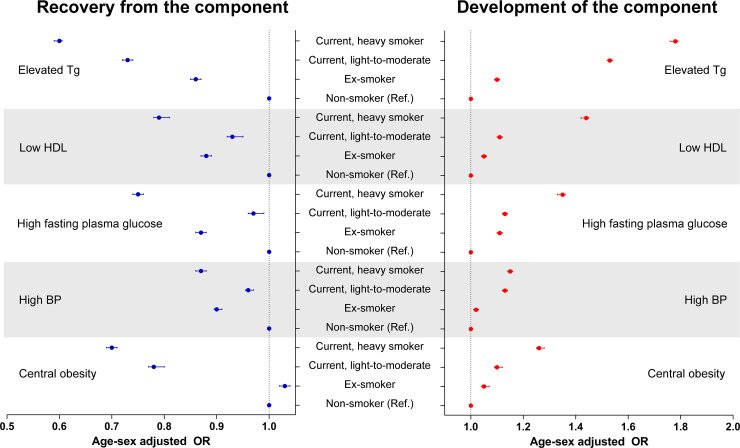
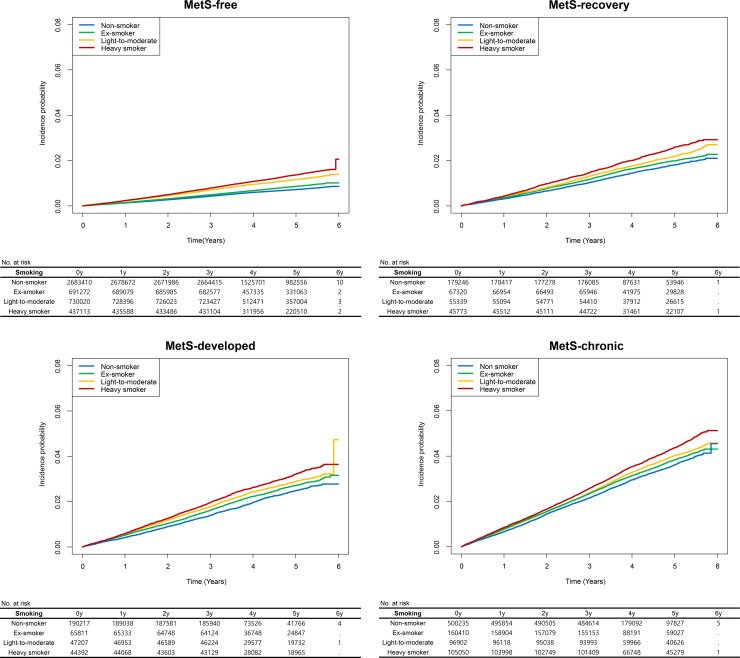
그림 출처: PubMed Central 공개 논문 (PMC7802921)
Conflict of interest statement
The authors have declared that no competing interests exist.
그 밖의 정보
- 출판 형태
- Clinical Trial, Journal Article, Research Support, Non-U.S. Gov't
- 저널
- PloS one · eISSN 1932-6203
- 전자 출판
- 2021-01-12
- MeSH
- Adult · Cardiovascular Diseases* / blood / epidemiology / etiology · Female · Follow-Up Studies · Humans · Male · Metabolic Syndrome* / blood / epidemiology / etiology · Middle Aged · Republic of Korea / epidemiology · Risk Factors · Smoking* / adverse effects / blood / epidemiology · Triglycerides / blood
- Substances
- Triglycerides
- 참고문헌
- 33편