
Sci Rep. 2026;16(1):10.1038/s41598-026-45232-7.
Obstructive sleep apnea in never-smokers with newly diagnosed lung cancer: a prospective study in a predominantly female Korean population.
제1저자 박진아 · 교신저자 조재영
소속 (5)
- Division of Pulmonary and Critical Care Medicine, Department of Internal Medicine, Seoul National University Hospital, 101 Daehak-ro, Jongno-gu, Seoul, 03080, Republic of Korea.
- Division of Pulmonary and Critical Care Medicine, Department of Medicine, Samsung Medical Center, Sungkyunkwan University School of Medicine, Seoul, Republic of Korea.
- Division of Pulmonary and Critical Care Medicine, Department of Internal Medicine, Dongguk University Ilsan Hospital, Goyang, Republic of Korea.
- Division of Pulmonary and Critical Care Medicine, Department of Internal Medicine, Seoul National University Hospital, 101 Daehak-ro, Jongno-gu, Seoul, 03080, Republic of Korea. apricot6@snu.ac.kr.
- Department of Internal Medicine, Seoul National University College of Medicine, Seoul, Republic of Korea. apricot6@snu.ac.kr.
Abstract
Emerging evidence suggests a link between obstructive sleep apnea (OSA) and lung cancer, but tobacco smoking may confound this relationship. This prospective study evaluated the prevalence and clinical features of OSA among never-smokers with lung cancer. Newly diagnosed, never-smoking lung cancer patients underwent respiratory polygraphy before cancer treatment. Of 77 enrolled, 67 patients were analyzed (age, 65 years; women, 83.6%; body mass index, 24 kg/m2). OSA (respiratory event index [REI] ≥ 5/hour) was present in 47.8% of the patients-specifically, in 29.4%, 60.0%, 65.0%, and 44.0% of the patients with stage I, II, III, and IV lung cancer, respectively (P = 0.175). 20.9% of the patients had moderate-to-severe OSA (REI ≥ 15/hour). Adenocarcinoma was the predominant histologic type (97%), and 67.2% had advanced-stage (stage III/IV) lung cancer. REI and the percent night time with oxygen saturation < 90% (T90) did not differ between the patients with advanced- and early-stage lung cancer (REI: 5.3/hour vs. 3.0/hour, P = 0.171; T90: 0.6% vs. 0.2%, P = 0.139). In multivariable logistic regression analyses, neither REI nor T90 was associated with advanced-stage lung cancer. Nearly half of never-smokers with lung cancer had OSA, with many having moderate-to-severe disease, underscoring the need for proper diagnosis and management.Clinical Trial Registration: NCT05224180.
© 2026. The Author(s).
Keywords
FemaleLung cancerNever-smokersObstructive sleep apnea
Figures
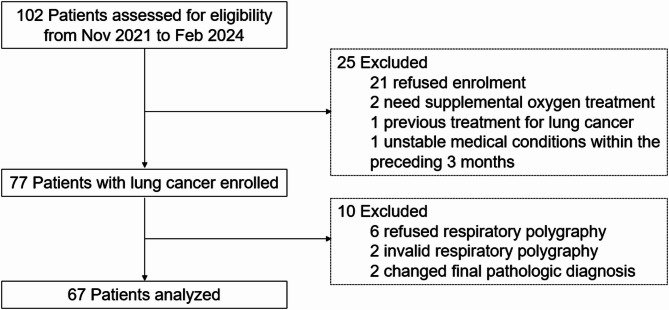
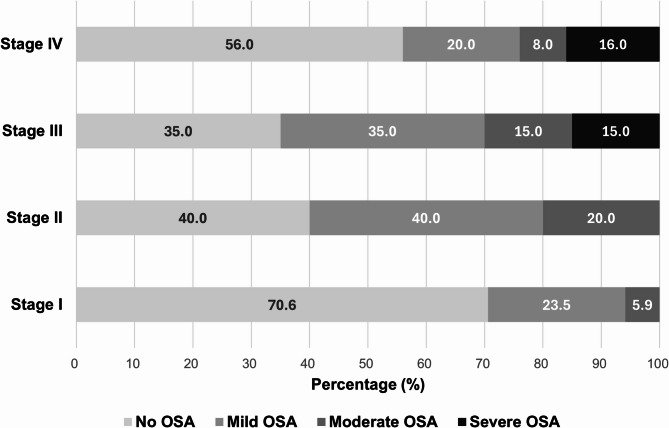
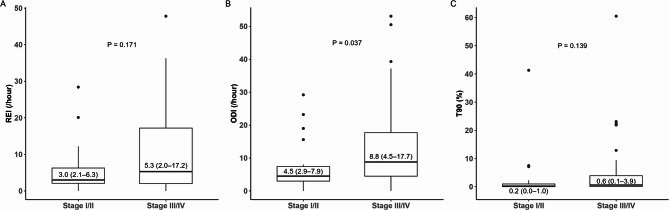
그림 출처: PubMed Central 공개 논문 (PMC13153253)
Conflict of interest statement
Declarations. Competing interests: The authors declare no competing interests.
그 밖의 정보
- 출판 형태
- Journal Article, Observational Study
- 저널
- Scientific reports · eISSN 2045-2322
- 전자 출판
- 2026-03-23
- MeSH
- Aged · Female · Humans · Middle Aged · Lung Neoplasms* / epidemiology / complications / diagnosis / pathology · Neoplasm Staging · Non-Smokers · Polysomnography · Prevalence · Prospective Studies · Republic of Korea / epidemiology · Sleep Apnea, Obstructive* / epidemiology / complications / diagnosis
- 연구비
- Seoul National University Hospital Research Fund 03-2021-0440
- 데이터
- ClinicalTrials.gov: NCT05224180
- 참고문헌
- 35편