
BMC Cancer. 2016;16:515.
Prognostic impact of AJCC response criteria for neoadjuvant chemotherapy in stage II/III breast cancer patients: breast cancer subtype analyses.
제1저자 양예원 · 교신저자 임석아, 김태용
소속 (8)
- Department of Internal Medicine, Seoul National University Hospital, Seoul National University College of Medicine, 101 Daehak-ro, Jongno-gu, Seoul, 110-744, Korea.
- Cancer Research Institute, Seoul National University, Seoul, Korea.
- Department of Internal Medicine, Seoul National University Hospital, Seoul National University College of Medicine, 101 Daehak-ro, Jongno-gu, Seoul, 110-744, Korea. moisa@snu.ac.kr.
- Cancer Research Institute, Seoul National University, Seoul, Korea. moisa@snu.ac.kr.
- Department of Internal Medicine, Seoul National University Hospital, Seoul National University College of Medicine, 101 Daehak-ro, Jongno-gu, Seoul, 110-744, Korea. ktyongmd@gmail.com.
- Cancer Research Institute, Seoul National University, Seoul, Korea. ktyongmd@gmail.com.
- Department of Pathology, Seoul National University Hospital, Seoul National University College of Medicine, Seoul, Korea.
- Department of Surgery, Seoul National University Hospital, Seoul National University College of Medicine, Seoul, Korea.
Abstract
BACKGROUND Neoadjuvant chemotherapy (NAC) is a standard treatment for stage II/III breast cancer patients, and response to NAC is a useful prognostic marker. Since its introduction, 6-8 cycles of NAC has become the standard regimen to improve the outcome of these patients. The purpose of this study is to evaluate the prognostic impact of the American Joint Committee on Cancer (AJCC) response criteria and this tool's usefulness in four different breast cancer subtypes.
METHODS We conducted a retrospective cohort study of clinical stage II/III breast cancer patients who received NAC of more than 6 cycles. Response after NAC and the clinicopathological factors were reviewed. AJCC response criteria for NAC were adopted from the AJCC Manual, 7th edition: complete response (CR), partial response (PR), and no response (NR).
RESULTS A total of 183 patients were enrolled; 22 (12.0 %), 123 (67.2 %), and 38 (20.8 %) patients showed CR, PR, and NR, respectively. The AJCC response was significantly associated with relapse-free survival (RFS) (P < 0.001), whereas pathologic CR (pCR), the current gold standard for response evaluation for NAC, was not (P = 0.140). AJCC response was a significant prognostic factor for RFS in all four breast cancer subtypes, namely luminal A (P = 0.006), luminal B (P = 0.001), HER-2 enriched (P = 0.039), and triple-negative breast cancer (P = 0.035).
CONCLUSIONS The AJCC response criteria represent a simple and easily reproducible tool for response evaluation of NAC patients and a useful clinical prognostic marker for RFS. These criteria also have a prognostic impact in all four breast cancer subtypes, including luminal A in which pCR has a limited role.
Keywords
American Joint Committee on Cancer (AJCC) responseBreast cancer subtypeBreast neoplasmNeoadjuvant chemotherapyRelapse-free survivalStage II or III
Figures
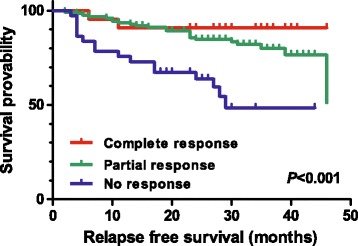
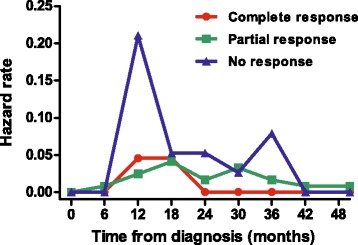
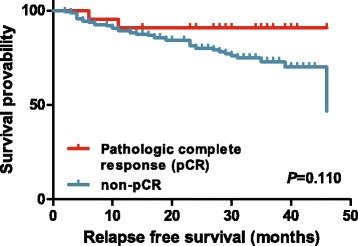
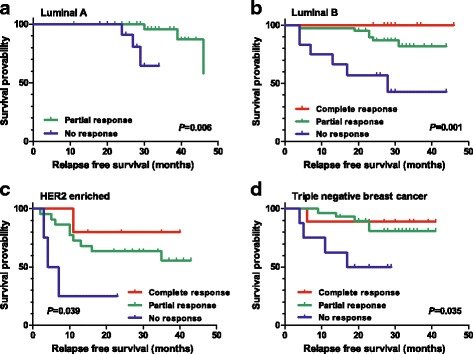
그림 출처: PubMed Central 공개 논문 (PMC4955253)
그 밖의 정보
- 출판 형태
- Journal Article, Research Support, Non-U.S. Gov't
- 저널
- BMC cancer · eISSN 1471-2407
- 전자 출판
- 2016-07-21
- MeSH
- Adult · Aged · Breast Neoplasms / drug therapy / mortality / pathology · Chemotherapy, Adjuvant / methods · Cohort Studies · Female · Humans · Kaplan-Meier Estimate · Middle Aged · Neoadjuvant Therapy / methods · Neoplasm Staging · Prognosis · Proportional Hazards Models · Retrospective Studies
- 참고문헌
- 41편