
PLoS One. 2020;15(9):e0238244.
Anemia is associated with the risk of Crohn's disease, not ulcerative colitis: A nationwide population-based cohort study.
제1저자 강은애, 천재영 · 교신저자 임종필
소속 (4)
- Department of Internal Medicine and Liver Research Institute, Seoul National University College of Medicine, Seoul, South Korea.
- Department of Internal Medicine and Institute of Gastroenterology, Yonsei University College of Medicine, Seoul, South Korea.
- Department of Internal Medicine, Gangnam Severance Hospital, Yonsei University College of Medicine, Seoul, South Korea.
- Department of Statistics and Actuarial Science, Soongsil University, Seoul, South Korea.
Abstract
Anemia is a common manifestation of inflammatory bowel disease (IBD), but it remains unclear whether anemia is associated with the development of IBD. We assessed the risk of developing IBD in anemic patients, and stratified the results with respect to their hemoglobin concentrations. A population-based study was conducted using the National Healthcare Insurance Service database in South Korea. We included individuals over 20 years' old who participated in the national health screening program in 2009 (n = 9,962,064). Anemia was defined as a hemoglobin level less than 13 g/dL in men and less than 12 g/dL in women. We compared the rate of newly diagnosed IBD in anemic patients and non-anemic individuals. Newly diagnosed IBD was identified using both the ICD-10 medical code and specialized V codes for rare intractable diseases in South Korea. During the mean follow-up period of 7.3 years, the incidences of CD and UC in anemic patients were 2.89 and 6.88 per 100,000 person-years, respectively. The risk of CD was significantly higher in anemic patients than in non-anemic individuals [adjusted hazard ratio (aHR), 2.084; 95% confidence interval (CI), 1.769-2.455]. The risk of CD development was inversely proportional to the hemoglobin concentration. A J-curve relationship was observed between age and the risk of CD in anemic patients. The risk of CD in male anemic patients was significantly higher than that in female anemic patients (aHR, 1.432 vs. 1.240, respectively). By contrast, there was no statistically significant difference in the risk of developing UC in anemic and non-anemic individuals (aHR, 0.972; 95% CI, 0.880-1.073). This work indicates that anemia is related to the development of CD, and this risk was inversely proportional to the hemoglobin concentration.
Figures

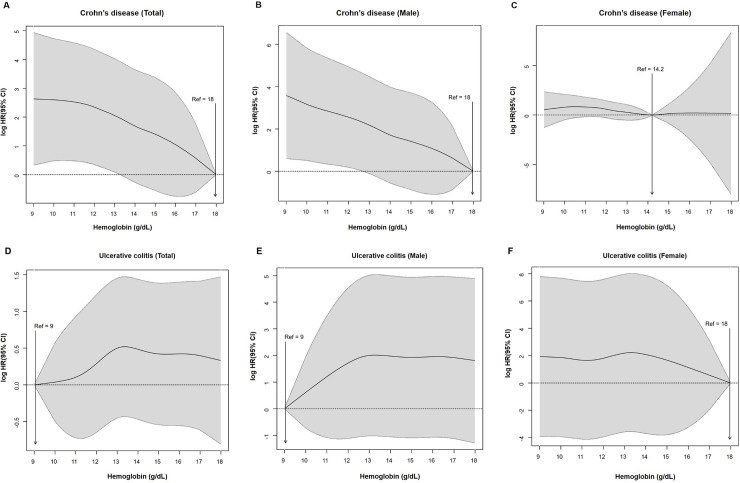

그림 출처: PubMed Central 공개 논문 (PMC7478647)
Conflict of interest statement
The authors have declared that no competing interests exist.
그 밖의 정보
- 출판 형태
- Journal Article
- 저널
- PloS one · eISSN 1932-6203
- 전자 출판
- 2020-09-08
- MeSH
- Anemia / complications · Cohort Studies · Colitis, Ulcerative / epidemiology / etiology · Crohn Disease / epidemiology / etiology · Female · Humans · Incidence · Male · Middle Aged · Republic of Korea / epidemiology · Risk Factors
- 참고문헌
- 31편