
PLoS One. 2020;15(6):e0235126.
Impact of idiopathic pulmonary fibrosis on recurrence after surgical treatment for stage I-III non-small cell lung cancer.
제1저자 송명진 · 교신저자 박종선, 이상훈
소속 (4)
- Division of Pulmonary and Critical Care Medicine, Department of Internal Medicine, Seoul National University College of Medicine, Seoul National University Bundang Hospital, Seongnam, South Korea.
- Department of Thoracic and Cardiovascular Surgery, Yonsei University College of Medicine, Seoul, Republic of Korea.
- Department of Thoracic and Cardiovascular Surgery, Seoul National University College of Medicine, Seoul National University Bundang Hospital, Seongnam, South Korea.
- Division of Pulmonology, Department of Internal Medicine, Institute of Chest Diseases, Severance Hospital, Yonsei University College of Medicine, Seoul, Republic of Korea.
Abstract
BACKGROUND Idiopathic pulmonary fibrosis (IPF) is an independent risk factor for lung cancer (LC) development; however, its effect on recurrence after curative surgery remains unclear.
OBJECTIVES This study aimed to determine the impact of IPF on recurrence-free survival following curative surgical resection of stage I-III non-small cell lung cancer (NSCLC) and investigate the effects of patient and surgical factors on the risk of recurrence.
METHODS We reviewed retrospectively collected data of patients with surgically resected stage I-III NSCLC from two tertiary care hospitals in South Korea. By propensity score matching, patients with IPF (LC with IPF) were matched to those without IPF (LC without IPF).
RESULTS In total, 3416 patients underwent surgical resection, and 96 were diagnosed with underlying IPF. In the LC with IPF group, 89.6% patients were men, and the average age was 69.7 years. Sublobar resection was performed more frequently in the LC with IPF group than in the LC without IPF group, while the rate of mediastinal lymph node dissection and dissected node number were lower in the former group. The 5-year recurrence-free survival rate was significantly lower in the LC with IPF group (49.2%) than in the LC without IPF group (69.1%; P<0.001). Multivariable Cox regression analysis revealed that IPF and postoperative stage III were independent risk factors for recurrence.
CONCLUSIONS IPF may increase the risk of recurrence after curative surgical treatment for NSCLC. Close surveillance for recurrence is mandatory for patients with underlying IPF.
Figures

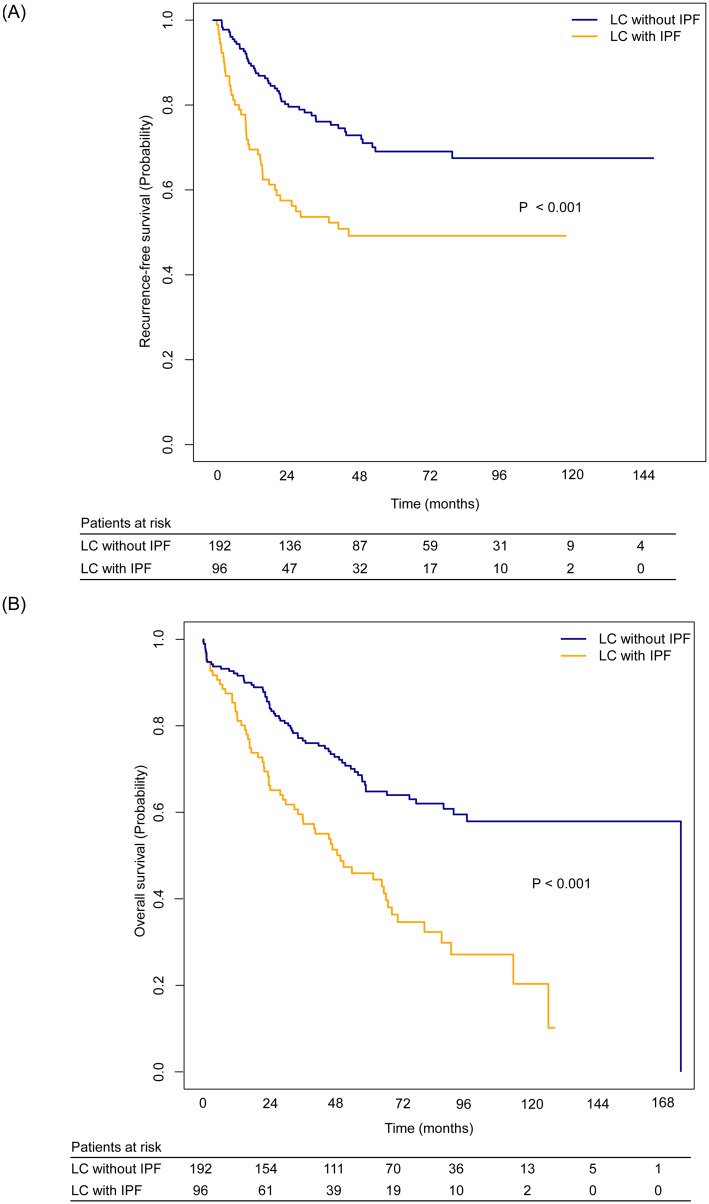
그림 출처: PubMed Central 공개 논문 (PMC7323957)
Conflict of interest statement
The authors have declared that no competing interests exist.
그 밖의 정보
- 출판 형태
- Journal Article
- 저널
- PloS one · eISSN 1932-6203
- 전자 출판
- 2020-06-29
- MeSH
- Aged · Carcinoma, Non-Small-Cell Lung / pathology / surgery · Disease-Free Survival · Female · Humans · Idiopathic Pulmonary Fibrosis / epidemiology · Lung Neoplasms / pathology / surgery · Male · Middle Aged · Neoplasm Recurrence, Local* · Republic of Korea · Retrospective Studies · Risk Factors · Tertiary Care Centers
- 참고문헌
- 33편