
PLoS One. 2020;15(12):e0244156.
Impact of variability in estimated glomerular filtration rate on major clinical outcomes: A nationwide population-based study.
제1저자 이수진 · 교신저자 김동기, 한경도
소속 (8)
- Department of Internal Medicine, Seoul National University Hospital, Seoul, Korea.
- Department of Internal Medicine, Seoul National University College of Medicine, Seoul, Korea.
- Department of Biomedical Science. Seoul National University College of Medicine, Seoul, Korea.
- Department of Internal Medicine, Armed Forces Capital Hospital, Gyeonggi-do, Korea.
- Department of Internal Medicine, Keimyung University School of Medicine, Daegu, Korea.
- Kidney Research Institute, Seoul National University College of Medicine, Seoul, Korea.
- Department of Internal Medicine, Seoul National University Boramae Medical Center, Seoul, Korea.
- Department of Statistics and Actuarial Science, Soongsil University, Seoul, Korea.
Abstract
BACKGROUND The estimated glomerular filtration rate (eGFR), commonly estimated using the serum creatinine value, often fluctuates throughout the serial measurement. The clinical significance of GFR variation among the general population with normal renal function has not yet been demonstrated. Thus, we explored the impact of GFR variability on adverse clinical outcomes.
METHODS A nationwide retrospective cohort study using the Korean National Health Insurance System database was performed. National health screening examinees who underwent creatinine measurement ≥3 times between 2012 and 2016 were considered. Those with eGFR under 60 mL/min/m2 were excluded. The fluctuation of eGFR was represented with variability independent of the mean (VIM) index; which was calculated by the standard deviation divided by the exponent of the regression coefficient of the mean. Then, the risks of myocardial infarction (MI), stroke and death were assessed according to the quartiles of the VIM.
RESULTS Of total 3,538,500 participants, 0.29% of myocardial infarction (MI), 0.14% of stroke, 0.36% of deaths were observed during the median follow up of 3.27 years. Participants with the highest VIM index, which represents the highest eGFR variability, were significantly associated with an increased risk of MI (hazard ratio [HR]; 1.10, 95% confidence interval [95% CI]; 1.04-1.16), stroke (HR: 1.16; 95% CI 1.09-1.23), and death (HR: 1.18; 95% CI 1.12-1.24). The elevated risk of adverse events was consistent after the multivariate adjustment with potential confounding factors, except the risk of MI (HR 1.06; 95% 1.00-1.06).
CONCLUSIONS Increased eGFR variability exhibited an association with major clinical outcomes, indicating that monitoring eGFR variability might be a useful parameter for predicting the adverse outcomes.
Figures

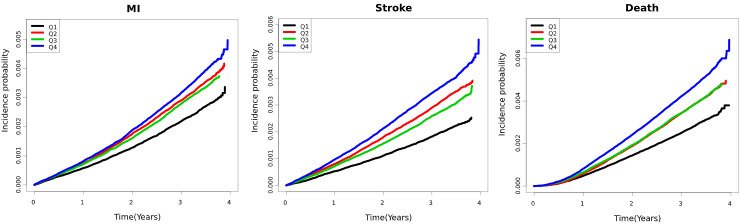
그림 출처: PubMed Central 공개 논문 (PMC7746294)
Conflict of interest statement
All authors have declared that no competing interests exist.
그 밖의 정보
- 출판 형태
- Journal Article, Research Support, Non-U.S. Gov't
- 저널
- PloS one · eISSN 1932-6203
- 전자 출판
- 2020-12-17
- MeSH
- Adult · Cardiovascular Diseases / epidemiology · Creatinine / blood / standards · Female · Glomerular Filtration Rate* · Humans · Male · Middle Aged · Mortality / trends · Population Health / statistics & numerical data · Renal Insufficiency, Chronic / epidemiology · Republic of Korea
- Substances
- Creatinine
- 참고문헌
- 27편