
Target Oncol. 2020;15(1):75-84.
Safety, Pharmacokinetics, and Clinical Activity of Adavosertib in Combination with Chemotherapy in Asian Patients with Advanced Solid Tumors: Phase Ib Study.
제1저자 Hidenori Kato · 교신저자 방영주
소속 (10)
- Division of Gynecologic Oncology, Hokkaido Cancer Center, Sapporo, Japan.
- Ingham Institute, Western Sydney University, Liverpool Hospital, Liverpool, NSW, Australia.
- School of Medicine, University of Wollongong, Wollongong, NSW, Australia.
- Department of Oncology, Asan Medical Centre, Seoul, South Korea.
- Centre for Clinical Studies, Nucleus Network Limited, Melbourne, VIC, Australia.
- National Cancer Center Hospital East, Kashiwa, Japan.
- Samsung Medical Centre, Sungkyunkwan University School of Medicine, Seoul, South Korea.
- AstraZeneca, Cambridge, UK.
- Quantitative Clinical Pharmacology, Early Clinical Development, IMED Biotech Unit, AstraZeneca, Boston, MA, USA.
- Department of Internal Medicine, Seoul National University College of Medicine, 101 Daehak-ro, Jongno-gu, Seoul, 03080, South Korea. bangyj@snu.ac.kr.
Abstract
BACKGROUND The WEE1 inhibitor adavosertib (AZD1775) has been investigated in Western patients.
OBJECTIVE This open-label Phase Ib study (NCT02341456) investigated the safety, pharmacokinetics, and clinical activity of adavosertib in combination with carboplatin alone or paclitaxel plus carboplatin in Asian patients with advanced solid tumors and defined the recommended Phase II dose.
PATIENTS AND METHODS Nineteen patients received adavosertib 175 mg twice daily (bid) for 2.5 days (five doses) in combination with carboplatin (AUC 5) alone or paclitaxel (175 mg/m2) plus carboplatin, or adavosertib 225 mg bid for 2.5 days in combination with paclitaxel plus carboplatin in 21-day cycles. Preliminary safety and dose-limiting toxicity analyses were performed and dose escalation/de-escalation conducted as appropriate.
RESULTS Adavosertib 175 mg bid for 2.5 days with carboplatin alone or paclitaxel plus carboplatin was considered tolerable. Two patients receiving adavosertib 225 mg bid in combination with paclitaxel plus carboplatin experienced dose-limiting toxicities (grade 4 sepsis; grade 5 acute respiratory distress syndrome); this regimen was not considered tolerable. Grade ≥ 3 adverse events reported most commonly in any cohort included: anemia; decreased white blood cell count; decreased neutrophil count; neutropenia; decreased platelet count; thrombocytopenia; and febrile neutropenia. Exposure to adavosertib, as determined by pharmacokinetic analysis, in Asian patients was higher than that previously seen in Western patients. A partial response occurred in 2/12 evaluable patients (16.7%) at the recommended Phase II dose.
CONCLUSIONS Adavosertib 175 mg bid for 2.5 days was chosen as the recommended Phase II dose in combination with paclitaxel and carboplatin in Asian patients.
Figures
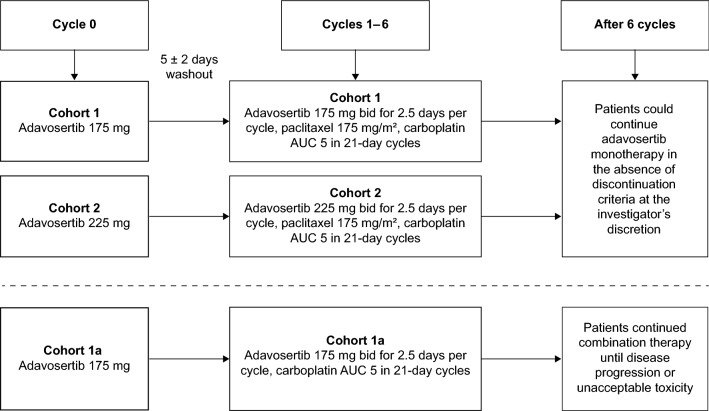
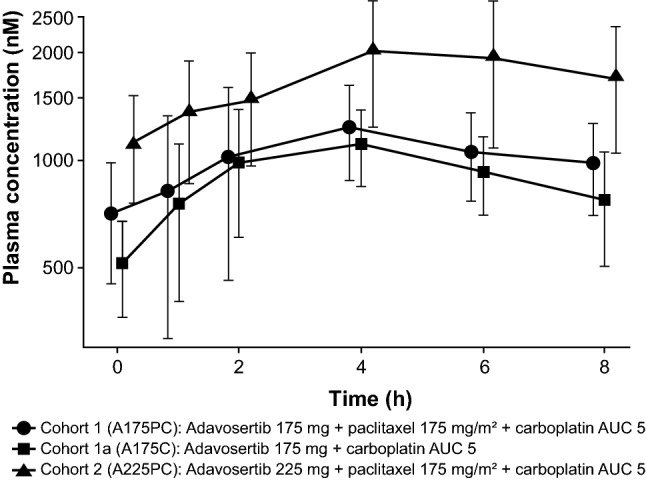
그림 출처: PubMed Central 공개 논문 (PMC7028795)
Conflict of interest statement
P de Souza is a consultant for Noxopharm Australia Pty Ltd and BioSceptre Australia Pty Ltd. S-W Kim reports an advisory role for AstraZeneca, Lilly, Ono, and Boehringer Ingelheim and research funding from AstraZeneca, Lilly, and Boehringer Ingelheim. Y Naito reports a speakers’ bureau role for AstraZeneca, Bayer, Chugai, Eisai, Eli Lilly, Fuji Film Toyama Chemical, Meiji Seika, Merck Serono, Nippon Kayaku, Novartis, Pfizer, Roche Diagnostics, and Taiho, and research funding from Roche Diagnostics. K Park reports an advisory role for AbbVie, Amgen, Astellas Pharma, AstraZeneca, Boehringer Ingelheim, BluePrint, BMS, Clovis Oncology, Daiichi-Sankyo, Eli Lilly, GSK, Hanmi, Incyte, Kyowa Hakko Kirin, LOXO, Merck KGaA, MSD, Novartis, Ono Pharmaceutical, and Roche and research funding from AstraZeneca and MSD. S Kumar and GM Mugundu are AstraZeneca employees and stock holders. Y-J Bang is a consultant and reports an advisory role for AstraZeneca, Novartis, Genentech/Roche, MSD, Merck Serono, Bayer, BMS, Eli Lilly, Taiho, Daiich-Sankyo, Astellas, BeiGene, GreenCross, Samyang Biopharm, Hanmi, and Genexine and institutional grants (for clinical trials) from AstraZeneca, Novartis, Genentech/Roche, MSD, Merck Serono, Bayer, BMS, GSK, Pfizer, Eli Lilly, Boehringer-Ingelheim, MacroGenics, Boston Biomedical, FivePrime, Curis, Taiho, Takeda, Ono, Daiichi-Sankyo, Astellas, BeiGene, GreenCross, CKD Pharma, and Genexine. No potential conflicts of interest were disclosed by the other authors.
그 밖의 정보
- 출판 형태
- Clinical Trial, Phase I, Journal Article, Multicenter Study, Research Support, Non-U.S. Gov't
- 저널
- Targeted oncology · eISSN 1776-260X
- MeSH
- Asian People · Cohort Studies · Enzyme Inhibitors / pharmacology / therapeutic use · Female · Humans · Male · Neoplasms / drug therapy · Pyrazoles / pharmacokinetics / therapeutic use · Pyrimidinones / pharmacokinetics / therapeutic use
- Substances
- Enzyme Inhibitors · Pyrazoles · Pyrimidinones · adavosertib
- 참고문헌
- 17편