
J Hematol Oncol. 2022;15(1):150.
Phase II trial of daratumumab with DCEP in relapsed/refractory multiple myeloma patients with extramedullary disease.
제1저자 변자민 · 교신저자 고영일
소속 (7)
- Department of Internal Medicine, Seoul National University Hospital, Seoul National University College of Medicine, 101 Daehak-Ro, Jongno-Gu, Seoul, 03080, Korea.
- Department of Hematology, Seoul St. Mary's Hematology Hospital, College of Medicine, The Catholic University of Korea, Seoul, Korea.
- Division of Hematology/Oncology, Department of Medicine, Sungkyunkwan University School of Medicine Samsung Medical Center, Seoul, Korea.
- Department of Internal Medicine, Seoul National University Bundang Hospital, Seoul National University College of Medicine, Seongnam, Korea.
- Chonnam National University Hwasun Hospital, Chonnam National University Medical School, Hwasun, Korea.
- Division of Hematology, Department of Internal Medicine, Yonsei University College of Medicine, Severance Hospital, Seoul, Korea.
- Department of Internal Medicine, Seoul National University Hospital, Seoul National University College of Medicine, 101 Daehak-Ro, Jongno-Gu, Seoul, 03080, Korea. go01@snu.ac.kr.
Abstract
Extramedullary multiple myeloma (EMD) is an aggressive subentity of multiple myeloma (MM) with poor prognosis. As more innovative therapeutic approaches are needed for the treatment of MM with EMD, we conducted this multicenter, non-randomized phase II trial of daratumumab in combination with dexamethasone, cyclophosphamide, etoposide and cisplatin (DARA-DCEP). A total of 32 patients (median age 59, range 35-73) were treated with DARA-DCEP. Based on the best response during the study, the complete remission (CR) rate was 35.5% and overall response rate (ORR) 67.7%. During the median follow-up of 11 months, the median progression-free survival (PFS) was 5 months and median overall survival (OS) 10 months. There were 7 long-term responders whose median PFS was not reached. The most common grade ≥ 3 hematologic AE was thrombocytopenia. The most common non-hematologic AE was nausea (22.6%), followed by dyspepsia, diarrhea and stomatitis (all 12.9%). Grade ≥ 3 daratumumab infusion-related reaction was noted in 9.7% of the patients. Except for the planned 30% dose adjustment in cycle 1, only 2 patients required DCEP dose reduction. This is one of the very few prospective trials focusing on EMD and we successfully laid grounds for implementing immunochemotherapy in MM treatment.
© 2022. The Author(s).
Keywords
DCEPDaratumumabExtramedullary multiple myelomaMultiple myelomaRelapse/refractory
Figures
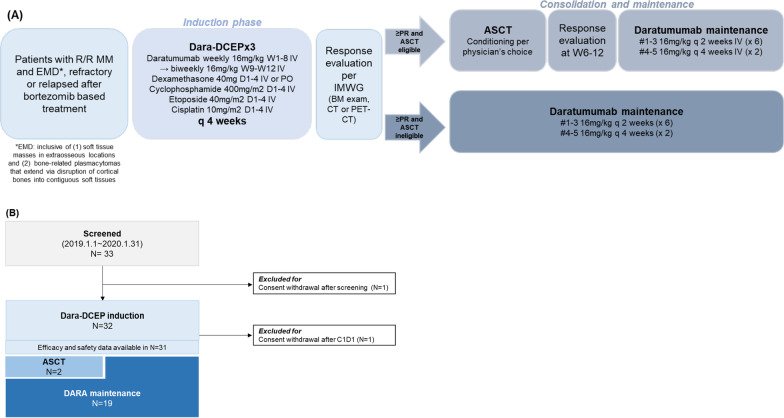
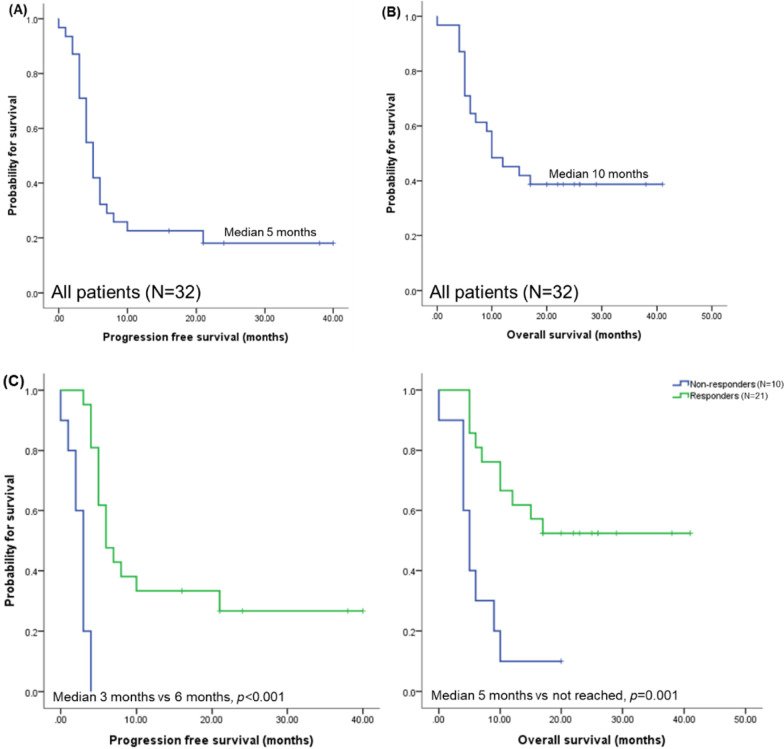
그림 출처: PubMed Central 공개 논문 (PMC9590218)
Conflict of interest statement
The authors declare that they have no competing interests.
그 밖의 정보
- 출판 형태
- Multicenter Study, Clinical Trial, Phase II, Journal Article, Research Support, Non-U.S. Gov't
- 저널
- Journal of hematology & oncology · eISSN 1756-8722
- 전자 출판
- 2022-10-23
- MeSH
- Humans · Middle Aged · Antineoplastic Combined Chemotherapy Protocols* / adverse effects · Cisplatin / therapeutic use · Cyclophosphamide / therapeutic use · Dexamethasone / therapeutic use · Etoposide / therapeutic use · Multiple Myeloma* / drug therapy · Neoplasm Recurrence, Local* / drug therapy · Prospective Studies · Adult · Aged · Antibodies, Monoclonal
- Substances
- Cisplatin · Cyclophosphamide · Dexamethasone · Etoposide · daratumumab · Antibodies, Monoclonal
- 연구비
- Korea Health Industry Development Institute HI14C1277
- 참고문헌
- 33편