
Diabetol Metab Syndr. 2023;15(1):43.
Effect of olmesartan and amlodipine on serum angiotensin-(1-7) levels and kidney and vascular function in patients with type 2 diabetes and hypertension.
제1저자 김규호 · 교신저자 임수
소속 (3)
- Department of Internal Medicine, College of Medicine, The Catholic University of Korea, Seoul, South Korea.
- Department of Internal Medicine, Seoul National University College of Medicine and Seoul National University Bundang Hospital, 300 Gumi-dong, Bundang-gu, Seongnam, 463-707, South Korea.
- Department of Internal Medicine, Seoul National University College of Medicine and Seoul National University Bundang Hospital, 300 Gumi-dong, Bundang-gu, Seongnam, 463-707, South Korea. limsoo@snu.ac.kr.
Abstract
BACKGROUND Recent studies suggest that angiotensin-converting enzyme 2 (ACE2) and angiotensin-(1-7) [Ang-(1-7)] might have beneficial effects on the cardiovascular system. We investigated the effects of olmesartan on the changes in serum ACE2 and Ang-(1-7) levels as well as kidney and vascular function in patients with type 2 diabetes and hypertension.
METHODS This was a prospective, randomized, active comparator-controlled trial. Eighty participants with type 2 diabetes and hypertension were randomized to receive 20 mg of olmesartan (N = 40) or 5 mg of amlodipine (N = 40) once daily. The primary endpoint was changes of serum Ang-(1-7) from baseline to week 24.
RESULTS Both olmesartan and amlodipine treatment for 24 weeks decreased systolic and diastolic blood pressures significantly by > 18 mmHg and > 8 mmHg, respectively. Serum Ang-(1-7) levels were more significantly increased by olmesartan treatment (25.8 ± 34.5 pg/mL → 46.2 ± 59.4 pg/mL) than by amlodipine treatment (29.2 ± 38.9 pg/mL → 31.7 ± 26.0 pg/mL), resulting in significant between-group differences (P = 0.01). Serum ACE2 levels showed a similar pattern (6.31 ± 0.42 ng/mL → 6.74 ± 0.39 ng/mL by olmesartan treatment vs. 6.43 ± 0.23 ng/mL → 6.61 ± 0.42 ng/mL by amlodipine treatment; P < 0.05). The reduction in albuminuria was significantly associated with the increases in ACE2 and Ang-(1-7) levels (r = - 0.252 and r = - 0.299, respectively). The change in Ang-(1-7) levels was positively associated with improved microvascular function (r = 0.241, P < 0.05). Multivariate regression analyses showed that increases in serum Ang-(1-7) levels were an independent predictor of a reduction in albuminuria.
CONCLUSIONS These findings suggest that the beneficial effects of olmesartan on albuminuria may be mediated by increased ACE2 and Ang-(1-7) levels. These novel biomarkers may be therapeutic targets for the prevention and treatment of diabetic kidney disease.
TRIAL REGISTRATION ClinicalTrials.gov NCT05189015.
© 2023. The Author(s).
Keywords
AlbuminuriaAmlodipineAngiotensin-(1–7)Angiotensin-converting enzyme 2Olmesartan
Figures
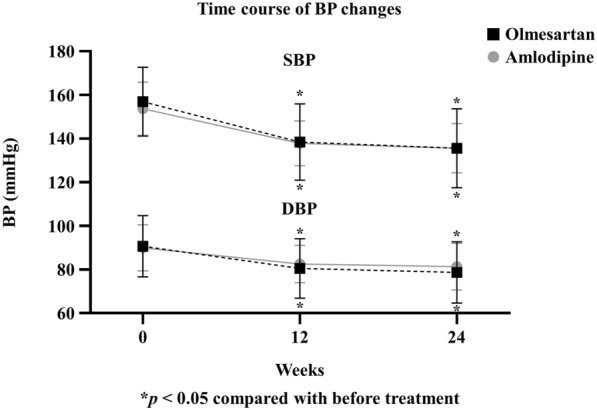
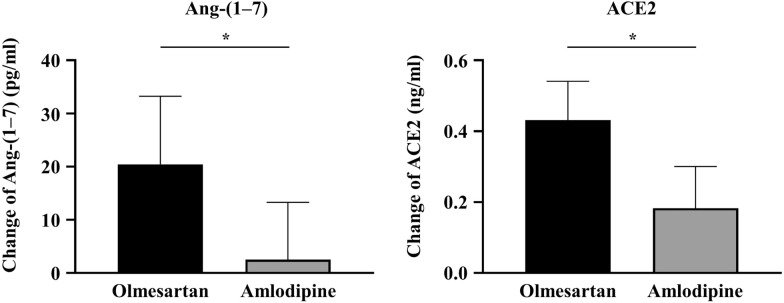
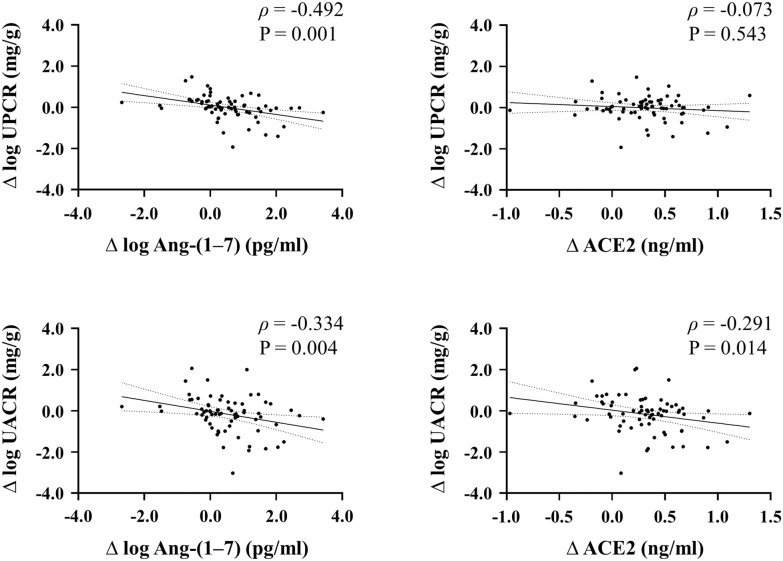
그림 출처: PubMed Central 공개 논문 (PMC10005920)
Conflict of interest statement
The authors have no conflicts of interest relevant to this article to disclose.
그 밖의 정보
- 출판 형태
- Journal Article
- 저널
- Diabetology & metabolic syndrome · ISSN 1758-5996
- 전자 출판
- 2023-03-11
- 데이터
- ClinicalTrials.gov: NCT05189015
- 참고문헌
- 46편