
BMC Cancer. 2015;15:690.
Prognostic influence of body mass index and body weight gain during adjuvant FOLFOX chemotherapy in Korean colorectal cancer patients.
제1저자 이대원 · 교신저자 한세원
소속 (20)
- Department of Internal Medicine, Seoul National University Hospital, 101 Daehang-Ro, Jongno-Gu, Seoul, 110-744, South Korea. silver2sky@hanmail.net.
- Department of Internal Medicine, Seoul National University Hospital, 101 Daehang-Ro, Jongno-Gu, Seoul, 110-744, South Korea. saewon1@snu.ac.kr.
- Cancer Research Institute, Seoul National University, Seoul, South Korea. saewon1@snu.ac.kr.
- Department of Internal Medicine, Seoul National University Hospital, 101 Daehang-Ro, Jongno-Gu, Seoul, 110-744, South Korea. yjchamd@gmail.com.
- Department of Internal Medicine, Seoul National University Hospital, 101 Daehang-Ro, Jongno-Gu, Seoul, 110-744, South Korea. drleekh@gmail.com.
- Department of Internal Medicine, Seoul National University Hospital, 101 Daehang-Ro, Jongno-Gu, Seoul, 110-744, South Korea. ktyongmd@gmail.com.
- Department of Internal Medicine, Seoul National University Hospital, 101 Daehang-Ro, Jongno-Gu, Seoul, 110-744, South Korea. ohdoyoun@snu.ac.kr.
- Cancer Research Institute, Seoul National University, Seoul, South Korea. ohdoyoun@snu.ac.kr.
- Department of Internal Medicine, Seoul National University Hospital, 101 Daehang-Ro, Jongno-Gu, Seoul, 110-744, South Korea. moisa@snu.ac.kr.
- Cancer Research Institute, Seoul National University, Seoul, South Korea. moisa@snu.ac.kr.
- Department of Internal Medicine, Seoul National University Hospital, 101 Daehang-Ro, Jongno-Gu, Seoul, 110-744, South Korea. bangyj@snu.ac.kr.
- Cancer Research Institute, Seoul National University, Seoul, South Korea. bangyj@snu.ac.kr.
- Department of Surgery, Seoul National University Hospital, Seoul, South Korea. sowisdom@gmail.com.
- Department of Surgery, Seoul National University Hospital, Seoul, South Korea. sbryoomd@gmail.com.
- Department of Surgery, Seoul National University Hospital, Seoul, South Korea. syjeong@snu.ac.kr.
- Department of Pathology, Seoul National University Hospital, Seoul, South Korea. ghkang@snu.ac.kr.
- Department of Surgery, Seoul National University Hospital, Seoul, South Korea. kjparkmd@plaza.snu.ac.kr.
- Department of Internal Medicine, Seoul National University Hospital, 101 Daehang-Ro, Jongno-Gu, Seoul, 110-744, South Korea. kimty@snu.ac.kr.
- Cancer Research Institute, Seoul National University, Seoul, South Korea. kimty@snu.ac.kr.
- Department of Molecular Medicine & Biopharmaceutical Sciences, Graduate School of Convergence Science and Technology, Seoul National University, Seoul, South Korea. kimty@snu.ac.kr.
Abstract
BACKGROUND Asian population has different body mass index (BMI) profile compared to Caucasian population. However, the effect of obesity and body weight gain in Asian colorectal cancer patients treated with adjuvant chemotherapy has not been studied thus far.
METHODS We have analyzed the association between disease-free survival (DFS) and obesity/body weight change during treatment in Korean stage III or high-risk stage II colorectal cancer patients treated with adjuvant 5-fluorouracil/ leucovorin/oxaliplatin. BMI was classified according to WHO Asia-Pacific classification. Weight change was calculated by comparing body weights measured at the last chemotherapy cycle and before surgery.
RESULTS Among a total of 522 patients, 35.7 % of patients were obese (BMI ≥ 25 kg/m(2)) and 29.1 % were overweight (BMI, 23-24.9 kg/m(2)) before surgery. 18.0 % of patients gained ≥ 5 kg and 26.1 % gained 2-4.9 kg during the adjuvant chemotherapy period. Baseline BMI or body weight change was not associated with DFS in the overall study population. However, body weight gain (≥5 kg) was associated with inferior DFS (adjusted hazard ratio 2.04, 95 % confidence interval 1.02-4.08, p = 0.043) in overweight and obese patients (BMI ≥ 23.0 kg/m(2)).
CONCLUSION In Korean colorectal cancer patients treated with adjuvant FOLFOX chemotherapy, body weight gain during the treatment period has a negative prognostic influence in overweight and obese patients.
Figures
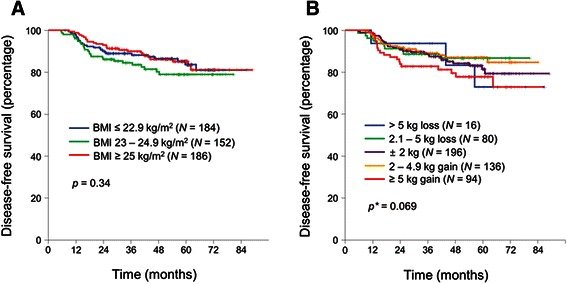
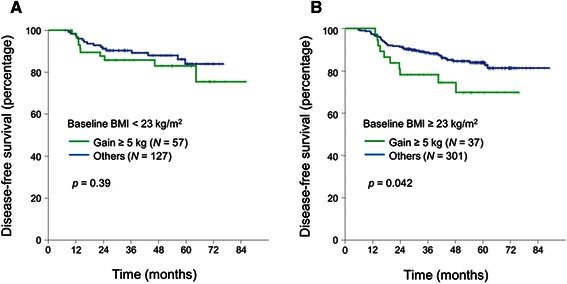
그림 출처: PubMed Central 공개 논문 (PMC4607099)
그 밖의 정보
- 출판 형태
- Journal Article, Research Support, Non-U.S. Gov't
- 저널
- BMC cancer · eISSN 1471-2407
- 전자 출판
- 2015-10-14
- MeSH
- Aged · Aged, 80 and over · Antineoplastic Combined Chemotherapy Protocols / therapeutic use · Body Mass Index · Chemotherapy, Adjuvant · Colorectal Neoplasms / diagnosis / drug therapy / mortality · Female · Fluorouracil / therapeutic use · Humans · Kaplan-Meier Estimate · Leucovorin / therapeutic use · Male · Middle Aged · Neoplasm Staging · Organoplatinum Compounds / therapeutic use · Prognosis · Republic of Korea · Retrospective Studies · Treatment Outcome
- Substances
- Organoplatinum Compounds · Leucovorin · Fluorouracil
- 참고문헌
- 31편