
BMC Infect Dis. 2015;15:289.
Why is asymptomatic bacteriuria overtreated?: A tertiary care institutional survey of resident physicians.
제1저자 이명진 · 교신저자 김홍빈
소속 (17)
- Department of Internal Medicine, Seoul National University College of Medicine, 101 Daehak-ro, Jongno-gu, Seoul, 110-744, Republic of Korea. mjinnie@naver.com.
- Department of Internal Medicine, Seoul National University College of Medicine, 101 Daehak-ro, Jongno-gu, Seoul, 110-744, Republic of Korea. moonsuk0725@gmail.com.
- Department of Internal Medicine, Seoul National University College of Medicine, 101 Daehak-ro, Jongno-gu, Seoul, 110-744, Republic of Korea. NH.Kim.MD@gmail.com.
- Department of Internal Medicine, Seoul National University College of Medicine, 101 Daehak-ro, Jongno-gu, Seoul, 110-744, Republic of Korea. erinus00@gmail.com.
- Department of Internal Medicine, Seoul National University Bundang Hospital, 173 Gumi-ro, Bundang-gu, Seongnam, Gyeonggi-do, 463-707, Republic of Korea. erinus00@gmail.com.
- Department of Internal Medicine, Seoul National University College of Medicine, 101 Daehak-ro, Jongno-gu, Seoul, 110-744, Republic of Korea. khsongmd@gmail.com.
- Department of Internal Medicine, Seoul National University Bundang Hospital, 173 Gumi-ro, Bundang-gu, Seongnam, Gyeonggi-do, 463-707, Republic of Korea. khsongmd@gmail.com.
- Department of Internal Medicine, Seoul National University College of Medicine, 101 Daehak-ro, Jongno-gu, Seoul, 110-744, Republic of Korea. pgchoe@gmail.com.
- Department of Internal Medicine, Seoul National University College of Medicine, 101 Daehak-ro, Jongno-gu, Seoul, 110-744, Republic of Korea. wbpark1@snu.ac.kr.
- Department of Internal Medicine, Seoul National University College of Medicine, 101 Daehak-ro, Jongno-gu, Seoul, 110-744, Republic of Korea. roundbirch@gmail.com.
- Department of Internal Medicine, Seoul National University College of Medicine, 101 Daehak-ro, Jongno-gu, Seoul, 110-744, Republic of Korea. yonathan@hanafos.com.
- Department of Internal Medicine, Seoul National University Bundang Hospital, 173 Gumi-ro, Bundang-gu, Seongnam, Gyeonggi-do, 463-707, Republic of Korea. yonathan@hanafos.com.
- Department of Internal Medicine, Seoul National University College of Medicine, 101 Daehak-ro, Jongno-gu, Seoul, 110-744, Republic of Korea. hswon1@snu.ac.kr.
- Department of Internal Medicine, Seoul National University College of Medicine, 101 Daehak-ro, Jongno-gu, Seoul, 110-744, Republic of Korea. molder@unitel.co.kr.
- Department of Internal Medicine, Seoul National University College of Medicine, 101 Daehak-ro, Jongno-gu, Seoul, 110-744, Republic of Korea. mdohmd@snu.ac.kr.
- Department of Internal Medicine, Seoul National University College of Medicine, 101 Daehak-ro, Jongno-gu, Seoul, 110-744, Republic of Korea. hbkimmd@snu.ac.kr.
- Department of Internal Medicine, Seoul National University Bundang Hospital, 173 Gumi-ro, Bundang-gu, Seongnam, Gyeonggi-do, 463-707, Republic of Korea. hbkimmd@snu.ac.kr.
Abstract
BACKGROUND Asymptomatic bacteriuria (ABU) is common and often leads to unnecessary antimicrobial use. Reducing antibiotic overuse for ABU is therefore an important issue for antimicrobial stewardship. We performed this study to investigate the appropriateness of ABU management and to evaluate physicians' knowledge and practice regarding ABU.
METHODS We reviewed all urine cultures of ≥10(5) cfu/mL of bacteria among inpatients in a 900-bed hospital in 2011. Each episode of bacteriuria was classified into ABU or urinary tract infection (UTI). ABU was defined as a positive urine culture (≥10(5) cfu/mL) without symptoms or signs suggesting UTI. In October 2012 a cross-sectional survey of resident physicians was undertaken using an anonymous, self-administered questionnaire.
RESULTS We identified 219 ABU cases among 1167 positive urine cultures, of which 70 (32.0 %) were inappropriately treated. Female gender, old age, pyuria, hematuria, and positive nitrite on urinalysis were associated with inappropriate ABU treatment in a multivariate analysis (P < 0.05). The response rate to the survey was 74.2 % (95/128). The mean knowledge score was 37.3 %, and 33.7 % of respondents were able to distinguish ABU from UTI, but less than half knew the indications for treating ABU. Even after ABU was correctly diagnosed, concerns about postoperative infections (38.6 %), UTI (9.1 %), and abnormal urinalysis (29.5 %) prevented proper management. About half of the respondents reported to prescribing antibiotics for ABU despite knowing they were not indicated.
CONCLUSIONS About one third of ABUs were inappropriately managed. Lack of knowledge and discrepancies between knowledge and practice, contributed to antimicrobial overuse for ABU. Our findings highlight the importance of developing interventions, including education, audit and feedback, to tackle the problem of inappropriate treatment of ABU.
Figures
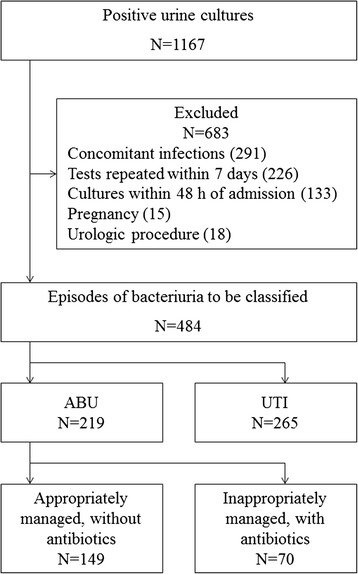
그림 출처: PubMed Central 공개 논문 (PMC4514993)
그 밖의 정보
- 출판 형태
- Journal Article
- 저널
- BMC infectious diseases · eISSN 1471-2334
- 전자 출판
- 2015-07-26
- MeSH
- Aged · Aged, 80 and over · Anti-Bacterial Agents / therapeutic use · Bacteriuria / diagnosis / drug therapy / epidemiology · Cross-Sectional Studies · Female · Humans · Male · Middle Aged · Practice Patterns, Physicians' / statistics & numerical data · Republic of Korea / epidemiology · Retrospective Studies · Surveys and Questionnaires · Tertiary Health Care / statistics & numerical data · Urinalysis · Urinary Tract Infections / diagnosis / drug therapy / epidemiology
- Substances
- Anti-Bacterial Agents
- 참고문헌
- 23편