
Clin Kidney J. 2021;14(8):1961-1968.
Predictive value of triglyceride/high-density lipoprotein cholesterol for major clinical outcomes in advanced chronic kidney disease: a nationwide population-based study.
제1저자 김예림 · 교신저자 김동기
소속 (9)
- Department of Internal Medicine, Keimyung University School of Medicine, Daegu, Korea.
- Keimyung University Kidney Institute, Daegu, Korea.
- Department of Internal Medicine, Seoul National University Hospital, Seoul, Korea.
- Department of Biomedical Sciences, Seoul National University College of Medicine, Seoul, Korea.
- Department of Internal Medicine, Armed Forces Capital Hospital, Gyeonggi-do, Korea.
- Department of Medical Statistics, College of Medicine, Catholic University of Korea, Seoul, Korea.
- Department of Statistics and Actuarial Science, Soongsil University, Seoul, Korea.
- Department of Internal Medicine, SMG-SNU Boramae Medical Center, Seoul, Korea.
- Kidney Research Institute, Seoul National University College of Medicine, Seoul, Korea.
Abstract
BACKGROUND Dyslipidemia is an essential parameter in the prediction of cardiovascular disease (CVD). We aimed to explore whether lipid profiles could predict major outcomes in patients with advanced chronic kidney disease (CKD).
METHODS We retrospectively reviewed the National Health Insurance Service database for people who received nationwide health screening in 2009. All subjects exposed to a lipid-lowering agent before screening were excluded. The population was divided into control, early [estimated glomerular filtration rate (eGFR) 45-59 mL/min/1.73 m2] and advanced (eGFR <45 mL/min/1.73 m2) CKD groups. The hazard ratios (HRs) of outcomes were calculated using multivariate Cox regression models.
RESULTS A total of 3 634 873 participants were included in this study, with 404 298 (11.1%) and 66 805 (1.8%) having early and advanced CKD, respectively. For all populations, levels of triglyceride/high-density lipoprotein cholesterol (TG/HDL-C) showed a linear association with major cardiovascular and cerebrovascular events (MACCEs) and all-cause mortality, while low-density lipoprotein cholesterol (LDL-C) showed a different pattern of association with MACCEs (linear association) from all-cause mortality (U-shaped association). The significance between the levels of LDL-C and outcomes was attenuated in the advanced CKD group. For TG/HDL-C, although the significance was decreased, the linear patterns with both MACCEs and all-cause mortality were maintained in the advanced CKD group.
CONCLUSIONS The pattern and significance of lipid profiles were different according to the grade of kidney function. TG/HDL-C should be additionally considered as a predictive marker for CVD and mortality along with LDL-C in patients with CKD.
© The Author(s) 2020. Published by Oxford University Press on behalf of ERA-EDTA.
Keywords
all-cause mortalitycardiovascular diseasechronic kidney diseaselipid profilestriglyceride/HDL cholesterol
Figures
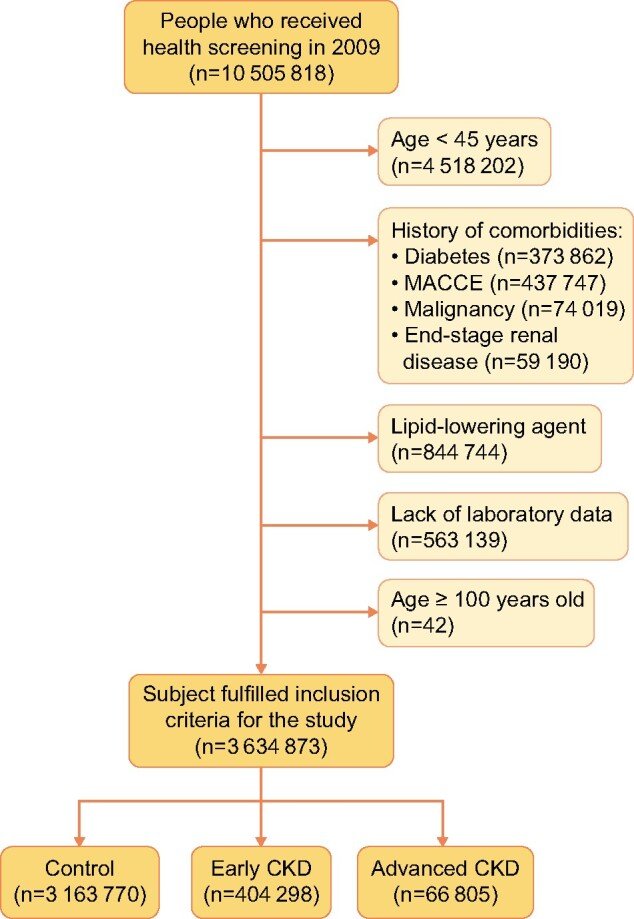
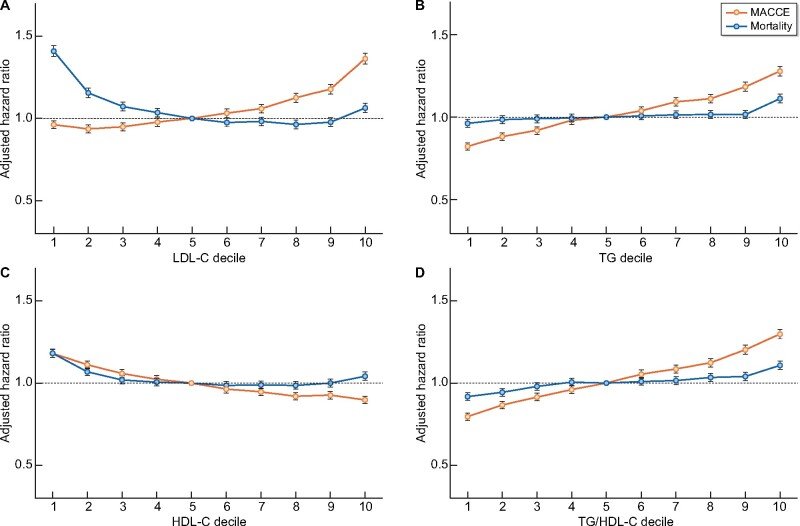
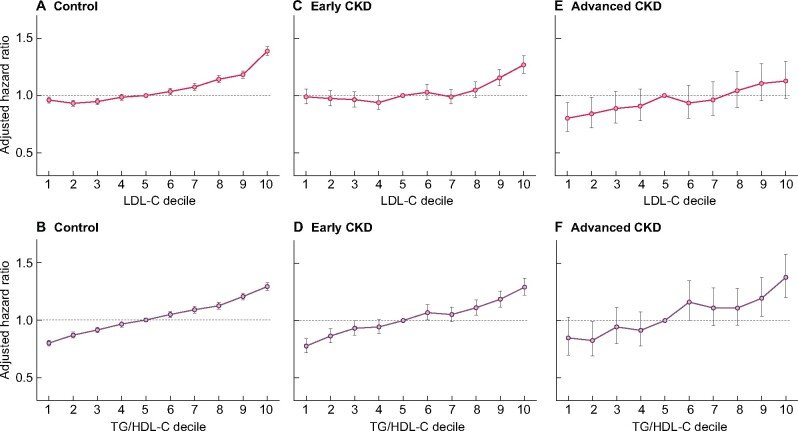
그림 출처: PubMed Central 공개 논문 (PMC8323149)
그 밖의 정보
- 출판 형태
- Journal Article
- 저널
- Clinical kidney journal · ISSN 2048-8505
- 전자 출판
- 2020-12-25
- 참고문헌
- 25편