
World Allergy Organ J. 2021;14(7):100561.
Pharmacological prevention of delayed hypersensitivity reactions caused by iodinated contrast media.
제1저자 김정현 · 교신저자 김세훈
소속 (6)
- Department of Internal Medicine, Seoul National University College of Medicine, Seoul, South Korea.
- Institute of Allergy and Clinical Immunology, Seoul National University Medical Research Center, Seoul, South Korea.
- Department of Internal Medicine, Seoul National University Bundang Hospital, Seongnam, South Korea.
- Department of Internal Medicine, Korean Armed Forces Capital Hospital, Seongnam, South Korea.
- Department of Radiology, Seoul National University Bundang Hospital, Seongnam-si, South Korea.
- Department of Internal Medicine, Korea University Medical Center Anam Hospital.
Abstract
BACKGROUND Delayed hypersensitivity reactions (DHRs) to radiocontrast media (RCM) occur in approximately 0.5-23.0% of patients and are thought to be caused by T cell-mediated mechanisms. However, an optimal pharmacological preventive strategy is not yet established in patients with histories of delayed reactions to RCM.
OBJECTIVE We aimed to evaluate the efficacy of pharmacological prevention in patients with histories of delayed reactions to non-ionic low-osmolar RCM when re-exposed to RCM.
METHODS A retrospective review of electronic medical records of 117 patients with previous histories of DHRs to RCM who visited an allergy clinic for the prevention of reactions after the re-exposure to RCM was conducted. The effects of pharmacological prevention were compared according to the symptom scores of previous reactions based on their intensities and durations with electronic medical records (EMRs).
RESULTS Of the 117 patients who experienced DHRs after RCM injection, we confirmed the outcomes of RCM re-exposure in 101 patients. For pharmacological prevention, 92 patients (91.1%) received steroids before RCM injection and among them, 50 patients (49.5%) received additional steroids after RCM injection. With this pharmacological prevention, patients of symptoms improved or no recurrence, recurrence of similar previous symptoms, and recurrence of worse symptoms were 98 (97.0%), 2 (2.0%), and 1 (1.0%), respectively. The proportions of no recurrence after pharmacological prevention were lower in patients with severe reactions and higher symptom scores.
CONCLUSION Pharmacological prevention showed a beneficial effect in most patients with delayed hypersensitivity to RCM. Further investigations are needed to establish an effective protocol for the prevention of delayed reactions to RCM.
© 2021 The Author(s).
Keywords
Delayed hypersensitivityRadiocontrast
Figures
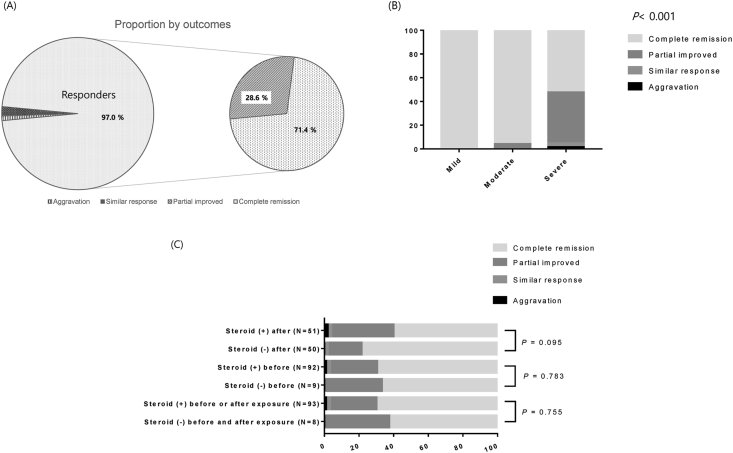
그림 출처: PubMed Central 공개 논문 (PMC8256281)
Conflict of interest statement
The authors declare that there are no conflicts of interest.
그 밖의 정보
- 출판 형태
- Journal Article
- 저널
- The World Allergy Organization journal · ISSN 1939-4551
- 전자 출판
- 2021-07-01
- 참고문헌
- 40편