
PLoS One. 2019;14(4):e0212748.
Factors affecting mortality during the waiting time for kidney transplantation: A nationwide population-based cohort study using the Korean Network for Organ Sharing (KONOS) database.
제1저자 이선화 · 교신저자 이정표
소속 (5)
- Department of Internal Medicine, Seoul National University Hospital, Seoul, Republic of Korea.
- Department of Internal Medicine, Dongguk University College of Medicine, Gyeongju, Republic of Korea.
- Department of Internal Medicine, Seoul National University Boramae Medical Center, Seoul, Republic of Korea.
- Department of Critical Care Medicine, Seoul National University Boramae Medical Center, Seoul, Republic of Korea.
- Department of Internal Medicine, Seoul National University College of Medicine, Seoul, Republic of Korea.
Abstract
BACKGROUND Long waiting time for deceased donor kidney transplant is inevitable due to the scarcity of donor, resulting in highlighting the importance of waiting time care. We analyzed the Korean Network for Organ Sharing (KONOS) database to assess the impact of waiting time on post-transplant survival outcomes and investigate risk factors for mortality by waiting time based on a complete enumeration survey in Korea.
METHODS We analyzed all persons aged over 18 years in deceased donor kidney transplant cases enrolled in the Korean Network for Organ Sharing (KONOS) database from January 2000 to January 2015. The primary end point was all-cause mortality after enrollment.
RESULTS Of the 24,296 wait-listed subjects on dialysis, 5,255 patients received kidney transplants from deceased donors, with a median waiting time of 4.5 years. Longer waiting times had distinct deleterious effects on overall survival after transplantation. While waiting for a transplant, patients with diabetes were more likely to die before transplantation (HR 1.515, 95% CI 1.388-1.653, p<0.001). Age was another significant risk factor for mortality. Only 56% of people aged 65 years survived after 10 years of waiting, whereas 86% of people aged 35 years survived after 10 years. Moreover, women on the waiting list were more likely to live longer than men on the list.
CONCLUSIONS More attention should be focused on patients with a higher risk of mortality while waiting for a deceased donor kidney transplant, such as patients with diabetes, those of advanced age, and those who are male.
Figures

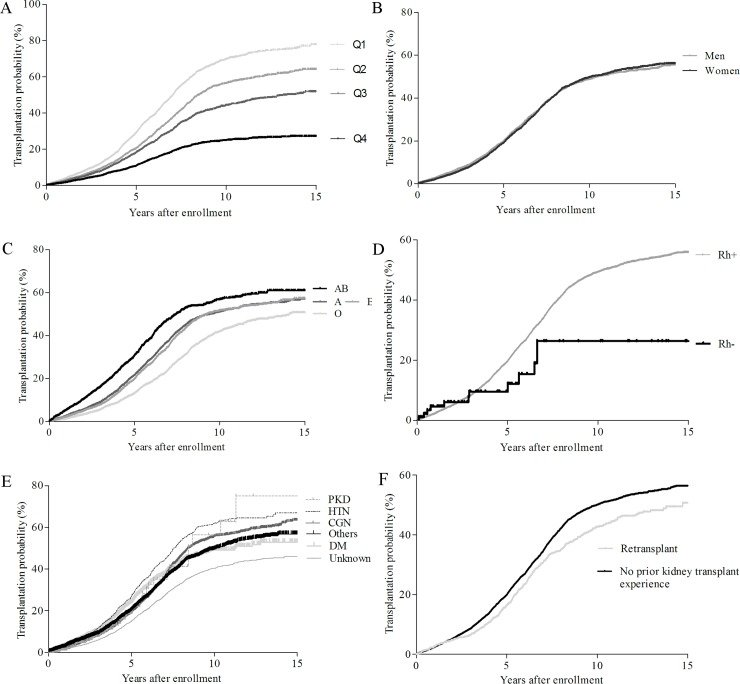
그림 출처: PubMed Central 공개 논문 (PMC6461220)
Conflict of interest statement
The authors have declared that no competing interests exist.
그 밖의 정보
- 출판 형태
- Journal Article
- 저널
- PloS one · eISSN 1932-6203
- 전자 출판
- 2019-04-12
- MeSH
- Adolescent · Adult · Aged · Cohort Studies · Data Management · Databases, Factual · Death* · Female · Humans · Kidney / physiopathology · Kidney Transplantation / adverse effects · Living Donors · Male · Middle Aged · Mortality · Renal Dialysis · Renal Insufficiency, Chronic / mortality / physiopathology / therapy · Republic of Korea · Risk Factors · Waiting Lists
- 참고문헌
- 35편