
Nutrients. 2022;14(3):nu14030664.
Continuous versus Intermittent Enteral Tube Feeding for Critically Ill Patients: A Prospective, Randomized Controlled Trial.
제1저자 이홍열 · 교신저자 이진우
소속 (5)
- Department of Critical Care Medicine, Seoul National University Hospital, Seoul 03080, Korea.
- Division of Respiratory and Critical Care, Department of Internal Medicine, Seoul Metropolitan Government-Seoul National University Boramae Medical Center, 20, Seoul 07061, Korea.
- Department of Food Service and Nutritional Care, Seoul National University Hospital, Seoul 03080, Korea.
- Department of Nutrition, Seoul Metropolitan Government-Seoul National University Boramae Medical Center, Seoul 07061, Korea.
- Division of Pulmonary and Critical Care Medicine, Department of Internal Medicine, Seoul National University College of Medicine, Seoul 03080, Korea.
Abstract
The appropriate strategy for enteral feeding remains a matter of debate. We hypothesized that continuous enteral feeding would result in higher rates of achieving target nutrition during the first 7 days compared with intermittent enteral feeding. We conducted an unblinded, single-center, parallel-group, randomized controlled trial involving adult patients admitted to the medical intensive care unit who required mechanical ventilation to determine the efficacy and safety of continuous enteral feeding for critically ill patients compared with intermittent enteral feeding. The primary endpoint was the achievement of ≥80% of the target nutrition requirement during the first 7 days after starting enteral feeding. A total of 99 patients were included in the modified intention-to-treat analysis (intermittent enteral feeding group, n = 49; continuous enteral feeding group, n = 50). The intermittent enteral feeding group and continuous enteral feeding group received 227 days and 226 days of enteral feeding, respectively. The achievement of ≥80% of the target nutrition requirement occurred significantly more frequently in the continuous enteral feeding group than in the intermittent enteral feeding group (65.0% versus 52.4%, respectively; relative risk, 1.24; 95% confidence interval, 1.06-1.45; p = 0.008). For patients undergoing mechanical ventilation, continuous enteral feeding significantly improved the achievement of target nutrition requirements.
Keywords
critically illenteral feedingmechanical ventilationnutrition
Figures

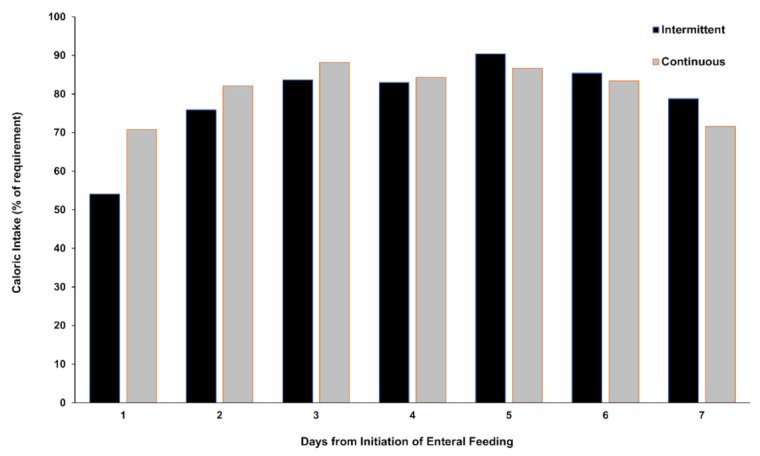
그림 출처: PubMed Central 공개 논문 (PMC8839656)
Conflict of interest statement
The authors declare no conflict of interest. The funders had no role in the design of the study; in the collection, analyses, or interpretation of data; in the writing of the manuscript; or in the decision to publish the results.
그 밖의 정보
- 출판 형태
- Journal Article, Randomized Controlled Trial
- 저널
- Nutrients · eISSN 2072-6643
- 전자 출판
- 2022-02-04
- MeSH
- Adult · Critical Illness* / therapy · Enteral Nutrition* · Humans · Intensive Care Units · Prospective Studies · Respiration, Artificial
- 연구비
- Seoul National University Hospital 04-2014-0620
- 참고문헌
- 24편